

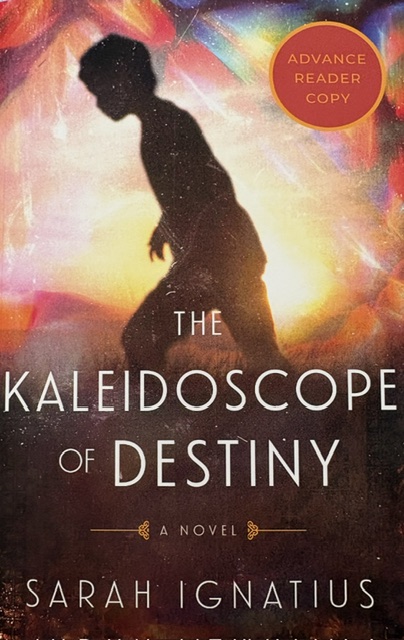
Sarah Ignatius’s brutal portrayal of the forced exile of the entire Armenian population living in Ottoman Turkey in 1915 takes her debut novel, The Kaleidoscope of Destiny (Koehlerbooks, 2026), beyond the unjustified arrests, the deportation camps and the mass killings it depicts. The unimaginable horrors suffered in the scorching heat of the desert by the women and the children along with the older men on their way to their final destination make the question Arakel Mazmanian ponders as he nears his devastated hometown — “What turns someone into a killer?” — totally irrelevant. For there can be nothing bigger than the incredible cruelty of Arakel’s journey. The now-fifteen-year-old is the only member of his family to survive the atrocities. Can the mere fact of his being alive be redeeming?
The story of Arakel, the thirteen-year-old son of the Mazmanian family, starts with the terrifying rumors and the arrests of all but the “essential craftsmen” of the Ottoman Armenian town of Kharpert. Arakel’s seventeen-year-old brother Mateos gets picked up for the labor battalion. His law-abiding father is arrested and imprisoned, to later “disappear.” The fear and the helplessness are palpable. Ignatius draws the reader right into the midst of the chaos of departure—the cherished belongings, the carpeted pillows and the rugs of the family sold or carted away for “safe keeping”—and the savagery of the “brutes,” the gendarmes flanking the lines of the starving refugees as they are marched over hills and valleys, tripping over loose rocks and getting tangled in thorny bushes. Arakel’s seven-year-old sister Anoush is kidnapped by a nomadic horseman. Women drop dead, exhausted. Naked bodies float in the Euphrates, its water turned red from the killings. Ignatius brings to life the misery at the Death camps along the Deportation route in horrifyingly vivid scenes. People wander around like skeletons. There is the appalling stench of the thousands of freshly dead corpses piled on top of each other at Goeljuk Lake in Mezre, the town near Kharpert. Can fiction measure up to the reality of the atrocities?
One leaves the novel haunted by the darkness in a soul that could devise the demonic plan to exterminate a whole people. Nothing will ease Arakel’s feeling of being abandoned by a God who allowed it to happen. “The desert tested me but not like your Saint Jerome. It wasn’t a choice or a religious scholar’s quest. It was a journey no one wanted to take,” is his response to President of Euphrates College Reverend Henry Riggs’s, “Have you ever heard of Saint Jerome?” We share the boy’s outrage at the injustice, at best the randomness, of it all. Why did he survive while the rest of his family disappeared with no trace? His brother Mateos’s unpublished story of “strength and fearlessness” fades against the urgency of Arakel’s “I have nothing left to lose . . . I have no reason to hope . . . why did I keep going ?” Is survival the torment of having to go on, when “I can’t go on?”
Nonetheless, a “second chance” always remains a possibility. When his family falls apart, Arakel creates a “new family” with Nishan and Tamar at the orphanage in Aleppo, belying his own, “Once you’ve crossed into the land of the dead, you can never go back.” The eyes of Khalid Efendi, the Bedouin camel caravan master who kidnaps Arakel and adopts him, are “warm, like Father’s or Grampa’s.” One even starts to wonder if a new “togetherness” with the German Dr. Conrad and his medic Fritz, Arakel rides with on horseback from Aleppo to Mezre as their interpreter, could redeem the loss of his family. Can what has been broken be brought back together?
Ignatius has no easy answers. Yet, “hav[ing] the strength to make it home . . . to huddle together under the thick blanket” remains the ultimate longing. Even on the deportation route, Arakel’s family are grateful they are “together.” Arakel and Anoush laugh and joke as they make a game out of naming their donkeys. Mother points out the field of red and yellow poppies and sheep grazing on a nearby hill to Anoush. “It’s strange how peaceful they look,” she muses.
While it confronts the desolation and the devastation boldly, The Kaleidoscope of Destiny also evokes the goodness in the hearts of men. Arakel’s Turkish friend, Mehmet’s mother offers refuge to his family. The son of the Kurdish boatman who helps Arakel flee into the Dersim Mountains salvages the strongbox Arakel drops into the current as they cross the lake in a small ferry boat. The box holds the single thing left of his family — the story Mateos was writing before he was arrested. As the kaleidoscope of the title might suggest, the possibilities of rebuilding what has been broken are endless. The little Kurdish boy is “hopeful, with an easy laugh, and a genuine smile.”