

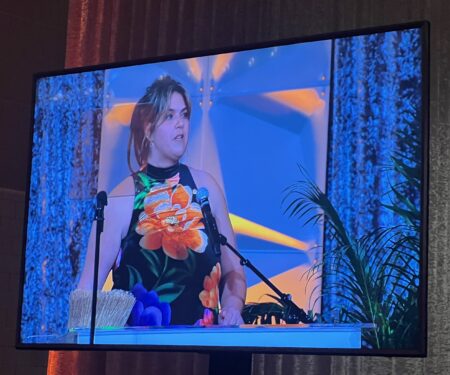
Armine Afeyan on one of the big screens while speaking at the Ellis Island Aurora Prize ceremony November 6 (photo Aram Arkun)

Armine Afeyan Leads the Aurora Humanitarian Initiative into a New Phase

405
0

WATERTOWN — Armine Helena Afeyan is the chief executive officer of the Aurora Humanitarian Initiative (AHI), an organization founded in 2015 to express the gratitude of Armenians who survived a genocide a century earlier. Its motto is “Gratitude in action,” and it works to address current humanitarian challenges. AHI held a ceremony and dinner to announce the 2025 Aurora Prize for Awakening Humanity at Ellis Island on November 6, at which Afeyan was one of the speakers.

Armine Afeyan speaking at the Ellis Island Aurora Prize ceremony November 6 (photo Aram Arkun)

Afeyan said that this event, the first in-person prize ceremony by AHI on the East Coast of the United States, was very much a successful one. “When we set out to do this, planning over a year ago, we knew we wanted to do something that was ambitious. We wanted to land in the US with two feet because it is … the historical philanthropic hub, and even with everything that is happening in global humanitarian aid, it is still a humanitarian hub,” she said.

Ellis Island is a symbolically important site for AHI because Aurora Mardiganian, the person after which AHI was named, came through there while immigrating to the US after surviving the Armenian Genocide (as did many Armenians). Furthermore, she said, “the reason why we do this [event] is because it is the singular, the best way, of showing people what the world could look like if humanitarians were actually upheld as the best of humanity.”

She noted that while AHI was proud to have many Armenian leaders present there, the audience was largely non-Armenian, including many who were new to Aurora. She said this “is ultimately what this is about too. It is scope. It is telling the story. It is telling true to our roots…but the goal is to expand the umbrella. We don’t have the market cornered on suffering and we won’t ultimately win if we don’t have teammates.”

Afeyan said that the event financially also went very well as it was oversubscribed, and there was a significant portion of new donors, including those making multiyear commitments to Aurora’s future. While no figures have officially been released, as an indication of the scope, the booklet distributed to guests at the event acknowledges two donors of $1 million or more and two donors of $250,000 or more, along with donors of other amounts.

Role in Aurora 

Get the Mirror in your inbox:

Afeyan became executive director of AHI in 2023 and in September 2024 was appointed CEO. As CEO, she said she manages a team of 13 in Armenia and a smaller team in Washington DC, as well as a few people in Boston where the Afeyan family’s office is located. She said, “I am essentially responsible for the day-to-day operations for Aurora and also, in the last several months, strategic planning for our next chapter.”

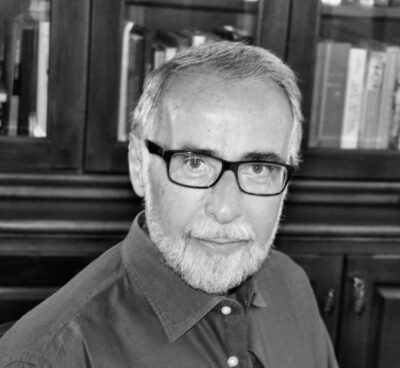
Armine Afeyan (photo AHI website)

She also is involved in the Afeyan family’s broader philanthropy and sits on several nonprofit boards outside of Aurora, noting her experience in all of these institutions helps inform her leadership.

At the heart of the Aurora Humanitarian Initiative is the Aurora Prize for Awakening Humanity, $1,000,000 given to people who risk their own lives to save people facing violent conflicts or atrocities. The Aurora Prize laureate receives $300,000 to continue his humanitarian work and can designate humanitarians and humanitarian organizations to receive $600,000. The remaining $100,000 is divided equally among the other finalists in the contest, called Aurora Humanitarians.

Another key program for the last eight years is Young Aurora, a competition for school-age children to come up with humanitarian solutions for their communities. Afeyan said about it that “we are going to continue and build on [it] in the future.” This program has been carried out in partnership with the United World Colleges (UWC) global network of schools. It started at UWC Dilijan, an international boarding school which Ruben Vardanyan and his wife Veronika Zonabend, together with the Afeyan family and other donors, set up in Armenia in 2014, and expanded to the other UWC schools.

The importance of such programs is the humanitarian in every human, Afeyan said, continuing: “The idea [is] that even if the UWC students don’t go on to become humanitarians themselves, when they are employed at a major consultancy, or a bank, or whatever else, that seed of a humanitarian being in all of us will persist.”

There is also what is called the Aurora Humanitarian Network, which is a group of around 100 humanitarians called the Aurora Luminaries. Their names are available on a website (auroraluminaries.com) with their stories and sometimes video content, and each has his or her own page. Afeyan remarked that in some cases this might be the only online presence of this person, while others like Dr. Denis Mukwege, who was the 2024 Aurora Prize laureate, also was a Nobel Peace Prize winner who has a great deal of online exposure.

Afeyan defined the next chapter for AHI as “one that is focused on building out the network in addition to the prize. That is something that has really galvanized both our historical base but has also brought in a lot of new support.” AHI will create community and capacity building programs for these humanitarians in this next phase, starting next year, though the preparations for this have already begun.

By running ten years of prize cycles, Afeyan observed that AHI has gotten to know many humanitarians well, particularly the semifinalists for the prize who are vetted extensively. Beyond that, AHI has been on an ad hoc basis inviting different humanitarians, including Aurora Prize semi-finalists, finalists and laureates to speaking engagements. Afeyan remarked that, “like when two Armenians meet they create a new Armenia — when you have two humanitarians meet, they find ways to collaborate with each other.” Even though they might be working in different settings, the humanitarians may have similar needs, which can create economies of scale.

She gave one example: a person working in health care and another working in education realized very quickly that the community healthcare model could be extended to community education models. In other words, educating or training local educators to reach more people in more areas, particularly in rural communities, would be more effective using a centralized model.

This kind of synergy has been happening for years, evidently in a spontaneous fashion. Afeyan declared, “Now we’re deciding to act on it by basically pairing those potential pools of demand, and we are going to be piloting this, with sources of supply, or supply chains, for backend needs, for administrative needs, to really try to bolster existing humanitarians. That is what we call the human in humanitarian.”

When asked whether the Aurora Prize ceremony would take place again in Armenia, as it has been held in other countries since 2019, Afeyan said that it is not ruled out, and meanwhile other types of events would continue to be held in Armenia. Most of the Aurora staff are located in Yerevan, and the US team accompanies Afeyan when she goes there. She added that there was a whole generation of volunteers in Armenia who had stayed in touch and “we really want to cultivate that group,” while humanitarian award winners also are interested in going there.

Afeyan’s Path to Aurora

Afeyan has important role models in philanthropy and humanitarianism in her own family. Her father, Dr. Noubar Afeyan, is a noted entrepreneur and philanthropist who was one of the three original founders of AHI. Her mother, Swedish-born biochemical engineer Anna Gunnarson Afeyan, is also a prominent philanthropist. In fact, Afeyan said, “My mom has been incredibly influential and she’s a real force when it comes to our family’s lives.”

Afeyan noted that the Swedes as a people have a long history of individual philanthropy, stating, “It is something that I have observed firsthand. There is a sense of responsibility…to see how they can help.” During the Armenian Genocide, Nordic missionaries served as humanitarians. Afeyan speculated: “There is a feasible world in which two sets of my ancestors were interacting in very different ways.”

When asked how her involvement with AHI in particular began, Afeyan pointed to her first name. She was named after her great-great-aunt Armenouhi Afeyan, a survivor of the Armenian Genocide who managed to keep her family together in those years. Afeyan’s father, Dr. Noubar Afeyan, shared a room with his great-aunt for over 20 years, so she was a big part of the lives of the Afeyan family. Afeyan recalled, “She was just a remarkable woman. I had the opportunity to meet her when I was young…She was a big part of our lives and a big influence on me. Her life was one entirely of service. And so, from way before I would have called it philanthropy, there was just an expectation of our giving back.”

One other important motivating factor for Afeyan was that her great-grandfather and his brother, Armenouhi’s siblings, survived thanks to help from others.

Afeyan recalled her education as an immense privilege which also amplified the expectation of eventual philanthropy and service. She went to St. Stephen’s Armenian Elementary School in Watertown, public school in Lexington, and then the private Winsor School before studying at Yale University, and getting an MBA in 2017 from INSEAD, a business school in Fountainebleau, France. She said, “These are places that open your eye and push you, and, I think, create an opportunity to give back.”

After completing her education, Afeyan worked for almost six years in the private sector, primarily for Wayfair, an e-commerce company that sells furniture and home goods online with extensive use of data and artificial intelligence. Afeyan said that even while there, she participated in Armenian activities in her early 20s, and then transitioned to broader nonprofit activities, though still largely focused on Armenia. After building two businesses at Wayfair and reaching the executive level there, and having moved back to the US from England, she said she was at a place professionally where coming back to Aurora made sense.

She had been involved at Aurora’s inception but then was basically a cheerleader on the sidelines not involved in the day-to-day work there until 2023, Afeyan related, when the Aurora leadership decided to continue the organization past its original eight-year commitment.

New Global Challenges

It appears that many governments in the world, including that of the United States, are moving towards a more inward-centered and transactional world view which entails reducing efforts at helping the less fortunate globally (and domestically). When asked how AHI and other private philanthropic endeavors are dealing with this new situation, Afeyan responded: “The scale of official development aid is not going to be replaced by philanthropy. However, as many people who are in philanthropy know, because they amass their wealth through value investing, whether that is in building a business or investing in other businesses, etc., you ought to be looking for value investments in a down market, so to speak. I am using that just as an analogy, but basically now is the best time to invest. Your money will go the furthest right now by investing in local humanitarianism.”

In other words, putting money into humanitarian endeavors will have a greater impact today than in other times and, Afeyan added, Aurora is one way of doing this.

She also pointed out that the world has been in such a situation before and individuals stepped up to meet the need. During and after the Armenian Genocide, which predated the post-World War II system of international aid and institutions like the United Nations, individual giving took place massively on the grassroots level. Afeyan said that Aurora Mardiganian was one of the inspirations of such aid movements, which mobilizing millions of dollars to save generations of Armenians. Therefore, she said, “We can take, if not comfort, then at least some level of confidence, in that we have been here before, and that individuals are still generous. If you ask Americans about foreign aid, highly unfavorable. If you ask Americans about feeding children, exceedingly favorable. And they’re one to one.”

As for the role of Armenians in this situation, Afeyan said, “I think Armenians have a special responsibility to the world, and I know that might feel like, oho, again we are being asked to do this. Again, in the middle of all of this? But actually the science behind it shows two things. One, being needed is key to a dignified life. It is when you feel forgotten and unneeded that things really come off the wheels. We are needed by the world. Our story, our work, our unique perspective, particularly on humanitarianism but whatever you want to call it, is needed at this moment now more than ever I would say.”

Secondly, Afeyan cited scientific studies confirming that seeing people being helped feels good, so for Armenians and non-Armenians alike, giving back to people is part of having a satisfying life and is good for you.

Moreover, she said, “By spreading our message more than a hundred years after the Genocide and continuing to do this even through more recent traumas, we as a people, Armenians, can serve as an inspiration. We also can get inspiration through others who are in their moment of greatest need and greatest crisis, and are still finding ways to give back and to uplift.”

For those who say why not first help Armenians facing trauma today after the occupation of Artsakh or turmoil in the Middle East, Afeyan said this approach will never mean “instead of.” If you are able to do both, or are able to provide support beyond Armenia too, she said you can look at it as an investment that gives back manyfold. “By associating ourselves with giving back, by associating ourselves with helping the world,” Afeyan said, “we make friends before we need them. We do what is right and Christian and all these things as well, but we make friends before we need them and we associate what being Armenian is with something really positive and still unique and still original.”

She stressed, “I will never go for a dollar bound for Armenia. We want Armenia to be strong, and on a personal level, I have lived in Armenia, I care deeply about Armenia, and my family does work in Armenia outside of Aurora. But if there are two dollars, and you want to give one that also pays back for Armenia, if not directly, this is another option for that.”

Smilingly, she said not to forget that there is an -ian in the word humanitarian too.

How to Participate in the Aurora Humanitarian Initiative

Afeyan said that the avenues for participation in the Aurora Humanitarian Initiative include donations and nominations. The next Aurora Prize cycle is open so anyone can nominate and anyone can be nominated. “We are always looking for more, better and more diverse nominations,” Afeyan said.

A third way is more general: to become more humanitarian in our lives. Afeyan said, “The goal really is sparking gratitude in action and I can’t think of a better way than to think about the humanitarians and to think about how we can be more like them.”

For more information, see the website aurorahumanitarian.org.

Get the Mirror-Spectator Weekly in your inbox: