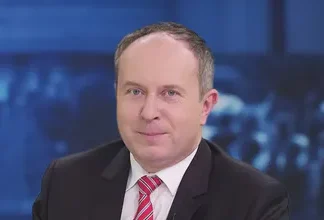


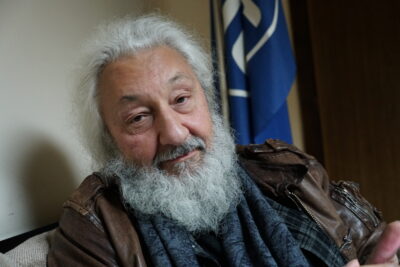
Stas Namin (photo Aram Arkun)

Mikoyan’s Grandson Stas Namin Created Soviet Rock’n’roll and Much More

74
0

YEREVAN — Anastas Alekseevich Mikoyan, the grandson of the Soviet Armenian politician Anastas Ivanovich (Hovhannesi) Mikoyan (1895-1978), goes by the moniker Stas Namin. Not only is he one of the early performers of Soviet rock’n’roll, but he has in various stages of his career been a painter, photographer, cinematographer and creator in various other artistic realms. He came to Armenia in October to receive a Vahan Tekeyan Award from the Tekeyan Cultural Association for his painting “Sanahin.”

Stas Namin at the Tekeyan Awards in Yerevan (photo Aram Arkun)

Memories of His Grandfather

Namin’s father Aleksei Anastasovich Mikoyan was a pilot all his life and was wounded during World War II. In fact, four out of five children (all sons) of Anastas Mikoyan were pilots, with one, Vladimir, shot down and killed during the Battle of Stalingrad in World War II. And of course, Anastas Mikoyan senior’s younger brother, Artem (Anushavan) Mikoyan, was the creator of the MiG fighter jets along with Mikhail Gurevich.

Namin recalled that the four surviving sons ended up having 10 children in all, five girls and five boys. He said they, as children, spent a lot of time in his grandfather’s dacha, or summer house, outside of Moscow. When they became teenagers, more grown up, he found a way to continue to bring them all together. He would invite them to lunch on Sundays. Why? Namin said, “because he understands that Saturday night we are all going out, having fun with our friends. Then Sunday, we are tired, so that just to come for lunch — not too early — is very pleasant. More than that, he said we could come with our friends, with guests. So there was a big table.”

Namin said that he was very close with his grandfather growing up but never discussed his career or political activity. “At that time,” he said, “he was just grandpa, and I knew him as a very kind person, very nice, polite to everybody, not only to his close people but also to his guests.”

Namin said that Mikoyan had become a communist because “he was fighting for justice, for rights for the people. That was the ideal of communism in the beginning but he was like that all his life, so his patriotism was very different than other patriotisms.”
Get the Mirror in your inbox:

At the lunches, there was mostly Armenian food. Namin remembered that when somebody said he did not like beans, his grandfather would declare that he should just try it. As his grandfather grew up in the village of Sanahin in northern Armenia, he and the other villagers did not have the opportunity usually to eat meat. They were poor and needed milk so they could not afford to kill the cows and eat them. This led to Mikoyan till the end of his life primarily maintaining a vegetarian diet. He was abstemious in general when it came to eating, and while he might have a little wine at night, Namin never saw him drink cognac.

Consequently, he did not offer toasts like some Armenians, and in fact had a reserved personality. He took his family to vacation usually in places like the Crimea, but also went back to his native village of Sanahin often, mostly for work, Namin said.

Namin related that though Anastas Mikoyan was a renowned international diplomat at the top ranks of the Soviet government during Nikita Khrushchev’s time in power, starting in the Leonid Brezhnev era, the Mikoyan name actually carried negative connotations officially. He said that when his grandfather “found out that Brezhnev started from corruption and started stealing, he understood that all his life what he did before went for nothing, because it was a different country already.” He therefore did not accept Brezhnev’s invitation to join him, and from that moment on, Brezhnev started acting against him in various ways.

Namin wrote a biography of his grandfather together with Andrei Rubanov which was first published in Russian in 2022 and then translated into Armenian by Khachatur Stepanyan and published in 2024. Its title, translated into English, is Anastas Mikoyan: From Ilyich to Ilyich, Four Eras, One Destiny: Documentary Drama. This liberally illustrated expansive volume (512 pages in Armenian) is based on many archival documents and also includes the remembrances of many Mikoyan family members.

Music

Namin, born in 1951 in Moscow, was fortunate to have had some of the best Armenian creative minds as his teachers as a child. He said that Arno Babajanian was his first piano teacher while Martiros Saryan taught him drawing. Moreover, the friends of his musicologist mother Nami (after whom he took the last part of his pseudonym) included people like composers Dmitri Shostakovich, Alfred Schnittke and Edvard Mirzoyan and violinist David Oistrakh. Namin said, “They were at our house all the time. Edvard Mirzoyan was my friend too. He was my mother’s friend but then we became friends all together.”

He said that for thirty years, they had the same joke. When they would meet, he would say, “We are going to take Ararat back. You are going left, Arno is going left, and I am going right … no, no, no. We change it. Three ways, so who goes left, who goes right?”

He understood that he was surrounded by giants of culture, but, he said, “I didn’t care so much because I was into rock and roll. In symphony, yes, they were geniuses and we were hooligans.”

Namin’s attraction to rock began with his father, whom he said also loved this kind of music and would take reel to reel tape recorders with him even when he served as an officer on Soviet military bases. His father loved Elvis Presley, Little Richard, Bill Haley and the like.

Namin was sent to Suvarov Military School, a Soviet boarding school, for seven years, and it was there, he said, that he first listened to the Beatles, Rolling Stones, Jimmy Hendrix and Janis Joplin. He said he taught himself to play guitar by ear. It was there that he created his first band with his friends: “We were not planning to do a career in rock and roll. We were just playing for ourselves. We all were just rock and rollers the same as everywhere in the world.”

While Namin was a student at Moscow State University, there was a contest for different student music groups, and three bands, including a new one he founded, won the contest. The prize was permission to make a single at the Melodiya, the state-owned record company of the Soviet Union. His group played a song that was more in the way of the lyric music of the Beatles (e.g. Something in the Way She Moves). Namin said, “Is it rock and roll? We understand, yes, but they don’t understand. So we did this type of music.”

It sold 7 million copies but the band did not get paid anything. Melodiya asked them to make another record. In all, Namin said over 60 million copies were sold of their records by the end of the 1980s.

This band, formed in 1969, was called Tsvety in Russian, which means flowers. He said this was “because of flower power and flower children. We were like hippies!” The other members of the band were all Russians initially, and they played songs from the Beatles, Rolling Stones, Jimmi Hendrix, Led Zeppelin, etc. In 1975 the Soviet Ministry of Culture banned the band for promoting Western ideology, but it reappeared the next year under the name the Stas Namin Group, only to face new state obstacles.

In 1980, Namin said, he decided to move to Armenia with his band. He said he decided to return to his roots. He said, “We were so popular that to come here was like the Beatles came to Armenia…We were playing concerts filling three stadiums a day, morning, daytime and at night, and at the Winter Palace of Sports.”

He organized a music festival in Yerevan in 1981, which was the first major rock festival in the Soviet Union, and also invited foreign bands. He said that in Moscow they stopped the foreign bands from coming, but fans arrived from all over the Soviet Union. Journalists from Western publications like Time Magazine and Stern covered the event. Time called it “Woodstock, Yerevan style.” Some 79,000 fans and 11 bands participated over a period of 9 days.

After these articles in the Western press appeared, Namin said they kicked him out of Armenia. The KGB wrote an official letter that he was anti-Soviet and doing rock propaganda from the West, so they took his passport away in the airport and stopped selling all his records.

As he could no longer work in music, he said, “I decided to move to a different profession and started studying filmmaking, graduated and did some other things until Gorbachev came to power.” He made several documentaries.

During the period of perestroika initiated by Mikhail Gorbachev, Namin and his old bandmates were allowed to leave the country. He said, “There was freedom so we went to the United States for a big tour, 45 days all around the United States. After that we went on tour all over the world for three years.”

In 1987 he created a new band called Gorky Park with some of the key musicians from the Flowers, and in 1989 organized the international rock festival in Moscow.  He also created the Moscow Symphony Orchestra in 1989. He continued to organize many different cultural events as an impresario, founded the Stas Namin Music and Drama Theatre at the end of the 1990s, and began to be more involved in painting, photograph and drawing.

Namin said that he has been coming to Armenia a lot recently, because he obtained an Armenian passport two years ago, although he said that from his point of view it is a very bad time for Armenia, with the last 30 years ruining everything that was done in Soviet times.

Looking back at the accomplishments of his multifaceted career, Namin said, “I am [approaching] 75 and during this long period of time I did many different things. The value is not to do many different things. The value from my point of view is what level I reached in each thing, in each direction.” However, he emphasized, “Right now, what is most valuable in my life is my family and my friends.”

His website stasnamin.com contains a great deal of information about his art, life, and works.

Get the Mirror-Spectator Weekly in your inbox: