

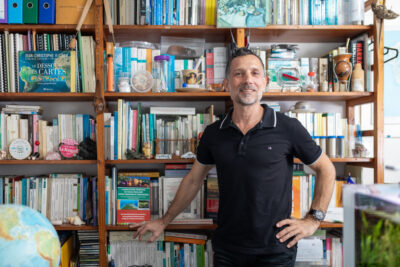
Anthony Tchékémian (Doris Ramseyer photo)

Anthony Tchékémian: The Scientist, the Athlete, the Armenian of Tahiti

349
0

YEREVAN/ FAAʻA, Tahiti, French Polynesia — Anthony Tchékémian, born in Valence, in the Drôme, France, holds a Habilitation to Direct Research (HDR) obtained in 2023 at the Doctoral School of the University of Avignon. Specialist in human geography, geopolitics, sciences of the environment, agronomy, planning and development of territories, he has been teaching and conducting research at the University of French Polynesia since 2013.

Tchékémian’s academic journey began with studies in urban planning at UPMF Grenoble, followed by a position at the University of Lorraine. His doctoral thesis examined the impact of the European Union’s Common Agricultural Policy on rural communities in France, a study that earned him the Medal of the French Academy of Agriculture in 2010.

Today, Tchékémian continues to publish and pursue research on the development of island territories, with a particular focus on French Polynesia, where global challenges such as climate change and food sovereignty intersect with local traditions and resilience. In 2023 he published Clipperton, the Remains of La Passion: Insights into the Only French Coral Atoll in the Northeastern Pacific Ocean (in French), about a little-known yet mysterious French atoll. After a month-long mission of total immersion, he returned with numerous observations and scientific data, including rare color photographs, which allow us to discover this French atoll at the edge of the world, serving as a sentinel island in terms of environmental protection.

Dear Anthony, how would you describe your academic path?

My academic path is somewhat unconventional. I began with vocational studies in environmental sciences, before turning to marine biology. My university degree later allowed me to focus on the relationship between “cities and nature” at the Grenoble Institute of Urban Planning, where I earned a bachelor’s and then a master’s degree in planning and research. After four years of teaching at the University of Lorraine, I decided to settle in French Polynesia. There, my work as a researcher has brought me the emotional depth and introspection that my earlier training lacked. I need to feel different, yet rooted in a sense of kinship and closeness. French Polynesia, through its culture and values, suits me best because it resonates with my distant Armenian origin.

My work follows a multidisciplinary and intercultural approach, connected to the research units SECOPOL (Tahiti) and Espace-Dev (Avignon).
Get the Mirror in your inbox:

I assume it should be very interesting to live on tropical island and conduct research.

My research focuses on territorial and health issues in tropical island spaces. I analyze tensions between agro-industrial models and traditional practices, while emphasizing local solutions such as community gardens and short food supply chains. My work explores the link between food sovereignty, subsistence agriculture, public health policies, and local dynamics. The aim is to develop broader reflections on territories in transition, facing globalization and climate change.

I stand out for my inclusive approach, grounded in respect for local communities, while striving to make my research accessible to the general public. My work in critical and cross-disciplinary geography aims to identify concrete solutions and contribute to more sustainable and just development for island populations.

Sport seems to be another foundational aspect of your life.

I started practicing judo at the age of seven, with Bernard Tchoullouyan (1953–2019), as a model, the French-Armenian judoka who became world champion in 1981. And I still practice today, at 50. I hold a 2nd dan black belt and had the chance to be selected to represent Polynesia at the Pacific Games in 2023 and 2024 in the seniors’ (-60 kg) category. I was French Polynesia champion in 2022 (-60 kg), runner-up in 2021 (-66 kg), and twice selected for the French corporate championships (2009 and 2011) in Paris. But beyond the results, judo has been much more than a sport for me: a balance, a way of life, a space for self-overcoming. The moral code—politeness, courage, sincerity, honor, modesty, respect, self-control, friendship—became a compass I apply in my family, professional, and personal life. I also had a long experience of voluntary teaching, in clubs, in schools, with varied audiences, including children with disabilities. Transmitting judo is not only transmitting a technique: it is sharing a philosophy of life.

I stopped competing at 50, after being selected for the Pacific Games. The moral code of this martial art has helped me face adversity and live by strong values, especially in the academic world where underhanded tactics and jealousy are common. Now, stepping away from competition, I strive to become “more like a reed than an oak.”

I also played rugby for four years as a hooker, one year in juniors, then three in seniors, to obtain a federal teaching diploma. This collective combat sport fascinated me: “courage and intelligence,” they said in the definition given during the diploma course. Coming from judo, at 17, I loved this collective combat sport, the mates, the friends, the loves, the troubles… as Charles Aznavour sang.

Even today, I consider these two combat sports, one individual, the other collective, as having forged me: two different but complementary disciplines, which taught me to face challenges, not to fear “mountains,” to face adversity, to remain faithful to an ethic, to one’s word, one’s honor, to friendship… to live with intensity and to pass on to my children the taste for life.

Please tell us about your Armenian ancestors.

My story begins in Valence (Drôme), France, a city with a strong Armenian community. I am the product of my family’s history of exile and resilience — a story that, I believe, reflects the courage of our people.

My paternal grandmother, Aravnie (Aghavni) Garabedian, was born in Beirut in 1922, after the “death marches” of the Armenian Genocide. Left for dead, she miraculously survived thanks to an uncle before eventually joining her family in France. With no status other than that of stateless refugees, the family found shelter in Valence. My grandfather, Bedros Tchékémian, fought for France during the Second World War and was taken prisoner for seven years, at a time when he had not yet been naturalized.

This story of survival and struggle forms the foundation of my identity and fuels my humanist commitment. Visiting the Armenian Heritage Center of Valence and discovering our family name there moved me deeply.

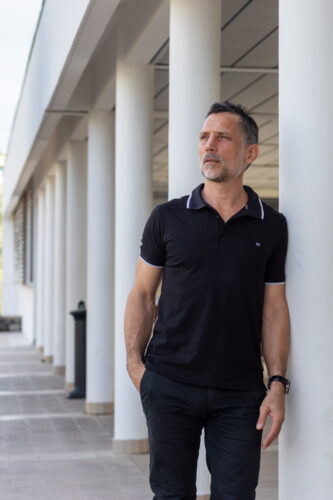
Anthony Tchékémian (Doris Ramseyer photo)

You said that Polynesia suited you particularly well because it resonated with your distant Armenian origins. Could you elaborate a bit more?

Polynesia resonates for me as a land of memory and resilience, echoing my Armenian origin. I even explained this in the foreword of my book Tropical Agriculture in an Island Environment between Tradition and Innovation, perhaps as a way of showing my respect to the Polynesian people. I grew up in a family marked by history: the genocide, the torturers, the states that were deaf and blind to the horror of death marches, massacres, rapes, and the most sordid and inhuman murders. I very quickly learned these words and understood their meaning, words that should be foreign to children: exile, suffering, and reconstruction.

The sounds of the Armenian language my father spoke, those I heard at my grandmother Aravnie’s home, from her friends and my aunts Vartouhie and Alis, already transported me as a child to that land. Polynesia, a land of migrations, of mixing, and of rebirth after historical trials, feels familiar to me: it resonates with the history of the Armenians, a people forced to reinvent themselves in part within the diaspora. Living here, I rediscovered that strength of belonging to a land and of transmission, which is also essential for my own identity.

I am proud of this family name that I passed on to my two children, born in Tahiti: Anouk-Aravnie-Atea, with the Polynesian name, and Axel-Azad-Aroma. I assert my origin, most certainly because I am part of the third generation, the one that saw its grandparents and parents work themselves to exhaustion, accepting “to earn their living, the first job that was vacant […] It could be done with an accent,” to quote the Great Charles. To integrate well, not to stand out, to try at all costs to show that we were good French citizens… But what for? I experienced racism as early as primary school, simply because of a family name of immigrant origin, very different from Lemaire, Reboule, Mondet, Palanque, Bouyet… So, very quickly I took the side of the underdogs, of the disabled, of foreigners — in short, of the different and often rejected. My parents took care to give me a first name that would mask the foreignness, to “sound French”: Anthony. Pity, I would have loved to be called Azad, “Freedom,” like in Henri Verneuil’s “Mayrig.” For indeed, freedom is precious for a people wounded before everyone’s eyes, without anyone reacting… So, I no longer hide. I live, I work, I succeed. Everything I do, everything I achieve is for my own, to show that I could make it, to thank them for their support, their kindness, so that they may be proud of me, of us, of themselves!

Apart from the Armenian first names your children bear, are there other Armenian influences in your family?

Yes, many. First, the language: my father spoke it, and although I did not inherit it fluently, I kept in memory certain expressions and sounds that shape an identity. In Gardanne, while I was studying for a BTSA, I even tried to learn Armenian through an association, but a year was not enough to master such a beautiful, rich, and complex language.

Then, the cuisine, a true living and delicious heritage. I grew up with the smells of kitchens, of pasterma, sujuk, coffee, olives, dates, apricots… I loved it when the kitchen was taken over by the ladies preparing dolma, börek, and other specialties difficult to make, yet quickly eaten! My grandmother, an excellent cook, prepared dishes whose flavors remain unmatched, beyond anything I’ve ever tasted in Middle Eastern restaurants or even during my travels in Turkey, especially in Malatya, where she had lived. My French mother also learned to cook Armenian dishes, and we enjoyed her little meals at home. My aunt Alice still carries on this link, delighting me with specialties, and in particular regularly sending me oriental-ground coffee, which I can’t find here in Tahiti. Every morning, our family shares an Armenian-Tahitian coffee, brewed in an enameled srjep (or jazzve) that belonged to my grandmother: it is a ritual for us and for my children who watch me prepare it! My father used to make me drink some when, as a child, he prepared me to leave for judo competitions. This simple ritual is a way of keeping memory alive in daily life.

I also think of the figures of my personal Pantheon. There was a very important one in my family, alongside my aunt Alice, my father’s sister: my uncle Gilbert. Passionate about Armenian history and culture, he had accumulated impressive knowledge about this people and its destiny. It is not always easy for refugee survivors to delve into this history. His readings, stories, analyses, and vision deeply marked me: like A Dagger in This Garden by Vahé Katcha. He also took me to listen to Gérard Chaliand, the French-Armenian geopolitician and essayist, near Charenton-le-Pont, and gave me Mémoire de ma mémoire, a collection of memories that I devoured. A few years later, I dared to ask Gérard Chaliand to write the preface to my book Clipperton, the Remains of La Passion, which he kindly agreed to do, telling me that his mother’s name was also Tchekemian. My uncle was, as we affectionately said, “the most Armenian of the French.” His words nourished my imagination and reinforced that feeling of belonging to a history larger than myself.

After that, I don’t know how much Armenia there is in me, but it seems to dominate: I don’t know why but, quite innately, I love galloping on horseback imagining myself as a warrior of the steppes, eating pomegranates, practicing judo under the influence of Eastern countries (more wrestling-oriented), I love the scents of jasmine, cumin…

Have you ever met other people of Armenian origin in Polynesia? A few years ago, I was in contact with Natacha Mirimanoff, of Armenian-Tahitian origin, and last year I interviewed Vadim Toumaniantz from Papeete.

Yes, even if such encounters are rare, they are always precious. Doesn’t a proverb say: “where there are two Armenians, they will meet”? In Papeete, I recently received a very kind message from Vadim Toumaniantz, who told me about your work and expressed his goodwill. This gesture deeply touched me. I have not yet had the chance to meet him in person, nor Natacha Mirimanoff, but I know their names and their background. Their presence in Polynesia bears witness to the discreet but very real existence of the Armenian diaspora in these islands. Each encounter, even virtual, creates an immediate sense of complicity and recognition.

Have you ever been to Armenia?

I haven’t had the chance yet, but it is an essential project for me. In the meantime, I raise my children by telling them about the diaspora, the life journeys of their ancestors, and by passing on to them some knowledge of this civilization, this culture, this Armenian heritage. I tell them that Armenia was one of the oldest civilizations in the world, renowned even in Egypt at the time of the pharaohs for its exceptional musicians. It was also the first nation to adopt Christianity in 301, and its landscapes around Mount Ararat, now in Turkey, are filled with symbols. I tell them about the kingdoms of Urartu and the Indo-European peoples who shaped this history, but also about the rich heritage of monasteries and churches, and the terrible ordeals, especially the genocide of 1915. I also show them the complexity of the Caucasus, a powder keg, its political, ethnic, religious, linguistic divisions, and the conflicts in Nagorno-Karabakh, the rivalries between powers, so that they understand that Armenian history can only be read in relation to its neighbors and great empires. Moreover, I will keep speaking about it as long as persecution remains of no concern to others… It is my way of fighting. Who remembers that in December 2022, in Nagorno-Karabakh, the Azerbaijani army blocked the Lachin corridor, the only road link between Stepanakert and Yerevan, thus preventing the supply of civilians in the middle of winter?

Moreover, I explain in my courses on the geography of conflicts that although it is commonly called Nagorno-Karabakh, I prefer the name Artsakh, since the former expression is built from words imposed by others: Turkish kara (black) and Persian bagh (garden), to which the Russians added nagorny (mountainous). The expression “Nagorno-Karabakh” is thus a condensation of Armenian pain, through the three powers that occupied, ruled, and sometimes persecuted the inhabitants of this region.

Such a trip to Armenia would have a twofold significance for me: an intimate return to my family roots, and a way of passing on to my children a living heritage, not confined to the past but rooted in the present and future. In my profession as a teacher, particularly in my geopolitics courses, I also strive to make this country known, to explain its complexity and importance, and to show students both the richness and fragility of this region.

Anything else you would care to add?

Yes, several things… I am deeply moved by the personality and life of Missak Manouchian, and so happy and proud that he has finally entered the Panthéon, as a French Resistance fighter of Armenian origin, in France and for France against Nazi barbarism. His courage, his commitment, and his sacrifice embody the dignity of a people fighting for survival and freedom. His memory nourishes me, as it nourishes so many descendants of the diaspora: it reminds us that it is possible to remain faithful to one’s values, even in extreme adversity, without bowing down or making pacts with evil.

I was also cradled by the voice and words of Charles Aznavour, who accompanied my childhood near Valence. His songs — well beyond La Mama, Ils sont tombés, Autobiographie — bring back that time to me with deep nostalgia. My father would sing at the top of his lungs at home: he could have been Monsieur Charles’ double! I particularly remember a gift from my grandmother to congratulate me for earning my doctorate: a seat in the front rows of the Palais des Congrès to go see him, while she herself sat further back in the hall. I cried from the beginning to the end of the concert, I could not stop. This gesture touched me, shook me deeply. Here in Tahiti, I had the incredible chance to see him in concert, and I even managed to get the handkerchief from La Bohème. My father, a die-hard fan, has seven. This object, beyond the anecdote, has become for me a symbolic treasure, linking the artist, my family, my memory, and my Armenian tears.

Get the Mirror-Spectator Weekly in your inbox: