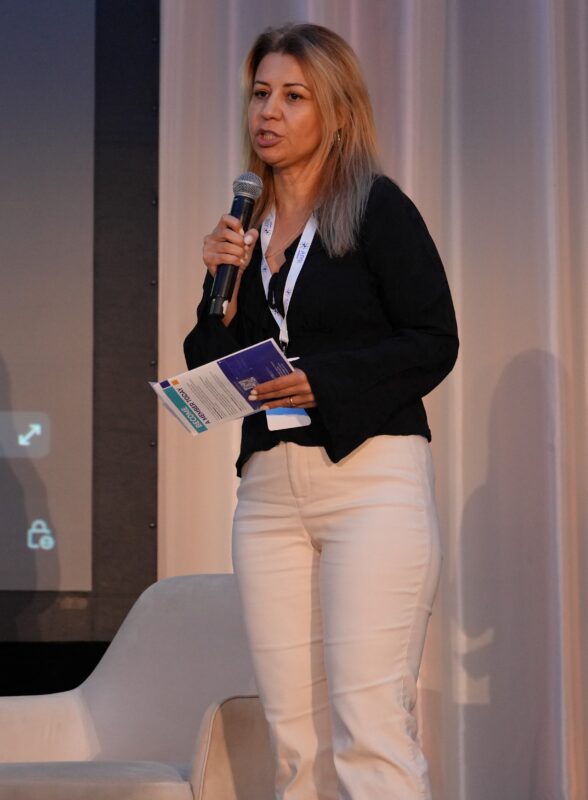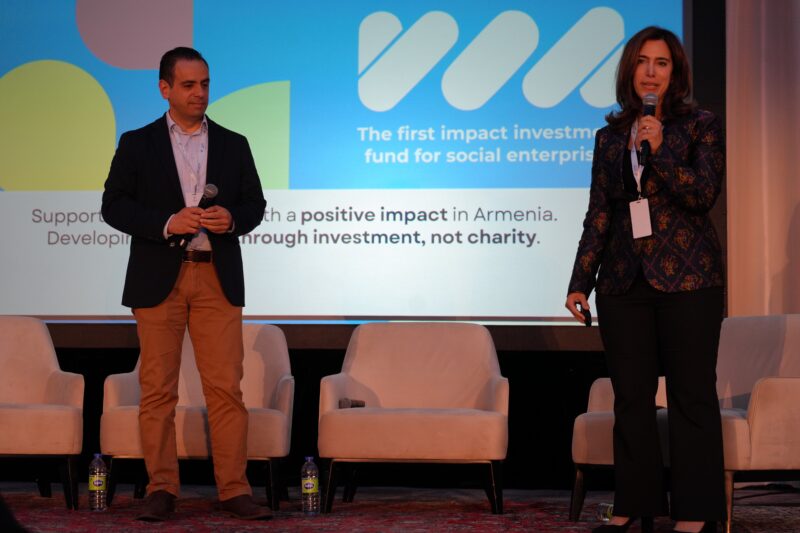


From left, Lara Setrakian, Arda Hartunian, Yervant Zorian (photo Aram Arkun)

Wide-ranging APRI Presentations Explore Future of Armenia at Montreal AGBU General Assembly

7
0

MONTREAL — The Armenian General Benevolent Union’s 94th General Assembly in Montreal included a series of wide-ranging presentations largely on international relations, economics, technology, and reforms under the title “Armenia at the Crossroads: Geopolitics, Connectivity, and the Tech Frontier.” The Applied Policy Research Institute of Armenia Foundation (APRI Armenia), which was founded with the support of the AGBU in 2022, convened a packed half-day of presentations on Friday, October 16.

APRI Armenia President Lara Setrakian began the afternoon with a recap of APRI’s mission and work since it was founded about five years ago. She declared: “We went out and studied the Council on Foreign Relations, the World Economic Forum, Brookings, and all of the world’s best. We did our utmost to adapt those models to what we felt Armenia was missing, because we felt that Armenia deserves to have the best as well.”

APRI identifies gaps in what Setrakian called the “nation-building blockchain” and attempts to add a piece of the answer through constructive work.

APRI Board Chair Yervant Zorian amplified Setrakian’s assessment that Armenia had a gap in research for decades and APRI attempts to fill that gap based on the work of experts not only in national security but also on other issues impacting Armenia’s long-term future, from transportation, to power and technology.

APRI Board member Arda Hartunian put an emphasis on APRI’s communication of smart ideas. She said, “We provide quality information, and then it’s up to the different institutions, government, nonprofits and businesses that use that information as to what they do with it.”

Former Amb. Andrew Turner
Get the Mirror in your inbox:

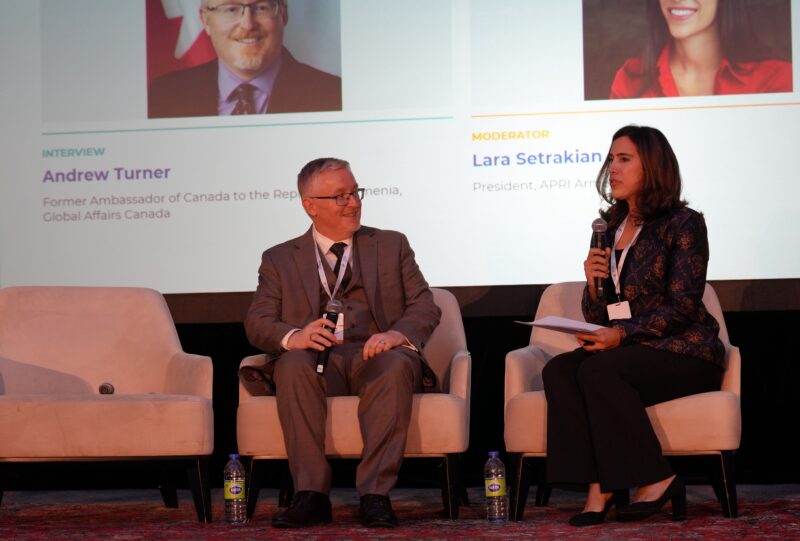
Setrakian conducted an interview with Andrew Turner, who served as the first ambassador of Canada to the Republic of Armenia from 2023 to 2026. Turner explained that Canada opened its embassy in Armenia as part of the expansion of Canada’s diplomatic footprint, and the Caucasus and in general the countries of the former Soviet Union were areas in which it was underrepresented compared to many of its peers.

Amb. Andrew Turner and Lara Setrakian (photo Aram Arkun)

Secondly, in the wake of the 2020 war, Turner said that Canada felt “it was particularly important…to signal Canada’s support for Armenia’s sovereignty and territorial integrity.” It also realized that it had less visibility on what was happening while operating from a distance through its Moscow embassy.

Thirdly, he said, Canada wanted to be in a position to work with partners in Armenia supporting democracy and continue to build people-to-people ties between the two countries.

Turner evaluated highly the August 2025 Washington agreements between Armenia and Azerbaijan mediated by the US, including the Trump Route for International Peace and Prosperity (TRIPP), which he said could positively change the dynamics between the two countries, if the momentum can be sustained.

As far as Canadian-Armenian relations, Turner found that there was great potential for cooperation in the IT sector, agriculture and mining. Aside from the actual opening of the embassy in Yerevan, Turner said another important step during his tenure was the launch of the Canada-Eurasia Chamber of Trade and Economy, through which businesspeople can join the economies together in practical ways.

Armenak Minasyants on Public Administration Reform

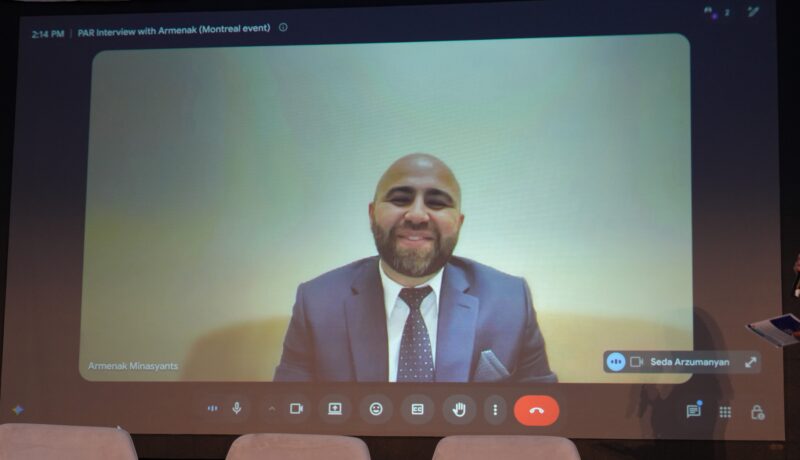
APRI Vice President of Donor Relations Seda Arzumanyan interviewed APRI Senior Research Fellow Armenak Minasyants via Zoom on public administration reform in Armenia. Minasyants said that APRI Armenia’s most important achievement is moving from identifying problems and researching them to contributing directly to policy development and reform discussions.

Seda Arzumanyan (photo Aram Arkun)

In a policy report published in May 2025, it identified systemic challenges and proposed concrete and practical solutions. In September of the same year, it submitted 15 recommendations through the government’s online portal, and seven were fully or partially reflected in the government’s revised management framework. Another important APRI achievement, according to Minasyants, was that APRI was selected to participate in the government’s civil society advisory platform. Beyond that, APRI reaches out to international partners like the United Nations Development Program (UNDP) and the German Development Agency.

Armenak Minasyants (photo Aram Arkun)

Minasyan pointed to three main obstacles to turning commitments to reform into practical and sustainable results. There is fragmented coordination and unclear institutional ownership; limited institutional capacity to deliver due to a problem in what Minasyants diplomatically called human capital; and the measurement of success through processes completed rather than actual results of policy.

Minasyants said the role of the diaspora can be to connect international expertise to Armenia in a practical manner. The goal should be, he said, “a transfer of knowledge: the way we can adopt the best practices and strengthen our own institutional capacity.”

High-Tech Armenia

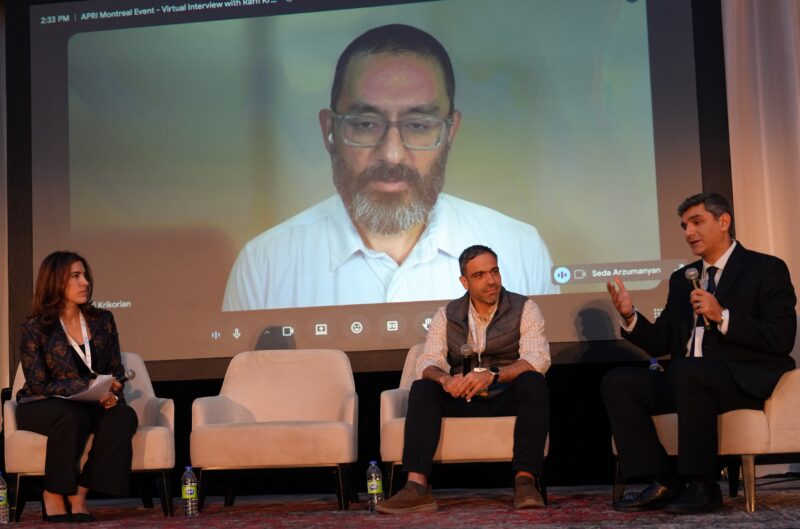
Setrakian took the microphone again as moderator, with in-person panelists Dr. Aleksandr Gevorkyan, professor and Henry George Chair in Economics at the Peter J. Tobin College of Business at St. John’s University, NYC; Ashot Arzumanyan, partner in SmartGateVC; and online participant Mozilla Chief Technology Officer Raffi Krikorian.

From left, Lara Setrakian, Raffi Krikorian (on screen), Ashot Arzumanyan, and Aleksandr Gevorkyan (photo Aram Arkun)

Krikorian said that the US-Armenia memorandum of understanding (MOU) on AI and semiconductors signed in August 2025 created an amazing headstart for Armenia but, he continued, “we need to start figuring out how we’re actually going to use that technology to diffuse AI technology throughout Armenia as a country.”

This means beyond access to necessary hardware to build a foundational software infrastructure that all Armenian companies, nonprofits and government agencies can use. This would be similar to the Internet as a set of open-source standards used by all kinds of institutions. One example he gave was a single Armenian large language model with a single set of Armenian data sets, on which every company can build its own applications.

In response to Setrakian’s question as to whether a small country like Armenia could have its own sovereign ecosystem, Krikorian replied that many other countries have done it, include the much smaller country of Estonia. He said that he thought it was a question of willpower and investment for Armenia to build the necessary infrastructure. One way would be Armenia as a country and government coinvesting in shared infrastructure in the same way that years ago it invested in cellular phone infrastructure.

With Firebird’s AI factory in Armenia, Krikorian said “We’re pretty much now the envy of a lot of the smaller-sized countries across the entire planet.” Armenia has computational infrastructure powered by Armenian power stations and run by Armenian people on its own territory, so it won’t need to outsource. Cross-border relationships might lead to losing access abruptly to various AI models.

Gevorkyan pointed out that the IT sector should be considered an extractive sector in Armenia’s economy. It contributes to socioeconomic disbalance, with the massive gap between the average wage in the IT sector and the rest of the economy, and its rising share of exports but it can be helpful if it is properly integrated with the rest of the economy. This means not just in the public sector, healthcare or education, but on a more advanced level too. Economic transformations of countries like South Korea, Gevorkyan said, provide instructive examples to learn from, including the need for guidance and investment (including from the diaspora).

Ashot Arzumanyan mentioned some of the top firms in tech right now in Armenia before declaring that AI is changing the situation in technology completely. He said, “It’s something like a wake-up call for Armenia, because AI is coming after many things, but it also is coming after the existing model of tech industry that we know and that existed for the last few decades, based on which all the success happened.”

He explained that in the world of startup firms, the latter must either leverage the distribution so they can have access to markets or leverage the technology part. Armenia, not having a distribution advantage, has always capitalized on its technological talent, which bought it time to figure out distribution. However, this is now getting automated by AI and the next wave of Armenian companies cannot follow the same model.

This is where Firebird AI comes in, he said, because it is infrastructure that provides an ecosystem or highway for Armenia. “Now, are you using that highway or others are using that highway is the question right now in front of Armenia,” he posited.

The panelists fielded a number of questions from the audience after their presentations.

Krikorian responded to a query on the environmental impact of the data centers. He was optimistic, declaring that unlike many data centers in the US powered by “dirty” energy sources, in Armenia there is full control over the power grid.

Gevorkyan suggested that while important, the IT sector is barely 5-7 percent of the GDP of the economy, and Armenians must pay attention to the difficult socioeconomic reality outside of Yerevan too.

US Policy in the South Caucasus and TRIPP

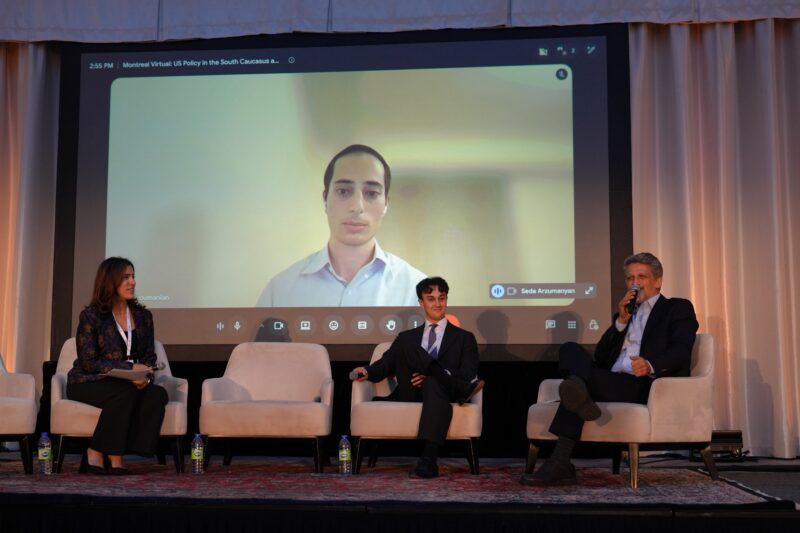
The next panel, moderated again by Setrakian, was on US policy in the South Caucasus and the implementation of TRIPP. Central Bank of Armenia macroeconomist Shant Arzoumanian participated remotely, while Quincy Institute for Responsible Statecraft Research Associate Artin DerSimonian and Carnegie Endowment for International Peace scholar and former Turkish Parliament member Garo Paylan were present in person.

From left, Lara Setrakian, Shant Arzoumanian (on screen), Artin DerSimonian, Garo Paylan (photo Aram Arkun)

Paylan began by stating that the August 8, 2025, Washington agreements stopped the prospect of renewed war between Armenia and Azerbaijan thanks to US President Donald Trump’s intervention. This provides a window of opportunity, but Paylan said, “I don’t think we are really benefitting enough of this window of opportunity.”

Armenia is becoming the subject of great power rivalry, which is very dangerous, he continued, pointing to Georgia and Ukraine as object lessons of what can go wrong. The Armenia-Azerbaijan-Turkey peace process needs to move much faster, he said, so various governments need to pressure the latter two countries to move forward on it. Without peace with its neighbors, Paylan said fancy data centers in Armenia could be easily destroyed with cheap drones. Armenia also might be forced to again become a Russian satellite, if it grows stronger with a settlement of the Ukraine war.

Setrakian asked why Turkey is not opening up its border with Armenia. Paylan responded that Turkish President Recep Tayyip Erdogan does nothing for charity. Opening the border is a card to be used by Erdogan, whose economy is in bad shape, while there are many problems in the region. US President Joe Biden did not want to engage with Erdogan, Paylan said, and though Trump wants to, the Israel lobby opposes it due to current tensions between Israel and Turkey. Meanwhile Azerbaijan, which has huge economic leverage due to its investments in Turkey, also is obstructing it.

Paylan said that hopefully after the Israeli elections, things will settle down between Israel and Turkey and it will be easier for Trump to call Erdogan and ask for opening the Armenian border simply as a favor. This normalization will provide Armenia a lifeline, Paylan said. The goal should be for Azerbaijan and Turkey to become difficult neighbors, as opposed to enemies, he concluded.

Arzoumanian declared that the biggest economic gain from TRIPP is an immediate reduction in the risk of renewed Azerbaijani aggression, at least while Trump remains in office. After the August 2025 Washington declarations and announcement of TRIPP, the yield the Armenian government has to pay on its Euro bonds fell by half a percentage point, and it continues to decline, as a sign of increased investor confidence. While there is some limited bilateral trade it is largely performative and easily reversible.

TRIPP does not help, however, in enhancing Armenian connectivity with any other country, Arzoumanian said, as getting to its location in Syunik from other parts of Armenia is very difficult. If it will be followed up with the opening of Armenia’s borders with Turkey and Azerbaijan, this would give Armenia direct rail access to Iran, which means access to India and South and East Asian countries as well as through Turkey to the EU and North Africa.

APRI estimated that TRIPP alone would generate close to $300 million, Arzoumanian said, but if all of Armenia’s borders are unblocked, that goes up to about 1 ½ billion dollars a year. The yield of Armenian bonds would fall even more, easing the cost of financing for the Armenian government and for Armenian companies. Multilateral tourism would increase too, he said.

Artinian said that TRIPP originally was formulated in November 2020 as a Russian-backed project, which the US took over. The Trump administration, he said, consists of multiple cohorts with different interests, but the dominant thinking concerns China as a threat. China is one of a number of actors competing over multiple routes, rail, technology, and infrastructure including in Central Asia and the south Caucasus.

Paylan interjected that all the Central Asian countries are in favor of TRIPP because they no longer fully can trust the Georgian line of transportation/communication (and the US does not trust it). They want diversification in relations and transportation. However, he said that TRIPP without opening up other connections for Armenia would leave Armenia merely a landlocked transit country with few benefits where consequently people do not want to live.

US-Iran Tensions and the Future of the South Caucasus

The final panel concerned the US-Iran war. Moderated by Setrakian, its panelists were independent writer and practitioner Dr. Hrair Balian, Lawrence Livermore Laboratory Visiting Scientist Dr. Hriar Cabayan, APRI Armenia Research Fellow Sergei Melkonian, and George Mason University researcher Olesya Vartanyan.

From left, Lara Setrakian, Sergei Melkonian, Hriar Cabayan, Olesya Vartanyan, Hrair Balian (photo Aram Arkun)

Cabayan declared that the US-Iran war is not going positively for the US. The big concern, he said, is if the US withdraws from the region, which will neither be good for the region nor for Armenia.

Melkonian said that in Tehran, his contacts have different views on the outcome, with some saying that Iran should not just allow the Americans to walk away but should exact a price, while another group finds that there is no victory or defeat, so a deal should be negotiated. However, all seem to agree that it will not be possible to avoid another round of escalation.

Balian declared “from a conflict resolution negotiation point of view that negotiations, US negotiations with Iran, are not like negotiations on the 35th floor of the Trump Tower in New York City. Unfortunately, the US is approaching negotiations with Iran from that perspective and not from a geostrategic military political perspective. So I agree with that the prospects for ending this war are very slim, and we are likely to see an increase of hostilities after the November midterm elections in the US.”

The risks for Armenia are many, he continued, including to TRIPP. Iran does not want to see its area in southern Armenia used as a front against it by the US or Israel. Armenia, Balian said, could reassure Iran by full transparency on TRIPP contracts and arrangements, as well as making sure Iran too could benefit from the TRIPP infrastructure. It could have a connection through it to Georgia and the Black Sea.

Balian also pointed out that one of the shortcomings of TRIPP is complete EU absence. Its involvement could have alleviated Iran’s concerns about TRIPP being used as a US instrument against it and Russia.

Vartanyan agreed about the transparency and the need to look into the contracts and possible corruption. She also noted that the idea of having an international presence originated in discussions with the European Union, and having more actors involved is not a bad idea. However, Vartanyan agreed that the August 2025 White House deal did bring more stability to the region.

Closing Remarks

Setrakian introduced Chief Executive Officer of Impact Hub Yerevan Nazareth Seferian. Seferian spoke about Impact Hub’s VIA Fund, which is the first impact investment fund for social enterprises in Armenia. The EU helped Impact Hub set up this fund, which then collected donations from individuals in Armenia and the diaspora.

Nazareth Seferian and Lara Setrakian (photo Aram Arkun)

Seferian said that it supports businesses which have a social mission, including Artsakh Armenians who are starting businesses in the Republic of Armenia.

Ardook by Shogher Atanesyan was supported by Impact Hub Yerevan (photo Aram Arkun)

One example is a laundry and ironing business called Ardook started by Shogher Atanesyan. Customers have someone pick up their clothes, which are sent to women who are able to do the work in their own homes, and then the clothing is picked up and delivered back to the customers. This allows women with children with disabilities who cannot go outside to work and do not have IT or online skills to still earn an income. Seferian gave several more examples of supported businesses.

At the close of the session, Setrakian and Seda Arzumanyan provided some more information about APRI’s work, forthcoming activities, and how to become a member (https://apri.institute/how-to-donate/#membership).

Get the Mirror-Spectator Weekly in your inbox: