

Each passing day in Armenia brings surprises or misunderstandings regarding its governance: base remarks and authoritarian drifts, amid general confusion about the new state of affairs. Is there any Armenian State conforming to its constitutional provisions? Its leader Nikol Pashinyan made the controversial remark during a press briefing on August 28, 2025: “I am the Government. No one in the Government can have an opinion that contradicts mine. If such people exist, let them submit their resignations right now and leave. If not, I will dismiss them myself.” In addition, his political party controls the legislative and judiciary powers. In other words, almost paraphrasing Louis XIV, who said, “The State is me!”.

Official statements contradict each other on sensitive subjects, notably concerning national security, economic and political blocs, as well as relations with Azerbaijan, Turkey and Iran. What is the value of the Armenian state’s word under these circumstances? Obviously, our neighbors do not value it much, as public versus private declarations and promises seem to be at odds.

Regarding relations with non-regional states, the official rhetoric is equally shifting, pointing to a dazzling array of international alliances.

The latest episodes are telling. Pashinyan, who had criticized the Biden Administration, hastened — in the wake of Trump’s electoral debacle — to assert that he was targeting only one individual in particular. The ratification by the Armenian parliament of accession to the so-called Board of Peace established by Trump and his small club of autocrats, aimed at weakening the United Nations and international law, is inconsistent with the announcement that Armenia would submit its application for EU membership sometime in 2028. Is it necessary to remind that the European Union defends the UN and international law?

Remarkably, Armenia is announcing an unsolicited candidacy to EU while simultaneously declaring its intention to remain within the Eurasian Economic Union treaty. Finally, let us recall that Armenia signed multiple bilateral and multilateral strategic agreements in 2026 (the US, France, United Kingdom, European Union) in addition to the TRIPP Framework Agreement (Trump Route for International Peace and Prosperity). Is there any strategic coherence and unsuspected resources to implement all these agreements?

The Armenian government lives for the rhythm of flashy announcements and international shows (European Political Community, EU-Armenia Summit, COP17, Francophonie, etc.). Beyond the pomp and ceremony of these events, has Armenia’s sovereignty been consolidated as the Pashinyan government maintains? This is probably what the 700,000 voters who voted for his party think. To convince themselves and others, the Armenian government has only one word on its lips: TRIPP. One cannot deny, failing a better alternative, that it holds some interest in its philosophy. Besides, the main opposition party in the Armenian parliament, Strong Armenia, although labelled a “Russian agent” during the electoral campaign, voted for the ratification of the Armenian-American Framework Agreement.

Get the Mirror in your inbox:

The questions raised regarding this project are twofold: For whom is it strategic? And does it guarantee Armenia’s sovereignty as the government, and more bizarrely certain “experts,” hastily claim?

To prove that Trump’s defeat will not thwart TRIPP’s realization, the US State Department has just declared the establishment of trilateral planning groups to advance it.

TRIPP: Geopolitical Architecture and Sovereign Asymmetries

Let us first recall that TRIPP has the stated objective of contributing to peace, stability, prosperity and regional integration. This is an entirely achievable goal if relations with neighboring countries are based on trust and if the determining factors for success are met.


I – Success factors of the TRIPP project

The Framework Agreement recalls the factors needed for the success of the project: the signing of the treaty, the delimitation and demarcation of borders with Azerbaijan, the normalization of Armenian-Turkish relations, the sustained engagement of the United States and regional cooperation and stability.

Azerbaijan, despite the re-election of Nikol Pashinyan, has still not signed the peace treaty after the Karabakh war. Neither President Ilham Aliyev nor the Republic of Azerbaijan sent him an official congratulatory message upon his re-election, while Azerbaijan continues to issue official or indirect conditions.

Their first condition is the adoption of a new Constitution stripped of its founding preamble, namely the Declaration of Independence, which mentions both the will to attach Nagorno-Karabakh to Armenia and the international recognition of the 1915 Armenian Genocide. Pashinyan has confirmed that this will be the case. During the last legislative elections, his party did not obtain the constitutional majority. Such a majority would allow him to call a referendum based on the new Constitution draft, the only known modification of which to date is the elimination of the reference to the Declaration of Independence. It is difficult to imagine that Parliament would adopt such a constitutional amendment without going through a referendum, when the founding principles of independence expressing the will of the people are eliminated.

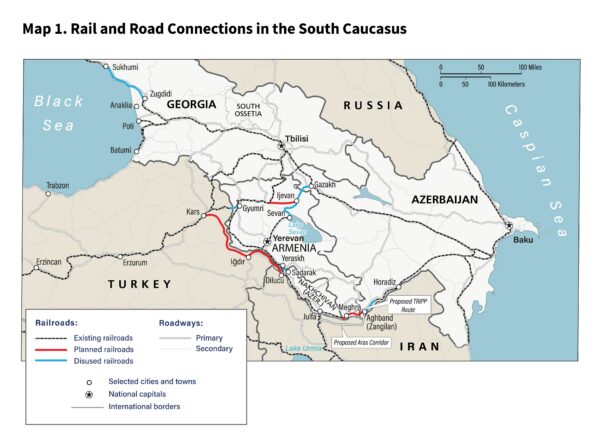
The second condition is one regularly reiterated: Azerbaijan will be able to use the southern Armenia corridor and the Trump route unhindered. The Armenian government does not offer explanations for these enigmatic statements and maintains that Armenia will retain control over the strip of land constituting the transit corridor and that it will derive economic benefits through transit fees on its territory.

While TRIPP fixes the issue of territorial control by Armenia, a major distinction is maintained by Baku. Azerbaijan argues that goods circulating exclusively between Azerbaijan’s main territory and the Nakhchivan exclave should benefit from streamlined and simplified procedures, without burdensome import or export duties, while accepting the application of standard transit or usage fees. For international transit along the corridor (for example, goods from Central Asia or China headed to Europe via Turkey), standard international transit tariffs and customs regulations would apply. Azerbaijan’s fluctuating and circumstantial discourse is therefore a source of uncertainty. In addition, nothing is said about reciprocal agreements for the transit of Armenian freight through Azerbaijan.

A major concession that goes unnoticed clarifies President Aliyev’s remarks when he asserts that Azerbaijanis will never mingle with Armenians during their transit. Article 8.2 of the Armenian-American Agreement indicates that Armenia has accepted the principle of using private operators at the border checkpoints of the strip of territory conceded to TRIPP. Even though the article stipulates that the choice of these operators will be made on the basis of mutual consent between Armenia and the TRIPP Development Company (TDC), Armenia is indeed dispossessed of effective control over its borders: a loss of sovereignty in terms of security and for the calculation of transit rights and customs fees since they will not control the source of the goods.

The third condition is the right of return of Azerbaijanis to Armenia, which some Azerbaijani leaders call “Western Azerbaijan.” President Aliyev regularly intervenes in international forums and conventions on this subject. Just what does this mean?

Delimitation and Demarcation of Borders

The delimitation and demarcation process between Armenia and Azerbaijan remains in a nascent stage. The number of kilometers delimited and demarcated to date is approximately 12.7 to 13. However, the total border between the two countries is estimated at around 1,000 kilometers.

The first concrete breakthrough was achieved in the Armenian region of Tavush and the Azerbaijani district of Gazakh. On this 12.7 km portion, more than 80 geodetic border markers were installed. This first agreement led Armenia to transfer under the sovereign control of Azerbaijan four non-enclaved border villages it had controlled since the 1990s (Baganis Ayrim, Ashagi Eskipara, Kheyrimli, and Gizilhajili). The two delimitation commissions ratified a joint regulation establishing the working methodology.

The process legally relies on the 1991 Alma-Ata Declaration, using Soviet-era maps as an administrative reference base. But obstacles are numerous for the rest of the route. Several obstacles persist: the status of Soviet enclaves on both sides, and the occupation by Azerbaijani forces of portions of sovereign Armenian territory (estimated at over 200 sq. km) seized during the 2021-2022 incursions.

It should be recalled that under the Declarative Act of State Independence, which constitutes the preamble and foundation of the 1995 Azerbaijani Constitution, Azerbaijan declared itself the direct legal successor of the Azerbaijan Republic of 1918–1920 (Article 2) and not of the Azerbaijan SSR. By rejecting the heritage of the Soviet Union (Article 3), the state does not recognize the Alma-Ata.

It seems rash to endorse a peace agreement without resolving the border issue, creating a process for the release of Armenian prisoners in Baku or the right to return of the Armenians of Nagorno-Karabakh.

Map of the region, courtesy of https://carnegieendowment.org/

Normalization of Armenian-Turkish Relations

The normalization of relations between Armenia and Turkey is seeing symbolic progress. It remains dependent on the global peace agreement between Armenia and Azerbaijan. Diplomatic dialogue, while active at first, appears to have slowed down. Holders of diplomatic, special or service passports benefit from free and simplified acquisition of electronic visas (e-visas) but not freedom to cross the land borders. Those are not open to the general public or general trade either despite the July 2022 agreement and border infrastructure work (notably at the Margara checkpoint) carried out by the Armenian government. The effective implementation of the agreement depends on the continuation of bilateral and global geopolitical discussions.

A joint protocol for the restoration of the historic Ani bridge (on the Akhourian River) was signed to physically connect the two countries at a major heritage site.

As for the Kars–Gyumri railway line, only a technical assessment of the Gyumri–Margara–Akhurik portion has been initiated. Finally, the reconstruction of the Yeraskh railway section aimed at extending the network from Turkey through Armenia to the Azerbaijani exclave of Nakhchivan is integrated into the Armenian government’s 2026-2031 program.

Official positions and statements are asymmetrical. The Armenian side advocates for normalization “without preconditions,” insists on the immediate reopening of borders and the restoration of diplomatic relations, which it insists would lead to economic gains.

On the Turkish side, they claim to want peace, but align their policy with Baku despite current disagreements between Turkish and Azerbaijani leaders. The Turkish Ministry of Foreign Affairs has explicitly recalled that complete normalization with Armenia advances in tandem with the Armenian-Azerbaijani peace process. Turkey is therefore awaiting the definitive settlement and the adoption of the new Armenian constitution to take the ultimate step of total commercial reopening.

United States Engagement

Do the framework agreement and the strategic partnership charter signed between Armenia and the United States — including agreements relating to the TRIPP corridor project or to defense cooperation — constitute a binding legal security guarantee (of the NATO or military alliance treaty type)?

The texts signed are economic in nature, not mutual military assistance treaties. There is no collective defense clause, and nothing stipulates that the United States will intervene militarily if Armenia is attacked. Only an alliance ratified in the form of a treaty by two-thirds of the US Senate could offer such an obligation. The agreements are purely operational (“executive agreements”), and therefore revocable by any successive US administration.

American engagement in the TRIPP project, if implemented, would at best constitute a deterrent with a patrimonial dominance. The creation of the TDC — majority-owned at 74% by the United States — is likely to involve direct American investments in the construction and operation of roads in the Syunik region.

Meanwhile, it should be recalled that other corridors are operational. First and foremost is the Middle Corridor (Trans-Caspian Transport Corridor). It is currently undergoing a massive expansion because it is subject to a bottleneck. It connects China and Central Asia to Turkey and Europe via the ports of Kazakhstan and Turkmenistan on the Caspian Sea, then through Azerbaijan and Georgia. It constitutes the main alternative route bypassing Russia. It benefits from significant support from “Global Gateway,” an initiative of the European Union, the European Bank for Reconstruction and Development (EBRD) and the governments of the region. TRIPP positions itself as a logical extension of the Trans-Caspian Corridor. Kazakhstan and other Central Asian countries have dispatched technical teams to study the modalities for directly integrating their rail freight into TRIPP.

The International North–South Transport Corridor is operational, but improvement work is underway. It connects Central Asia (Turkmenistan/Uzbekistan) to Iran toward Turkey/Southern Europe. It offers a land alternative that bypasses the Caspian Sea. The Northern Corridor is a Eurasian land bridge connecting China/Central Asia to the European Union (Poland/Germany) via Russia and Belarus. Historically, this is the fastest and most efficient overland rail connection. However, EU sanctions and geopolitical tensions have led Europeans to divert a significant portion of the flows of these two routes toward trans-Caspian paths.

In summary, these Armenian-American agreements will only become a deterrent the day American economic assets are engaged in the construction of TRIPP infrastructure and in the mining sector. From a legal standpoint, Armenia does not benefit from any contractual American security umbrella. From a political standpoint, the implementation of these projects heavily depends on Trump’s team of advisors and negotiators, the maintenance of the Abraham Accords, and the outcome of the wars against Iran and between Russia and Ukraine. The cessation of conflicts would imply the re-exploitation of existing corridors and could potentially weaken American interest in TRIPP.

In any case, Azerbaijan claims the position of strategic pivot in the region and in the Central Asia-Europe relationship. And it seems they are not the only claimants of it.

 Regional Cooperation and Stability

It is well known that economic and political projects in the Caucasus are directly controlled and managed by President Trump’s close team, namely his chief negotiator Steve Witkoff, the latter’s personal advisor Aryeh Lightstone, and the Russian-American investor Konstantin Sokolov. The latter was appointed chairman of the TRIPP Fund by the US State Department. This fund is endowed with $200 million. He is already the chairman of the Transcaspian Transport Corridor Fund.

Lightstone’s background deserves mention. He is an American diplomat and senior advisor within the US Office of Peace Missions and played a driving role in negotiating the TRIPP agreements. In addition to his work on regional connectivity in the South Caucasus, he acts as a senior advisor for peace issues (Board of Peace). Appointed in 2020 as Special Envoy for the Abraham Accords, he helped supervise the “Peace to Prosperity” economic initiatives, led the Abraham Fund, and piloted the first Abraham Accords Business Summit. This involvement demonstrates how much American-Israeli foreign policy influences regional agreements in the South Caucasus, through the TRIPP Agreement but also through the project of integrating several Caucasus and Central Asia states — notably Kazakhstan, Azerbaijan, and Armenia — into the Abraham Accords. The central role of this multilateral and economic integration into an expanded “Abrahamic” framework is given to Azerbaijan and involves multiple parties — Israel, the United Arab Emirates, the United States and Eurasian transit corridors.

This is where the Armenia-Iran relationship and trade route projects between the two countries are threatened. The Armenian government’s timid assurances will change nothing. Iranian authorities, despite diplomatic lip service, regularly raise the issue and still have not obtained an Armenian guarantee that the corridor will not host an American military base or other infrastructure capable of harming Iran’s security. While the TRIPP Agreement stipulates in its preamble that control of the territory strip conceded to TRIPP and the borders remain under Armenia’s sovereignty and jurisdiction, numerous articles undermine jurisdictional sovereignty over the projects implemented on this territory as well as the choice of operators for these projects. The Agreement expressly requires that the Armenian government ensure these territories are free of any encumbrances or rights belonging to third parties (Article 6.1) and bear all financial costs related to these procedures. In other words, this means families or businesses shall be expropriated at the Armenian government’s expense.

II – Jurisdictions associated with TRIPP limit sovereignty to the land property

It should be noted that the June 2026 Agreement provides for two categories of projects within the strip of land conceded. “TRIPP projects” concern transport and flow infrastructure: rail, road, oil and gas pipelines, fiber optics and electricity. But Article 6 of the Agreement also provides for “non-TRIPP projects”, which any legal entity, individual or corporate (company or State), can propose. These are “Special Purpose Vehicles” (SPVs). The SPVs will be subsidiaries of TDC for the purpose of implementing a specific TRIPP modality. This article exposes Armenia to several risks: any third-party state, directly or more likely indirectly, could develop and finance projects dangerous for Armenia’s neighbors or for environmental protection through private companies.

Even if Armenia were to oppose it, its share in the TRIPP company does not give it the ability to block the project in case of disagreement. For example, will the American partner, influenced by its regional ally Israel, allow Armenia to build the Iran-Armenia railway? In the context of the current war between the US/Israel and Iran — recalling that the Abraham Accords are managed by the very people who designed the TRIPP agreement — we can reasonably doubt it.

An example corroborates this doubt. The Board of Peace established primarily to cease the war and to reconstruct Gaza, fails to impose an end to Israeli aggressions on Gaza. The first decision of this Council does not concern the reconstruction of Gaza — housing, hospitals, schools, water or electricity networks — but rather focuses on the construction of a military base intended to host 150 Moroccan soldiers of the international force.

The legal and institutional design of the TRIPP Framework Agreement fundamentally transforms the landscape of Armenia’s sovereign governance. Although presented as a transit corridor promoting peace, its functional architecture introduces deep structural asymmetries from a jurisdictional and economic standpoint. Let us look more closely at several aspects of this agreement.

Legal concessions

The Framework Agreement is dependent on two other contractual documents that are not yet public: the Shareholders’ Agreement (the shareholders of the TRIPP Development Company—TDC—are TDC US and the Armenian State) and the TDC Charter.

The Shareholders’ Agreement is a private American commercial contract governed by US law, specifically that of the State of New York. Its purpose is to govern certain rights and obligations of TDC’s shareholders, as well as matters relating to the management of TDC. TDC grants a 74% majority stake to an American entity (TDC-US) registered as a subsidiary of the United States International Development Finance Corporation (DFC), an American federal agency headquartered in Delaware, a US tax haven.

Only the TDC Charter will be governed by Armenian law. This Charter will notably manage rights relating to the TRIPP Implementation Area, meaning the strip of territory conceded to the TDC company for 49 years, namely exclusive rights of development, land use and exploitation. This concession could be extended up to 99 years. As a reminder, the Armenian State holds only 26% of the shares in this company.

Despite all the rhetorical assurances of the Armenian government, there is a loss of control over legal sovereignty. Article 5(3) stipulates that the Framework Agreement prevails over Armenian domestic law in the event of a conflict. This primacy assumes that the Framework Agreement is elevated to the rank of an international treaty ratified by both Armenia and the US Congress for it to be constitutional. Private law disputes relating to companies involved in the project are submitted to the law of the State of New York.

The Armenian National Assembly ratified the TRIPP framework agreement. Furthermore, the Armenian government convened an extraordinary parliamentary session to adopt the necessary amendments to the Law on Joint-Stock Companies, the Civil Code, and regulations relating to public-private partnerships, specifically to allow the formal registration and legal establishment of the entity (Article 3.6 of the Framework Agreement). These legislative amendments bypass existing Armenian legislation and grant privileges to investors and companies involved in TRIPP projects. The modifications will be included in the Shareholders’ Agreement and the TDC Charter.

The United States Congress has not ratified the agreement. Furthermore, the TDC joint-stock company itself is still in the process of being created and is not operational.

Economic and Financial Concessions

Economic and financial concessions are numerous, and their sum raises questions regarding benefits for Armenia.

Armenia agrees (Article 4.3 of the Framework Agreement) that TDC is authorized to select third parties to assist in each TRIPP project implemented by the ad hoc companies (SPVs), including third parties acting as concessionaires, developers, operators, contractors or EPC (engineering, procurement, and construction) providers for such a TRIPP project.

TRIPP offers very few tax resources, so extensive is the list of exemptions.


Article 9 includes the following concessions:

  • TDC US (i.e., 74% of TDC’s revenues) will be exempt from all taxes. (9.1)


  • Dividends paid to TDC by subcontractors (SPVs) will also be non-taxable. (9.2)


  • Capital gains and transfers of shares of TDC and its subsidiaries (SPVs) will be exempt from any taxation. (9.3)


  • Finally, TDC and its subsidiaries will pay no tax on the transfer or assignment of conceded rights, whether from the Armenian government to TDC or from TDC to its subsidiaries. (9.4)


Off-budget financial vehicles — such as the $402 million “TRIPP+ Trans-Caspian Enterprise Fund” backed by the United States — completely bypass state accounts to target investments in private enterprises in the region.

TRIPP functions more like an “offshore” concession zone than a source of tax revenue. This absence of fiscal and financial benefits reveals not only a loss of economic sovereignty, but calls into question Armenia’s interest in this project.

In conclusion, we observe a totally asymmetrical agreement with a loss of jurisdictional and fiscal sovereignty over the activities and investments that will be operated in the conceded territory strip. Azerbaijan considers that freight transiting between Azerbaijan and Nakhchivan must not be subject to the same transit fees as freight originating from other entities. However, control at the checkpoints will be subcontracted to a private operator.

This unbalanced agreement adds to the threats of commercial sanctions from both the Russia/EEU bloc (due to the rapprochement with the European Union) and the United States (due to trade with Iran) despite the desire to diversify export markets; and to an already high public debt for a country exposed to structural imbalances economically and socially. These Armenian-American agreements — whose durability is unknown and whose legal design and the men who conceived them threaten to transform the TRIPP El Dorado into long-term systemic dependency and a manifest loss of sovereignty that goes unmentioned. It may be difficult to erase the Agreement if it becomes an international treaty.

(Philippe Raffi Kalfayan, based in Paris, is a lawyer, lecturer in international law and a former secretary general of FIDH (International Federation of Human Rights), who has earned a Ph.D. in international law. He is a regular columnist for the Armenian Mirror-Spectator.)


Get the Mirror-Spectator Weekly in your inbox: