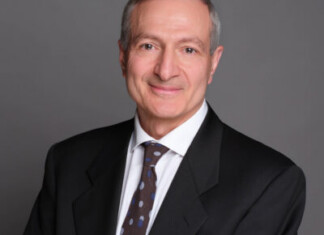


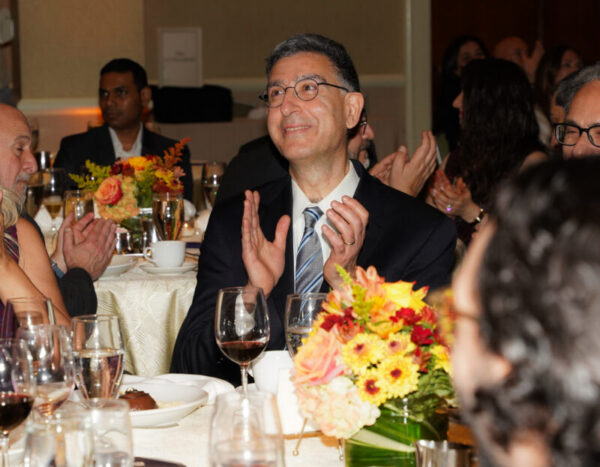
Honoree Dr. Vatche Minassian (photo Julie Manoogian, courtesy AAMA)

Boston’s Armenian American Medical Association Holds 55th Anniversary Gala

15
0

Dr. Ari Damla served as the master of ceremonies. Damla, who resides in Watertown, is an assistant professor of Musculoskeletal Radiology and the Radiology Residency Program Director at Boston Medical Center and the Boston University Chobanian & Avedisian School of Medicine.

Damla pointed out that the AAMA is one of three major Armenian medical associations in the United States, but, he said, “It’s more than just a regional committee. It’s more than just a national committee as well and really has global outreach. It’s truly a driving force in the community. Our local education includes outreach to vital medicine care and international projects.” Indicating the importance of the gala, Damla reflected, “The work driven by the people in this room truly does change lives.”

Keynote Speaker Dr. Hagop Youssoufian

Alexa Diranian Ekchian is the first physician assistant serving as AAMA president. She spoke briefly about the work of the organization before introducing the keynote speaker, Dr. Hagop Youssoufian, a physician-scientist who has more than 25 years of experience in drug development. He’s a consultant for biotechnology and pharmaceutical companies focused on cancer therapeutics, and an adjunct professor of medicine at Brown University. He received his medical degree from the University of Massachusetts Medical School and completed his training at the Cleveland Clinic, Johns Hopkins and Massachusetts General Hospital.
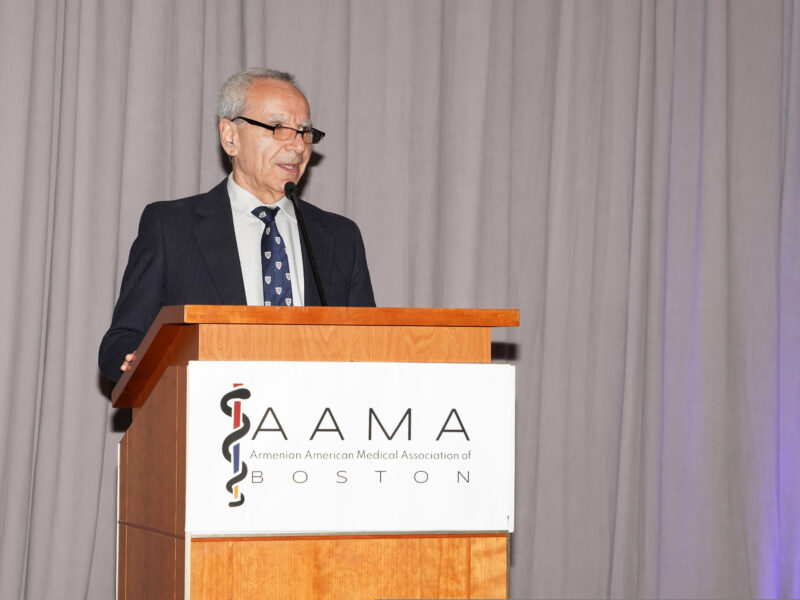
Keynote speaker Dr. Hagop Youssoufian (photo Julie Manoogian, courtesy AAMA)

Youssoufian spoke about his personal professional journey, accompanying his talk with slides. He grew up in Aleppo, Syria, and went to the AGBU Lazar Najarian-Calouste Gulbenkian School. His parents were part of the Armenian healthcare ecosystem, with his father a pharmacist and his mother a nurse. He recalled: “People came to our house to get their blood pressures checked and vaccinated.”

In 1971, they immigrated to the US, and the influence of his cousin Dr. Nishan Goudsouzian, a prominent Harvard anesthesiologist, had its effect on him, along with several other mentors. After graduating Watertown High School and then Boston College, he went on to medical school at the University of Massachusetts and started to do research. He lost his parents at a fairly young age while he was at the Cleveland Clinic.
Get the Mirror in your inbox:

After his fellowships, Youssoufian was a visiting scientist at the Whitehead Institute at MIT, where he did research, and then became an assistant professor of medicine at Brigham and Women’s Hospital and then Section Chief of Medical Genetics at the Baylor College of Medicine till 2001.

After a tropical storm devastated his lab, he switched fields to become a pharmaceutical physician and succeeded in getting a number of drugs approved against cancer. His first job was head of experimental medicine at Bristol-Meyers Squibb. He went on to work at various other well-known pharmaceutical and biotech companies, including Sanofi Aventis as a distinguished scientist, ImClone as Chief Medical Officer (CMO), Zipharm Oncology as president of research and development (R&D) and CMO, Progenics as executive vice president of R&D, and BIND Therapeutics as CMO.

Youssoufian gave several examples about trials of colon and ovarian cancer drugs, which block the effects of mutations in the KRAS gene.

Finally, Youssoufian suggested, among other things, that Armenia could be a valuable participant in the field of late stage clinical trials because patients there are usually not as heavily pretreated as in Western countries, which is attractive to drug developers, and they have a closer relationship with their doctors, unlike in places like India.

Honoree Dr. Vatche Minassian

Dr. Sam Badalian introduced the evening’s honoree, Dr. Vatche Minassian. Badalian is Chief of the Department of Women’s Health at the Bassett Healthcare Network in New York and a clinical professor of obstetrics and gynecology at Columbia University’s Vagelos College of Physicians and Surgeons. Born in Armenia, he graduated Yerevan State Medical University and then obtained a PhD and a Doctor of Medical Science degree in physiology, before completing a postdoctoral fellowship in obstetrics and gynecology at Columbia University. He chairs the Membership Committee of the International Urogynecological Association.

Badalian said his over 20 years of friendship with Minassian began in 2005 at a meeting of the American Urogynecologic Society, when he asked the latter a simple question: do you speak Armenian? They became such good friends that at the American Urogynecologic Society they started calling them “the Armenian gang.”

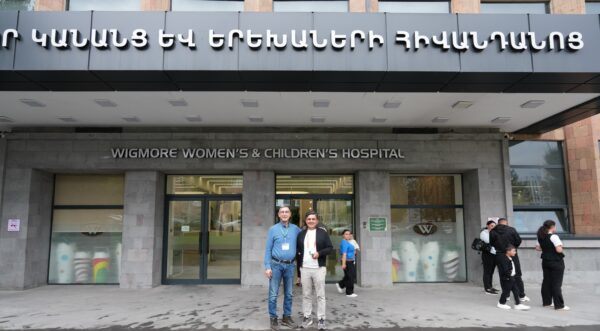
Badalian explained how together they ended up creating a fellowship program to introduce the subspeciality of urogynecology to Armenia (see an accompanying article on this program here).

He said, “When I look back, I realize that this achievement has never been about fellowship or about published paper or research findings. It was about the women who deserve better care, about the young physicians who deserve to learn more, and about the country who deserve to receive appropriate care for their people. Vatche’s dedication, generosity, and honour and commitment have been invaluable for this mission. He has given not only his expertise, but his time, his knowledge, and his heart to Armenia.”

Badalian declared: “I never could imagine that this friendship could continue so long and you and I would be able to work together and benefit generations of women and physicians in Armenia.”

Minassian completed his medical degree at the American University of Beirut Medical Center in Lebanon in 1994, where he also did his internship. He moved to the US in 1995, where he completed his residency in obstetrics and gynecology at UCLA and the University of Iowa (1999). He practiced three years as a generalist at Texas Tech University before completing his fellowship training at Mt. Sinai Hospital at the University of Toronto in Female Pelvic Medicine and Reconstructive Surgery in 2004.

He then moved to the Geisinger Medical Center in Pennsylvania to work as a urogynecologist till 2011, until he was appointed chief of Urogynecology at Brigham and Women’s Hospital, where he served through September 2025. He is an associate professor of OB/GYN at Harvard Medical School and the author of more than 85 publications, editorials and book chapters. He is at present in an executive MBA program in Brandeis University.

Minassian, a past president of the AAMA of Boston, has worked to help healthcare in Armenia and the diaspora.

In his talk, Minassian first acknowledged by name many family members and friends who had come to the banquet. Using slides, he started by posing the question of whether AAMA wanted to be known as a Swiss watchmaker or a passionate gardener. He said that as AAMA grew, it changed from a group of male doctors to incorporate an equal number of women, and to expand by adding physicians’ assistants and nurses as members. It helped Armenia through three wars and one earthquake and supported 17 hospitals, clinics and medical institutions there.

He said that for its first 50 years the AAMA was like Patek Philippe: unique, exceptional and exquisite, valuing tradition and heritage but modest and understated. When he took on the reins in 2019, this was the situation, but suddenly everything changed with the 2020 war in Armenia and Artsakh and the Covid-19 pandemic.

During the first six weeks of the war, he said, AAMA was able to collect over hundreds of thousands of dollars in donations and medical equipment and supplies. Minassian gave the example of a hyperbaric oxygen chamber which was installed at Mikayelian Hospital in Yerevan. It was so big that a wall had to be demolished and a separate entry made to get it inside the hospital.

The number of board members was increased and a full-time volunteer manager served as its representative in Armenia. Daily meetings were held with her and weekly meetings with the Armenian Ministry of Health. A robust social media campaign was established by AAMA, Minassian said. Blood drives were held in Boston. They became experts in shipping to Armenia.

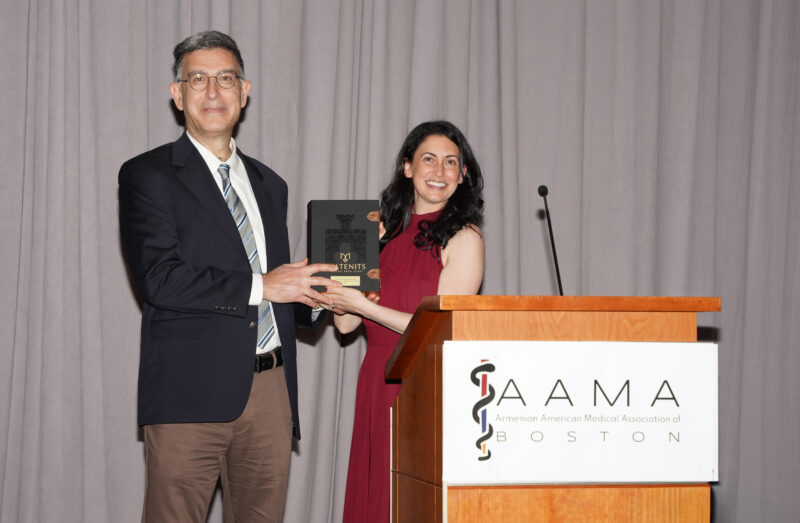
Dr. Vatche Minassian gets a gift of royal elixir from AAMA President Alexa Diranian Ekchian (photo Julie Manoogian, courtesy AAMA)

Minassian related the story of the creation of the urogynecology fellowship in Armenia, started by Badalian. Despite all the twists and turns, the two of them (with a number of other professionals outside of Armenia), were able to create the program, even with the obstacles created by the Covid pandemic.

Minassian recalled that he was asked by a wise man, who was present in the audience that night, how can we ensure that young Armenian doctors in the diaspora work and coalesce together to preserve our heritage and carry the torch forward. He concluded that for the future, perhaps AAMA wants to be like the passionate gardener and create a path for the young generation that emphasizes a foundation in nursing, medicine and allied health fields, not just through scholarships and humanitarian work, but by enabling them to get the skills that they need to succeed in their lives. His proposal was to do this through creating a leadership program for postgraduate residents and fellows.

Videos from the first graduates of the urogynecology program in Armenia were then screened, praising Minassian’s kindness, generosity and dedication, as well as a surprise video from his parents expressing their pride in his achievements.

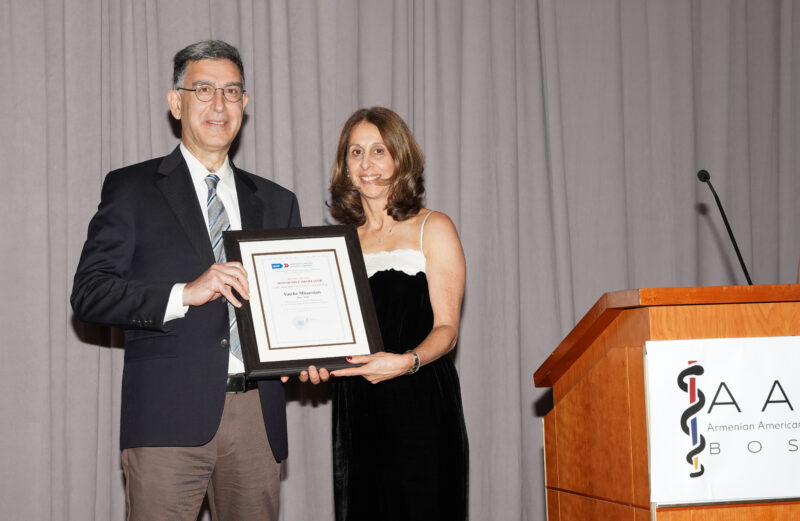
Dr. Vatche Minassian receives certificate of honorary professorship from Dr. Gail Guzelian (photo Julie Manoogian, courtesy AAMA)

Ekchian presented Minassian with gifts, including a royal elixir which was a special collaboration between the Matenadaran (the Mesrop Mashtots Institute of Ancient Manuscripts) and the Armenian Tree Project, and a painting inspired by ancient Armenian manuscripts. Dr. Gail Guzelian then presented Minassian with a certificate from Dr. Alexander Bazarchyan, dean of the National Institute of Health in Yerevan, which made him an honorary professor of the Department of Obstetrics and Gynecology there.

Closing Talk

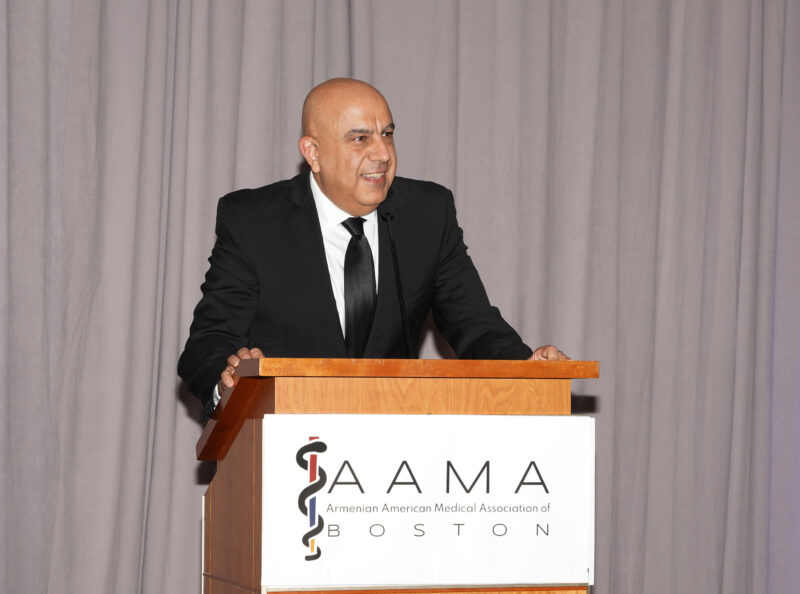
Dr. Shant Parseghian, AAMA treasurer and Gala Chair, gave the closing talk. He reported that AAMA was able to allocate $780,853 over the last five years for health care, including for education, training, increasing health care access in Armenia and donating to refugees from Artsakh. Through partnership with various organizations, AAMA donated close to $280,000 to Artsakh. More than $80,000 was spent on education and scholarships, of which $55,000 went to the New England area or to youth from New England. Through a partnership with the Afeyan Family Foundation, more than $400,000 was donated to help 10 projects, including pediatric, urologic, hypertension management, and geriatric care. The most recent project to be supported will be OHFAR (Oral Health Foundation for Children of Armenia), which will get $75,000 to help buy a second bus.

Dr. Shant Parseghian gives the closing remarks (photo Julie Manoogian, courtesy AAMA)

He thanked many people for their help, and pointed out Al Campbell in particular, the prior Winchester Hospital president who flew from Washington to be present at the gala. Campbell twice welcomed nurses from Armenia for a special training and partnership environment.

Parseghian said, “I promise that every dollar you give us will have a different meaning and will change the life of an Armenian person in Armenia.” In particular, he said that whatever funds would be raised that night would go to AAMA scholarships.

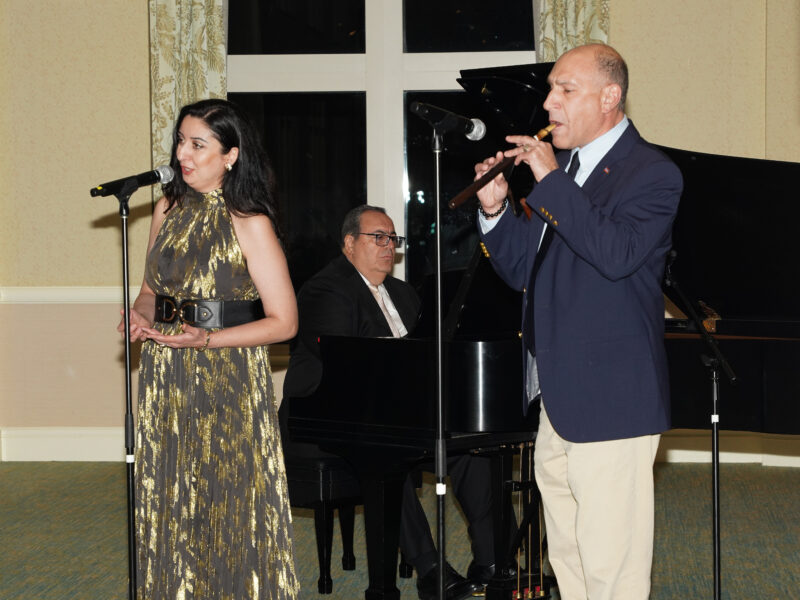
From left, musicians Knarik Nerkararyan, Levon Hovsepian, and Martin Haroutunian (photo Julie Manoogian, courtesy AAMA)

The evening included musical performances by pianist Levon Hovsepian, soprano Knarik Nerkararyan and duduk performer Martin Haroutunian.

Get the Mirror-Spectator Weekly in your inbox: