

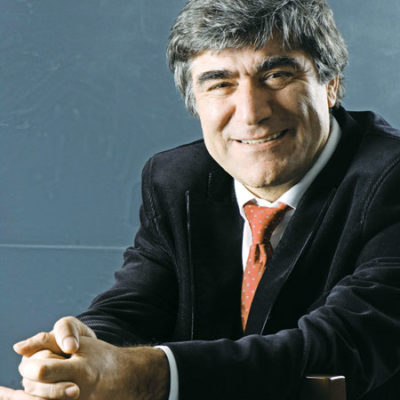
LOS ANGELES — In January 2007, the assassination of Hrant Dink in Istanbul set in motion profound social and political responses in Turkey and beyond. To mark the twentieth anniversary of his assassination, the UCLA Promise Armenian Institute’s Armenian Genocide Research Program (AGRP) will host Hrant Dink’s Legacies: Conversations on the 20th Anniversary of His Assassination, a public program exploring Dink’s life and ideas, the impact of his assassination, and the different ways his legacy has evolved over the past two decades.
The event will take place on Saturday, January 30, 2027, from 11 a.m. to 4 p.m. at the Ararat-Eskijian Museum, 15105 Mission Hills Rd., Mission Hills, CA 91345.
The program will bring together scholars, journalists and activists for a day of reflection and conversation on Dink’s life, his assassination, and the different ways his legacy has evolved in Turkey, Armenia, the Armenian diaspora, and in Armenian-Turkish relations.
“For Hrant, Armenians and Turks were two close peoples who had become distant neighbors. He believed that overcoming this divide required civil rights for all in Turkey, justice for historical injustices, and genuine conversation and engagement between the two peoples. It was this vision that made Hrant a Martin Luther King Jr. for the region,” said Dr. Taner Akçam, director of the AGRP.
Dink, founder and editor-in-chief of the bilingual Turkish-Armenian newspaper Agos, and co-founder of the publishing house Aras, was assassinated in Istanbul in January 2007. His deepest aspiration was to bring Turkey and Armenia, as well as Turks and Armenians (including Diaspora) together across historical divides. A passionate advocate for civil rights and historical justice, he fought racism and discrimination in Turkey and envisioned a society where Armenians and other minorities could live as equal citizens.
Twenty years after his assassination, the program will revisit Dink’s ideas not as a single, fixed legacy, but through the different ways his life, work, and vision have been remembered and interpreted. It will explore their continuing relevance to questions of democracy, civil rights, historical justice, memory, and Armenian-Turkish relations.