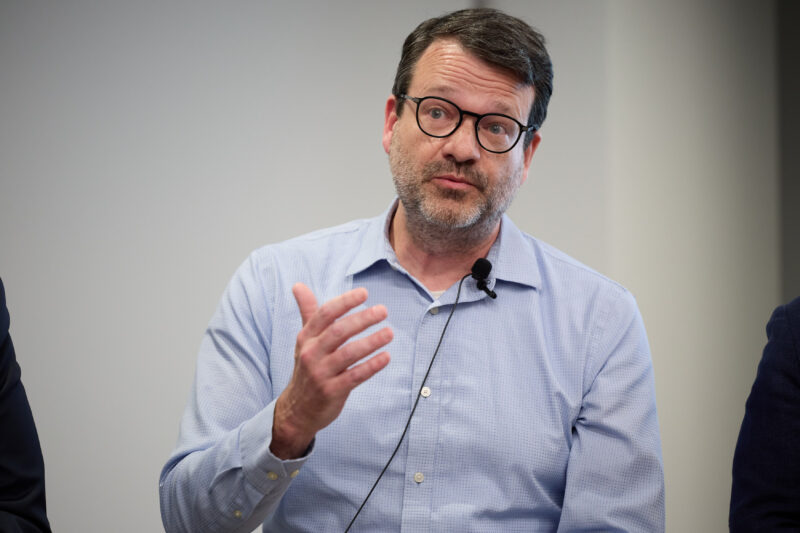


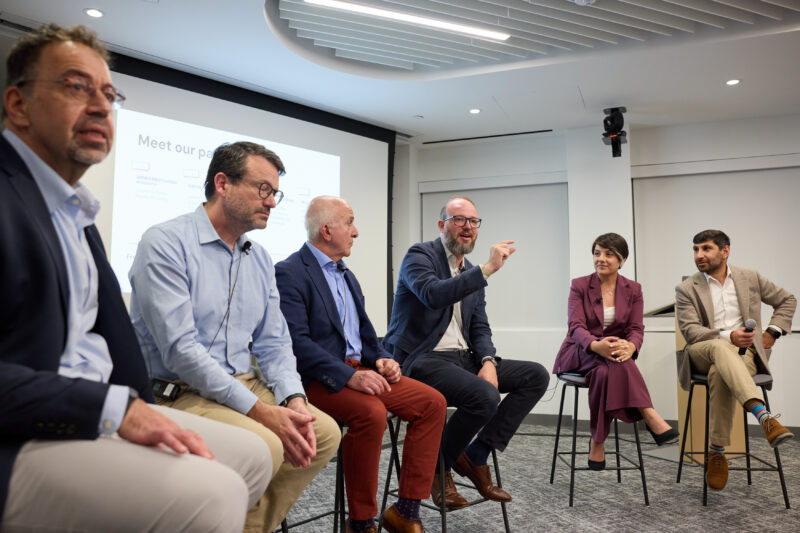
Panelists, from left, Daron Acemoglu, Chris Glass, Harry Glorikian, Nicolò Fusi, Suzanna Shamakhyan, Armen Mkrtchyan (photo courtesy FAST)

FAST Panel Explores AI and Armenia’s Future

100
0

CAMBRIDGE, Mass. — The dangers and promises of artificial intelligence (AI) have been constantly in the news recently. These are issues that concern all mankind, so naturally Armenia cannot but be part of this rapidly evolving story. Consequently, a panel organized by the Foundation for Armenian Science and Technology (FAST) and the Armenian Biotech Group, in partnership with Flagship Pioneering, Armenian American Medical Association (AAMA) and Armenian General Benevolent Union (AGBU) New England on September 10 at Flagship Pioneering’s offices in Cambridge was quite timely. While it was titled “From Classrooms to Innovation: Building Armenia’s AI Future,” the panelists touched upon many universal issues.

The speakers, prominent voices from academia, technology and innovation, were Daron Acemoglu, Chris R. Glass, Harry Glorikian and Nicolò Fusi, with Dr. Armen Mkrtchyan and Suzanna Shamakhyan serving as moderators.

Panelists, from left, Armen Mkrtchyan, Chris Glass, Daron Acemoglu, Nicolò Fusi, Harry Glorikian, Suzanna Shamakhyan (photo courtesy FAST)

Mkrtchyan is an origination partner at Flagship Pioneering, leading teams inventing, launching and building AI-native companies, while Shamakhyan, based in Yerevan, is the executive director of FAST.
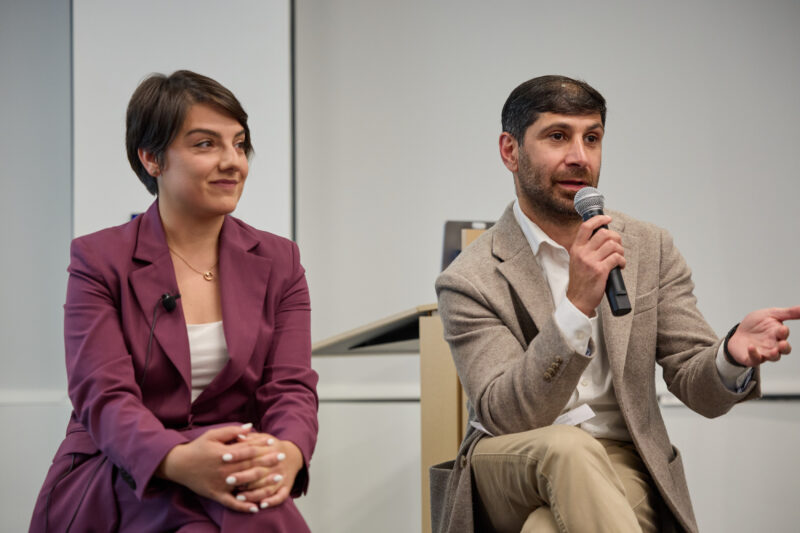
Suzanna Shamakhyan and Armen Mkrtchyan (photo courtesy FAST)

The Nobel Prize-winning Acemoglu, an Armenian born in Turkey, is the Elizabeth and James Killian Professor of Economics at the Massachusetts Institute of Technology (MIT) and the author of seven books, one of which has been translated into Armenian. Glass is Professor of the Practice at Boston College, where he directs the Executive Doctor of Education in Higher Education Program. Glorikian, the author of four books on technology strategy and the future of business (the newest one, The Invisible Interface, came out on June 30), is a general partner at Scientia Ventures and a research affiliate at the MIT Media Lab. Fusi is vice president and Distinguished Scientist at Microsoft Research, where he leads the AI research teams on the East Coast.

FAST

Armen Mkrtchyan at the start of the evening presented the example of Tigran Ishkhanyan, a FAST fellow around eight years ago, to show how the ecosystem of FAST works. Tigran grew up in Armenia, went to France to study computational sciences. He then returned to Armenia, but instead of settling in Yerevan, he moved to Vanadzor in the north. He works for Wolfram, a company which had created the software system Mathematica. He also teaches high school students AI in Armenia. He has been teaching the Armenian AI Olympiad high school team, which placed fifth this year out of 131 national teams globally. Mkrtchyan said that this encapsulates the ethos of what FAST does and is one indication of its impact.


Yelena Bisharyan (photo courtesy FAST)

Get the Mirror in your inbox:

Dr. Yelena Bisharyan, co-founder and CEO of Trillion Bio and of the Armenian Biotech Group, which was one of the cosponsors of the panel discussion, remarked that this evening was one of the rare occasions when four different Armenian organizations came together, along with Flagship Pioneering. She thanked the organizations, asked for support for FAST’s work to build the next generation of leaders in AI in Armenia, and invited Shamakhyan to elaborate.

Shamakhyan observed that FAST’s mission has been to help Armenia transform into an innovation and AI hub through entrepreneurial philanthropic organization. FAST imagines the type of future desired and tries to reverse engineer it and identify high-impact opportunities, she noted. It designs new models, tests them and if they work, spins them off or scale them, whether through partners, self-sustainability, or the government.

FAST began focusing on AI since 2017 based on Armenia’s strong mathematical education legacy and a growing AI infrastructure. The global Armenian tech network helped Armenia create a thriving tech ecosystem, Shamakhyan said, and FAST decided a long time ago to focus on talent in this context. It developed the Generation AI program, creating a network of public schools with the government in all regions of Armenia, where every child who is interested in advanced mathematics and AI will have access to a high-end program. This has been operational for three years now but last year it was expanded to all medium and large cities in Armenia. About 1,500 students are engaged in the program.

The next task is to try to provide a competitive university education in Armenia so they afterwards could become AI innovators. Part of this, she said, was engaging with industry partnerships and providing research opportunities. The Armenian government is co-funding some of this process because it has recently announced that AI research is one of its top priorities.

Shamakhyan expressed the hope that many in the audience would become a partner with FAST in this process.

Panel Discussion: On Compute

Mkrtchyan’s first question went to Glorikian about the impact the Firebird AI data center in Armenia might have on the country. Would it concentrate money, power and influence in the hands of a few people? How would these things percolate down to the rest of the populace?

Harry Glorikian (photo courtesy FAST)

Glorikian replied that he does not know what deal the Armenian government made with the data center, but it was a for-profit enterprise, and it is estimated each megawatt would go for $40 or $50 million so it can be incredibly profitable if sold to the highest bidder — and there is an immediate global demand for it.

Mkrtchyan interjected that as far as he knew, a percentage of the compute (processing power or capacity) would go to the government and the country, and part of it will go to FAST as well. He then asked Acemoglu if there were any positive externalities that might come out of it.

Daron Acemoglu (photo courtesy FAST)

Acemoglu said that while there is a lot of uncertainty about the current direction in general, the one thing that is for sure is that the demand for compute is still very high, especially outside of the US and China. The question is, he said, where are you going to be in what is sometimes called the AI stack (the hardware, software, data and tools necessary to run AI systems, ranging from foundational hardware to the user interface). Some countries in the future will just provide compute power to the rest, while others will build models or applications on top of that.

He noted that some think the mid-layer of the AI stack, where foundation models are, is where profits will be found, while others argue that it is at the highest level of the stack. In any case, he said the next step is to make sure that the investment in compute is turned into a more holistic AI infrastructure. For this, human capital, organizations and a holistic AI strategy for the country are necessary. Right now, because of the great demand, functioning data centers will make money, but in ten years’ time, he said, the picture will be different.

Cultivating Good Judgment or Taste

Mkrtchyan asked Glass how one could teach good judgment or critical thinking when students will have access not just to on-demand information but intelligence itself.

Chris Glass (photo courtesy FAST)

Glass said that this problem is basically the question of how people should interact with systems more intelligent than humans. The answer is rather counterintuitive. He explained that cognition is a series of epistemic [knowledge-connected] communities which form judgment socially, in the sense of a different word that can be used as a synonym for judgment – taste.

Intelligent systems or super-intelligent systems are going to allow people to create an infinite number of outputs but humanity has to resolve which of them are worth creating. Universities must think about developing human agency, not just for cognition but to make sure humans feel they have the capacity to shape their own future. Human metacognition — the ability, he said, to think about thinking and know what and why we are thinking — must be cultivated. Thirdly, people have to have a sense of aesthetics or taste to determine what is worth creating.

Mkrtchyan followed up by asking how scientific taste can be created when science itself is autonomous in that. Glass said that a person who has been trained in a discipline has a sense of what is a beautiful form, whether of an equation or a type of architecture. In other words, Glass said, it takes disciplinary knowledge in an epistemic community to be able to know what is important. While artificial intelligence can be instrumental, human intelligence has a sense of judgment of what is worth creating with that instrument.

Nicolò Fusi, right, with Harry Glorikian (photo courtesy FAST)

Fusi cited an analogy made by mathematician Terence Tao of a hike to a waterfall with the process of scientific discovery. In science, the waterfall is the discovery, but on the way, you can meander and look at various other things. AI basically takes a helicopter to the waterfall so the experiences learned from the trip are lost. Moreover, judgment is still necessary about which waterfall is worth visiting.

AI and Education

Shamakhyan declared this is where questions for educators come in, like whether it is still necessary to teach handwriting or mathematics if AI can use all those things. But, she said, society actually needs that, and she asked the panelists how much hard knowledge to teach still, or whether the focus should be more on people using AI for ideation, the shaping of taste or challenging ideas.

Glorikian said that humans don’t do well without friction. They don’t learn much if they don’t fall off a bike. If a machine suggests an experiment, he asked, how do you know you should run it if you have not played with it yourself. Therefore, he said, all major skills still must be taught, though that doesn’t mean AI can’t play a role. Education has to change fast, he said, because of how quickly technology is moving.

Glass concurred that social communities need to learn discipline and habits of mind, which can’t be learned in an instant. Human cognition always exists within a context, he stressed. He referenced Howard Gardner’s 2006 book, Five Minds for the Future, in which he said one can’t think out of the box if there is no box. Disciplines provide that box so that one can have original thinking by breaking out of that box.

AI is a tool of perception, Glass said. Just like the microscope in a way invented new fields, this is a tool that gives us a new way to explore knowledge landscapes and reality. It helps change paradigms to reality, he added.

Acemoglu focused more on the importance of the human element, saying that the first imperative in changing educational systems is to save them from AI. Learning comes from exerting oneself and if institutions stop teaching hard sciences and math, he added. If AI progresses to artificial super intelligence (ASI), that should mean that it would also have creativity and judgment and be so much better than humans that there would be no need left for the latter.

Noubar Afeyan, left, with Daron Acemoglu after the presentations (photo courtesy FAST)

The alternative, he said, is that perhaps this horizon is nowhere in the near future, and the AI models can’t do everything. Instead you will need humans to work with AI models, and if so, humans need a lot of capabilities to navigate those models as well as hard and tacit knowledge that is so important for the creative process.

AI models at present lack the understanding of mechanisms, Acemoglu said, which are key for human understanding and are the process by which the generalizable part of knowledge is created.

Fusi disagreed, saying that there is mechanistic understanding from AI that you would expect from a scientist who is an expert in a particular discipline. However, these systems shoot out what he called spikes of competence, so that in between these spikes there is also what he called “not brilliance.”

AI and Armenia

Shamakhyan redirected the conversation back to Armenia and a national strategy to make a small country be more competitive in this sphere.

Glass declared that he thought Armenia is very well positioned. He said that there is a multipolar world in terms of the fragmentation of geopolitics around the world, but it is also a technopolar world where nonstate actors like large technological companies have influence over geopolitics like a small state. Armenia, he said, should leverage what already exists, such as its strong global diaspora, its ability to have compute and infrastructure and its ability to attract talent.

Glass predicted that nations with the culture in which scientists can use the best tools to advance knowledge will attract talent, so that the compute strategy is the culture strategy. People are part of the scientific infrastructure.

He also declared that given the geopolitical situation, all kinds of mid-level powers will have to negotiate if there is pressure to align with the models or philosophies offered by China or the US.

Shamakhyan wondered whether there were enough people in Armenia ready to leverage the compute that the Armenian government has purchased to be given to local startups. She said people are exploring how to enable the local scientists and students to be ready to take advantage of this.

Mkrtchyan asked Glass what ChatGPT or similar tools do to cultural sovereignty or independence when every young kid has access to ChatGPT and they perceive and interact with the world in this way.

Glass replied that that artificial intelligence aggregates whatever corpus these models have been trained on, and this risks creating a type of monoculture. As the Pope Leo XIV’s encyclical noted, humanity needs to think about cultural preservation too. Glass said that countries should think about training or post-training their own models.

Glorikian agreed, stating that if everybody uses ChatGPT around the world, in one or two generations they will be like everybody here, because it influences the way people think, especially for children. That is why the US and China want their own models everywhere. He said that this situation will be problematic unless countries throughout the world have models contextualized to their culture.

An audience member questioned how teaching AI might make the life of average Armenians better and not just lead to further emigration, or brain drain. Shamakhyan replied that technical knowledge alone is not enough. FAST is teaching 15-year-old children a lot of skills but also agency.

She said that though excellence and hard work are extremely important, “the biggest change is going to come because these kids believe they can apply that knowledge for Armenia and be globally relevant, and not sacrifice their careers, lives, etc. …That is the type of vision we are trying to build.”

Get the Mirror-Spectator Weekly in your inbox: