

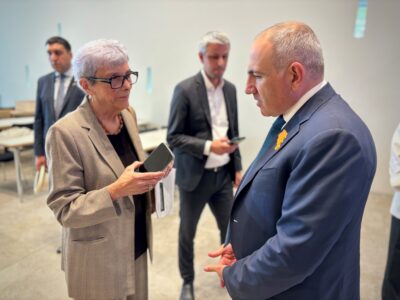
Muriel Mirak-Weissbach with Prime Minister Nikol Pashinyan in Hesse (Photo credit: Hessischer Landtag, Benjamin Holler)

WIESBADEN, Germany — On September 18, the State Parliament of the state of Hesse welcomed members of the German federal government, diplomats, and regional political figures for the official presentation of the Hessian Peace Prize for 2026 to Armenian Prime Minister Nikol Pashinyan. The prize, established by the Albert Osswald Foundation, was given to Pashinyan in recognition of his “outstanding service” in the peace process between Armenia and Azerbaijan.

State Parliament President Astrid Wallmann has said the “recent progress” in this process “belongs to the most significant political developments in the southern Caucasus.”

As State Minister Ingmar Jung said, “Peace is not to be taken for granted.” Pashinyan, he went on, knew this personally; his endurance and ability to make “difficult decisions” in the face of domestic opposition, deserved great respect.

What Price for Peace?

As State Parliament vice-president Dr. Daniela Sommer (representing Wallmann, who was unable to attend for health reasons) concluded, Pashinyan’s departure from the path of a “decades-long, enduring, structurally violence-marked conflict is not easy.” Pashinyan “assumed responsibility and opened a path of dialogue and diplomacy,” she added.

The presentation of the official award was made by Chairman of the Hessian Peace Prize of the Albert Osswald Foundation, Karl Starzacher and Michaela Jäckel-Osswald. The prize carries a monetary award of 25,000 euros.
Get the Mirror in your inbox:

The theme of responsibility and courage ran like a leitmotif in all the speakers addressing the festive event. In her comments, titled “His Path is Distinguished by Political Courage,” Parliamentarian and State Minister in the Foreign Ministry Serap Güler (CDU) stressed Pashinyan’s willingness to take risks, as a student, as opposition leader and as leader of the 2018 peaceful revolution, to “go against the wind,” and to abandon “mistrust and violence that characterized the region,” to give peace a chance. In the November 2020 armistice, he chose peace; after the 2023 expulsions of Armenians from their homeland Artsakh (Nagorno Karabakh), she said, “old wounds were reopened,” and, addressing him, said, “You assumed responsibility” and “recognized Azerbaijan’s sovereignty over Karabakh” even against “tough domestic opposition.”

And similar praise came from Hessian State Minister Ingmar Jung: “The path to peace is not an easy path. It demands courage, endurance, and the readiness to make even difficult decisions.” Bringing up a thorny point, he added, “This is the case particularly when these decisions come up against opposition in one’s own country.” In sum: “Political responsibility is demonstrated precisely in those moments when the necessary is not at the same time the most comfortable or easy,” he concluded.

In his acceptance speech, Pashinyan emphasized the advantages of the peace process. Since it began in 2024, there had been no casualties on the border, which was unprecedented, he said. In addition, the Armenia-Azerbaijan interstate document regulating the border demarcation, based on the 1991 Alma-Ata declaration; the opening of transportation links and trade routes, to be enhanced by the planned TRIPP project, all were positive developments. He expressed his thanks to President Donald Trump whose “leadership was decisive,” and to Azerbaijan President Ilham Aliyev, “who is equally deserving of this award,” as well as the peoples of both nations, who, despite their suffering, had accepted the peace.

He said one could not change the past but could alter the future. Pashinyan concluded his acceptance speech with warm words of gratitude to the State of Hesse, whose government and people had come to the aid of Armenia following the 1988 earthquake, building a kindergarten and hospital, to the Federal Republic of Germany, and the European Union for their support.

Questionable Reasoning

In the course of the dignified ceremony, graced with musical offerings from Khachaturian and Mendelssohn-Bartholdy provided by violinist Severin Marks and pianist Julian Hofmann, oblique references were made to opposition to the terms of the peace process.

In Güler’s address, she developed a point based on flawed reasoning, that may provide insight into the broader question. Following her praise for Pashinyan’s courage in accepting Azerbaijan sovereignty over Karabakh, she drew a distinction between historic Armenia and the Republic of Armenia, adding that it is culture and strong institutions, not the territorial dimensions that count.

“We Germans,” she said, “know how difficult it is to accept territorial losses.” In two World Wars millions of Germans had lost their homelands; yet, reconciliation, not revanchism, prevailed.

Not a few eyebrows were raised in the room. How can the Republic of Armenia today be compared to Imperial Germany, which was allied in the First World War with the Ottoman Empire, whose wartime regime committed genocide against the Armenians and other Christian minorities? Or to Nazi Germany in World War II, which was responsible for the Shoah, the death of 6 million European Jews, and the devastation of Europe? How can one compare the Karabakh conflict, with its long and complex history, to Germany’s imperial conquests and military occupations of nations? Did Armenia do anything comparable?

For a Just Peace

Pashinyan did not give a press conference after the program, but he did agree to meet briefly with some journalists and media, as arranged by State Parliament Press Officer Benjamin Holler. In reply to a question from the Armenian Mirror-Spectator regarding the fate of the Armenian prisoners in Azerbaijan, the Prime Minister, replied, “This is of course a very sensitive question for us, and we are, without exaggeration, working on it on a daily basis. As I said, the public coverage of the topic — specifically this topic — isn’t always very useful, but in diplomatic dimensions, we are working on it.” He added that, since 2020, “more than 20 detainees were returned to Armenia and last year as well, and we hope that this process will continue until all our compatriots are returned to Armenia.”

In a follow-up exchange, he answered a second question by the Mirror-Spectator regarding the destruction of Armenian cultural heritage sites in Azerbaijan and Karabakh.

“You know,” he said, “of course the topic of culture and humanitarian issues are very important, and our region is very complicated. There are many complications from all sides, many people accusing others of damaging cultural heritage sites etc., and we need to work on this without damaging peace.”

He continued with consideration of a more general issue: “By the way, it is very important — and I have said this many times in Armenia — that in 1988 with conflict and war, everything started from an argument. It seemed to be an easy question, cultural heritage, etc., etc. No one would have thought it would turn into a bloody war. So, the past is very important, but it is very important not to lose the future by being too dedicated to the past. So now,” he concluded, “we are concentrating on the future, of course, without losing our identity, on our side. I think that only if we lose our future will we lose our identity, because identity derives from the past, but to be alive and continuous, we need to have a future — and that is why we are working on the future.”

Get the Mirror-Spectator Weekly in your inbox: