


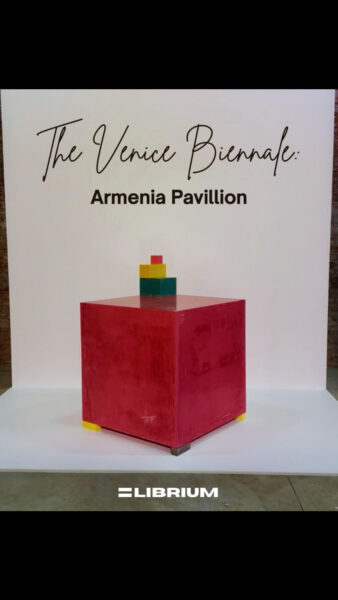
VENICE/YEREVAN — This year, at the 61st International Art Exhibition of Venice — the Biennale — the National Pavilion of the Republic of Armenia presents Zadik Zadikian’s solo exhibition, “The Studio.” The project is curated by the renowned art dealer Tony Shafrazi, whose half-century-long relationship and close collaboration with Zadikian have shaped the concept of the pavilion, together with curator and cultural strategist Tina Chakarian.
The pavilion opened on May 9 and will remain open until November 22. It reimagines the exhibition space as a living studio — an active site of creation, transformation, and restoration. Here, the plaster sculpture is not simply displayed but is continuously being made, reconstructed, and reinterpreted in real time, turning the entire project into a meditation on memory, resilience, and collective form.

Zadikian, born in Yerevan in 1948, has resided in the United States since 1969. He has collaborated with prominent American artists, including Beniamino Bufano and Richard Serra. In 1976, he covered his entire house and studio — from floor to ceiling — with industrial gold, transforming the whole space into a uniquely luminous and unified vision. In 1978, he created the project “1,000 Bricks Gilded with 24-Karat Gold Leaf.” He attracted particular public attention after donating two of his large-scale paintings to the Glendale Police Department in 2003.
The Egyptian Pavilion at this year’s Biennale presents Armenian-Egyptian artist Armen Agop, who is now based in Italy. His project, “Silence Pavilion: Between the Tangible and the Intangible,” is considered one of the best of this year’s Biennale.
Moving through three rooms and three sensory experiences, the visitor makes a transition from the material to the intangible and then to the invisible and mystical. It is a space for contemplation, introspection, and reflection, inviting the viewer to listen to silence, perceive the unseen, and distinguish the scents and barely audible sounds of the intangibility.
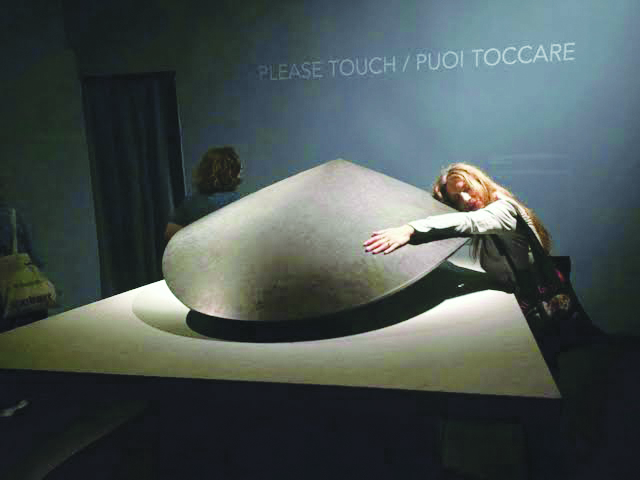
In our noisy world, the artist invites visitors to enter his space on the condition that they switch off their mobile phones and remain silent, thus becoming more receptive both to the inner world of the artworks and to themselves. Here, time unfolds slowly in different layers: the material of the first part — in this case, a granite mass reminiscent of a vishapakar (dragon stone) — carries within it its geological and human history, while memory reverberates in invisible voids. Contrary to the usual conventions of museums and exhibitions, in the second room visitors are allowed to touch the exhibited work, establishing, in semi-darkness, a silent connection between themselves and its smooth material surface. In the third room, elusive sounds are heard at first, eventually transforming into the beating of a heart, while a spreading scent creates yet another intangible connection between the viewer and what is presented, prompting reflection on the perceptible and elusive bonds between human beings and their surroundings.