

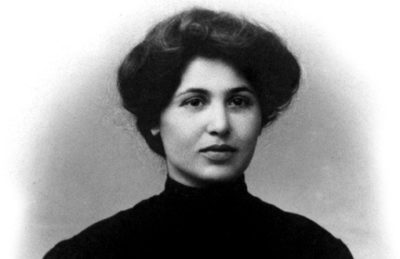
Zabel Yesayan

‘Zabel in Exile’ Revives Yessayan’s Brave Message on Stage

849
0

By Lisa Gulesserian

BOSTON — While writer and activist Zabel Yessayan had been relegated to obscurity for decades after her disappearance under murky circumstances in 1942 after her repatriation to Soviet Armenia, a new play titled “Zabel in Exile” resurrects her on stage with powerful, humorous and touching scenes of Yessayan’s past and excerpts of her written work.

Written by R.N. Sandberg and sponsored by Judith Saryan and Victor Zarougian, “Zabel in Exile” offers a fresh perspective on Yessayan’s life that imagines aspects of the past in ways that resonate in the present for all Armenians.

The play will be staged at the Boston Playwrights’ Theatre starting on February 19 and will run through March 8.

The play centers on the character Zabel as she awaits execution in a Soviet prison cell in 1937. Zabel remembers her life’s major moments of resistance in classrooms, state hospitals, the Ottoman Empire and the Soviet Union. The play’s non-linear vignettes shed light on the events that she experienced and the places in which she lived.

Even Armenian audiences familiar with Yessayan’s life and times can learn something new by watching the play. As Saryan admits, “We know the stories that she’s been through: the massacres, the genocide, the Soviet Union, the [Stalinist] purges. We know these stories, but to actually learn about someone who experienced a huge swath of this very tumultuous time and who came out with so much energy, vigor, hope, and a willingness to come face to face with her monsters…I think that Armenians would feel very proud.”

Get the Mirror in your inbox:

Actor Grace Experience, whose father is novelist Chris Bohjalian, expressed her excitement to play Yessayan’s daughter Sophie by sharing, “I grew up with [Yessayan’s] books in my house, but I know that most people don’t know who she is.” She continued, “Zabel was so brave, and hearing the play during our first read through made me feel empowered to be brave. I hope that people watching can walk away with that, as well as knowledge of the time and the complicated, brilliant person that Zabel was.”

The production boasts a predominantly Armenian cast. Director Megan Sandberg-Zakian noted that “it was beyond my wildest imagination to have four of the six actors be Armenian” when putting out a call for Middle Eastern actors. Sandberg-Zakian, who is Armenian on her mother’s side, reflects that “since I didn’t grow up speaking Armenian or immersed in Armenian community, I sometimes wondered if I was ‘Armenian enough.’” Over the years, she has had the opportunity to direct plays about many other communities, but “this production feels like a kind of homecoming.”

It’s a homecoming for many of the actors, too, who are returning to their New England Armenian roots by being cast to play an ensemble of various characters on stage. June Baboian, who was born and raised in Watertown where she serves as a music director for a local Armenian church, beamed while sharing that “I feel like all my ancestors are going to be on stage with me.” Anelga Hajjar, who was born and raised in Boston but more recently has been recently based in Chicago, remarked on her role of the Guard: “People see bushy eyebrows and cast me as every ethnicity under the sun, but this time I’m going to get to be Armenian, so I’m excited.” Robert Najarian, whose Armenian-Italian family has roots in Massachusetts, stated, “That’s what I really hope for this show. That the Armenian community is made aware of it, because when they are made aware that they can see Armenians being represented on stage, they will come out in force.”

Megan Sandberg-Zakian and R.N. Sandberg

For Armenians in the cast, the family dynamics depicted on stage — such as the relationship between young Zabel and her father, or the relationship between the older Zabel and her daughter — inspire recognition and a renewed appreciation for the enduring bonds of family. Hajjar muses that “I’m curious about what we teach our children about our past and how to even frame the past that we’ve lived. From an Armenian standpoint, too: How do we teach our children to take in what has happened in our past, in our history? What lessons do we want them to learn? What characteristics do we want them to have?”

The actor who plays Zabel, Sarah Corey, shared a personal connection, saying, “Zabel reminds me very much of my Lebanese grandmother, Isabelle, who came from Beirut and was very strong and incredibly intelligent. My Grammy is very much like Zabel.”

Playwright Sandberg describes the play by making connections to his Jewish heritage: “So many Armenian and Jewish works of art deal with genocide, holocaust, victimhood…and this has aspects of that. But it’s a family story. It’s a parents-and-children story. It has a good amount of humor in it, and it’s not a downer.”

MORE FROM Armenian Genocide

Ultimately, “Zabel in Exile” offers a timely and inspirational experience for Armenians watching Zabel come to life on stage.

“You’re going to be captivated by this woman,” says Sandberg, the play’s writer. “You’re going to be moved. You’re going to laugh. You’re going to learn things. You’re going to be appalled. You’re going to hopefully come out of it and want to engage with things in your life in a more active way. You’re going to look at people more openly.”

This exploration of interconnectedness is also articulated by Danny Bryck, a cast member of partly Sephardic Jewish heritage. Depicting characters from Zabel’s past, who represent a diverse range of cultural backgrounds violently uprooted and displaced by the Ottoman Empire, is “to stitch that tapestry back together,” “to reach back to the lost connections that our ancestors had to inspire us to forge new ones now.”

Tickets for the three-week run of Zabel in Exile are on sale now at www.BostonPlaywrights.org. Pay-What-You-Want previews will be held Thursday, February 19 (7 p.m.) and Friday, February 20 (8 p.m.).


Get the Mirror-Spectator Weekly in your inbox: