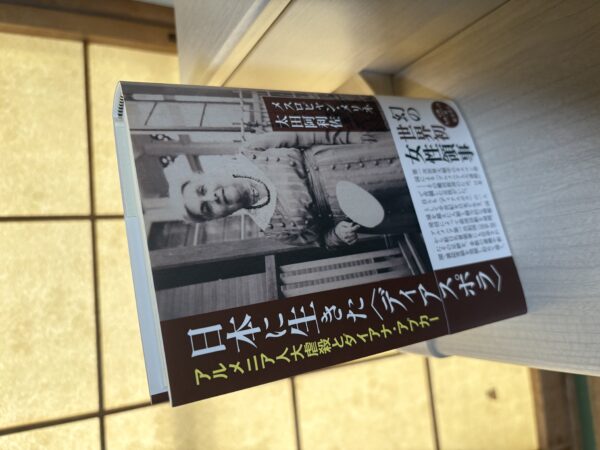


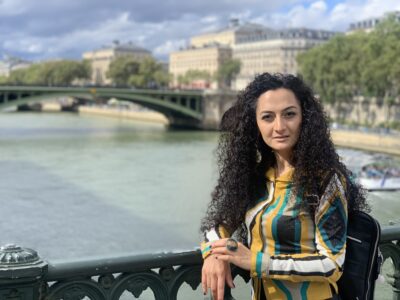
YEREVAN-KOBE, Japan — Meline Mesropyan (born in Yerevan) studied Japanese at the Yerevan Institute of Humanities before working at a travel agency for a few years. She has lived in Japan since 2011. In 2025, she co-authored the Japanese-language book The “Diaspora” that Lived in Japan: Diana Apcar and the Armenian Genocide, a study of Diana Apcar (1859–1937), an Armenian-born businesswoman, writer, humanitarian, and Honorary Consul of Armenia in Japan.
Dear Meline, how did you end up in Japan?
I began studying Japanese at the Yerevan Institute of Humanities, and I quickly fell in love with the language. It was difficult, but fascinating — full of cultural layers. Like many students of Japanese, I started to dream of one day living in Japan. In 2010, I took the entrance examination and received a scholarship from Japan’s Ministry of Education, Culture, Sports, Science and Technology to continue my studies at a Japanese university.
I moved to Japan in October 2011 as a researcher and settled in Sendai, home to Tohoku University. In 2013, I entered Tohoku University’s master’s program and then continued to doctoral studies, where I wrote my dissertation on Diana Apcar. Today, I teach courses such as “Global Europe,” “Japanese Culture and Society,” and English and Russian at universities in Kobe and Osaka. Last year, I also had the chance to teach Armenian for one year at Kobe City University of Foreign Studies. I had seven students, and their enthusiasm was truly moving. We even held an Armenian food gathering at the end of the year, cooking dishes like harisa and tolma together, and sharing gata for dessert. Unfortunately, the course could not continue due to reductions in teaching hours, but the students kept writing to me with Armenian grammar questions for nearly a year afterward. I hope I can revive such classes again in the future.
I congratulate you on the publication of your Japanese-language work devoted to one of the most fascinating women in our history, Diana Apcar. Since 2004, I have written about her on a regular basis, exploring the Armenian press of the time and studying archival materials; however, there was a need not to repeat what had already been said many times, but rather to incorporate information from Japanese sources in particular. This could only be done by a researcher with knowledge of Japanese, which you have accomplished over the past 13 years. What path did your work take, and where has it arrived?