
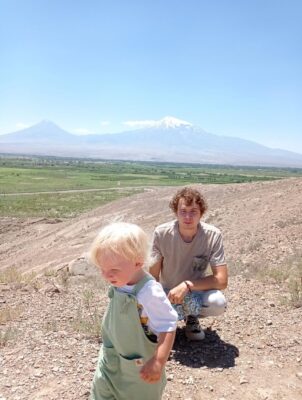
Alexander Listengort and his son

Alexander Listengort: ‘Armenians and Jews Have Lots of Things to Learn from Each Other’

436
0

YEREVAN-HAIFA, Israel — Born in Moscow in 1993, Alexander Listengort graduated from the Moscow State Linguistic University, where he studied international journalism and public relations. Later, his curiosity led him to Ankara University’s Tömer Center, where he immersed himself in Turkish language and culture. Later he volunteered in the Israel Defense Forces.

Listengort has worked at the Embassy of Armenia in Russia, the TASS news agency in Moscow, and the Berlitz Language School in Tel-Aviv. He launched the first Ulpan (class for Hebrew learners) in Yerevan.

An author, linguist, and spiritual practitioner, he has published a Hebrew textbook as well as the books A New Stage of Awakening and Ocean of Divinity. Alongside his writing, he teaches yoga and conducts sessions with Tibetan singing bowls, meditation, and yogic breathing. He works as interpreter and foreign languages instructor.

A true polyglot, Listengort moves with ease among Russian, Armenian, Hebrew, English, Spanish and Adyghe. He also hosts several Telegram channels dedicated to Hebrew, the Armenian language, and the Adyghe people (Circassians), with a combined audience of more than 4,000, and runs a YouTube channel followed by over 29,000 subscribers. 

Alexander, you have a deep admiration for languages. In your view, what matters most in learning a new one — clear-headed reasoning, emotional connection, or something else entirely?

From my point of view, anyone is capable of acquiring a foreign language if three key factors are taken into account: genuine interest, strong motivation, and an appropriate learning method. Moreover, it is essential that a language be learned with joy; otherwise, the brain simply won’t absorb it and will, in some way, resist. I would even say that languages are acquired rather than learned, unlike poems or laws. A language is not merely a collection of new words and sounds—it is a vast spiritual and cultural system encompassing the cultural, mental, and folk dimensions of the people who speak it. In this regard, I am especially proud and honored to speak and read the Armenian language, one of the most astonishing, profound, and universal systems I have ever encountered.
Get the Mirror in your inbox:

Your grandparents were translators. Do you believe a passion for languages can be inherited, or is it something one develops independently?

Indeed, genetics play a significant role. However, even if your ancestors had nothing to do with foreign languages, you still have a great opportunity to start this tradition yourself. As for me, my great-grandfather Lev, my grandfather Yuri, and my grandmother Maria all graduated from the same university I attended. Interestingly, I discovered this only in the fourth year of my studies—that it was, in fact, the very same place.

 You’ve said that each language has its own energy. How would you describe the energy of the Armenian language?

The Armenian language, to me, is all the rocky landscapes of Armenia, its magnificent lakes, and the flavors of its fruits. It is exceptionally rich and vibrant in sound. Moreover, one can trace Sanskrit, Persian, Aramaic, and, above all, ancient Indo-European roots in Armenian words, which naturally gives it a completely unique character. Wherever I am in the world, hearing Armenian fills me with warmth and a sense of home deep in my heart. It is worth noting that Armenian varies significantly even across its own provinces, and, of course, among the diaspora abroad.

 While exploring Armenian, have you come across words or expressions that are particularly difficult to translate into other languages?

Sure. Probably saying that “tsaved tanem” is hard to translate and explain to foreigners would sound too trivial. But let’s take such words as “meghraham” – “with the taste of honey.” I noticed similarities between Armenian and Hebrew: the Armenian word “gaghut,” meaning “colony” or a group of ethnic Armenians living outside their homeland, and the Hebrew “galut,” referring to those who live outside Israel. Same story with the words “Yerkir” and “Aretz” – the Promised land, if you will. The Land of the Ancestors. Even though commonly they just mean “land” or “country.”

 You translate actively from five languages. What translations from Armenian have you done so far, and into which languages?

Probably the most interesting experience I had was in 2018, while serving in the Israel Defense Forces. I received a call from the Ministry of Heritage requesting a translation of three pages from Western Armenian into Hebrew and English. These pages were from a very old book, printed in Beirut in 1918, dedicated to an Armenian officer who fought against the Turks and Germans as part of the Armenian Legion of the French Army in the Holy Land.

For quite some time, I was also passionate about producing poetic and eurhythmic translations from Armenian into Russian of songs by renowned Armenian artists such as Ruben Hakhverdyan, Artur Meschian and Vahan Artsruni. I adore Mr. Artsruni’s songs, specifically Yes inch Tam Qez Im Ser, Chanaparh and Yerkir Armenia. It has been 12 years that I listen to these masterpieces! My goal was to allow Russian-speaking audiences, including Armenians, to appreciate the depth and brilliance of their masterpieces — and, of course, to refine my own translation skills.

Today, I dedicate part of my time to comparing Armenian translations of the Old Testament (Hebrew Bible).

 Your Ph.D. research examines “The Holocaust in the perception of the Circassians and the Adyghe genocide in the perception of the State of Israel.” Could a similar comparative study be made between the Holocaust and the Armenian Genocide, or is that still a taboo subject in Israel?

Frankly, I feel sorry for the Armenian people that the recognition of the Armenian Genocide in Israel comes up on the agenda every year amid geopolitical crises, yet still has not been officially acknowledged. However, I want Armenians to know that Israeli scientists, journalists, and artists frequently raise this issue in the local media and are often astonished that the state authorities seem to act as if they do not hear.

Certainly, as a small nation surrounded by powerful neighbors with long-standing conflicts, Israel must first and foremost do everything possible to ensure its own security. Maintaining specific ties with several Muslim-majority states that deny the Armenian Genocide is currently considered necessary to fulfill this goal.

Still, I believe that the warm relations between Jews and Armenians will eventually lead to new agreements between Israel and Armenia. There are no nations closer to the Jews than Armenians—and vice versa. I am proud to carry both identities within myself. In comparison, the situation of the Circassians is even more complicated. The Circassian genocide involved the forced displacement of about 95% of the Circassian population during the final stages of the Russian invasion of Circassia (the Northern Caucasus) in the 19th century. It has not been recognized as genocide by any country except Georgia, whose recognition was also politically motivated. Today, the historical Circassian homeland is divided among three national republics within the Russian Federation, and the Circassians — like Armenians and Jews — are dispersed across the world.

 It is often said: “There is no country without Jews; there is no country without Armenians.” Between our two nations there seems to be a kind of silent competition — yet don’t you think we have more reasons to stand together?

I definitely see this as proof of God’s presence in the world and the fulfillment of biblical prophecies. Both Jews and Armenians have a special spiritual mission as nations—to create, build, transform, and guide the world around them.

As for the matter of “competition,” unfortunately, Armenians—much like Jews—often tend to compete among themselves rather than between the two nations. This is a serious issue, as the lack of unity within both peoples poses a challenge to their survival and prosperous development. A crisis of unity and the loss of spiritual direction inevitably lead to external crises, manifesting in wars, anxiety, and other negative consequences.

 What lessons could Armenians and Jews learn from each other today, and what are your strongest impressions of Armenia and Armenians?

I visited Armenia in 2014, 2015, 2018 and 2022 and spent overall 7 months there and 3 days in Artsakh back in 2014. When I first arrived in Armenia in 2014, as a 20-year-old student who had pooled all his savings to make the trip possible, I felt at home. I felt that Armenia, like Israel, is a Promised Land. Both Armenians and Jews should never forget their spiritual mission and the importance of remaining united as a people.

From Israel, Armenia could learn to defend its interests and territories with greater determination and rigor. Young men and women from all over the world move to Israel to serve in the Israel Defense Forces, to honor ancestors who never had such an opportunity, and to protect the Promised Land. It would be wonderful if something similar could happen in Armenia.

Conversely, Israel could learn from Armenia to approach the world with greater lightness, compassion, and flexibility in its decisions, perspectives, and relations. We have much to learn from each other to ensure prosperity for future generations. Above all, we must first work on ourselves to make this possible.

 Do you also foresee new Armenia-related projects in your future work?

I am always open to any inspiring projects connected with Armenia. At the moment, I am mostly occupied with raising my little son from my first marriage (by the way, we spent six months together in Armenia, in the marvelous village of Getargel, also known as Balahovit in Kotayk, when he was just 1.5 years old), working on my PhD, teaching, and interpreting. I am also preparing my fifth book, a collection of poetry, which includes a chapter of Armenian poems.

So, besides German Jonathan Spangenberg and Hungarian Benedek Zsigmond, you are the only other non-Armenian writing poetry in Armenian!

Most of my poems are in Russian. Of those I write in other languages, most are in Armenian. I also have some in Adyghe, English, Spanish, Turkish, and Hebrew. Yet it is primarily Armenian and Hebrew that inspire me to write in other languages.

I know some Russian Jewish intellectuals residing in Yerevan since the Ukrainian war.

Truly, lots of talented Russians of Jewish identity moved to Yerevan and stayed there to live and grow. Armenia is a dream place to live. I was crying when I left Armenia by my car back in August 2022 via Bagratashen Armenia-Georgia border.

While caring for my family, I always strive to instill in its members a genuine respect for all nations, religions, and cultures worldwide, with a special focus on Armenians, who have played a profound role in my life. This all began with my encounter with the sacred Armenian alphabet, and I feel grateful every day for my enduring connection with Armenia.

Get the Mirror-Spectator Weekly in your inbox: