

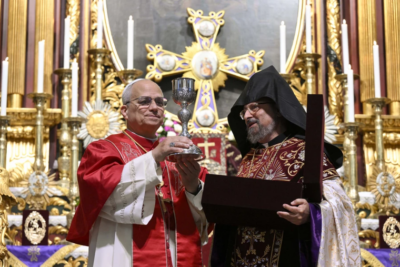
Pope Leo XIV with Archbishop Sahak Mashalian in Istanbul on November 30 (Vatican media photo)

Pope Leo XIV Calls on Lebanese Leaders to Be True Peacemakers as He Seeks to Bring Message of Hope

87
0

BEIRUT (AP/Vatican News) – Pope Leo XIV challenged Lebanon’s political leaders on Sunday, November 30, to be true peacemakers and put their differences aside, as he sought to give Lebanon’s long-suffering people a message of hope and bolster a crucial Christian community in the Middle East.

Leo arrived in Beirut from Istanbul on the second leg of his maiden voyage as pope. He came to encourage the Lebanese people to persevere at a precarious moment for the small Mediterranean country as it faces economic uncertainty, deep political divisions and fears of a new war with Israel.

Leo is fulfilling a promise of his predecessor, Pope Francis, who had wanted to visit Lebanon for years but was unable to because of its many crises and as his health worsened.

Lebanon’s political system, based on sectarian power-sharing, has been prone to deadlock with lengthy power vacuums and regular stalemates over controversial issues, including the investigation into the deadly 2020 Beirut port explosion.

Most recently, the country has been deeply split over calls for Hezbollah, a Lebanese militant group and political party, to disarm after fighting a war with Israel last year that left the country deeply damaged.

“You have suffered greatly from the consequences of an economy that kills, from global instability that has devastating repercussions also in the Levant, and from the radicalization of identities and conflicts,” Leo said. “But you have always wanted, and known how, to start again.”
Get the Mirror in your inbox:

He told Lebanese leaders to seek the truth and engage in a process of reconciliation with “those who have suffered wrongs and injustice” if they truly want to be considered peacemakers.

A culture of reconciliation, he said, must come from the top with leaders willing to put their personal interests aside and “recognize the common good as superior to the particular.”

For many people, Leo’s mere presence was a message.

“It shows that Lebanon is not forgotten,” said Bishop George, archbishop of the Melkite Greek Catholic Archeparchy of Beirut.

At the Beirut airport, where his plane landed with a Lebanese military jet escort, Leo was greeted first by President Joseph Aoun, then by Parliament Speaker Nabih Berri and Prime Minister Nawaf Salam.

He moved through the streets of the Lebanese capital in a closed popemobile, a return to the past after Pope Francis eschewed closed popemobiles. Lebanese troops deployed on both sides of the road and a helicopter flew overhead.

The Vatican spokesman, Matteo Bruni, had declined to discuss the types of vehicles Leo would use in Lebanon, and whether they would be bulletproofed. The visit came just a week after an Israeli strike in Beirut killed five people, including a top Hezbollah official.

In Turkey, Leo marked an important Christian anniversary. In Lebanon, Leo was seeking to encourage Lebanese who believe their leaders have failed them, and to call on Lebanese Christians to stay or, if they have already moved abroad, to come home.

A Muslim-majority country where about a third of the population is Christian, Lebanon has always been a priority for the Vatican, a bulwark for Christians throughout the region. After years of conflict, Christian communities that date from the time of the Apostles have shrunk as families have moved abroad for safety and better lives.

In his welcome speech, Leo said “much good can come” from the Lebanese diaspora. “However, we must not forget that remaining in our homeland and working day by day to develop a civilization of love and peace remains something very valuable,” he said.

Despite a U.S.-brokered ceasefire last year that nominally ended a two-month war between Israel and Hezbollah, Israel continues to launch near-daily airstrikes that it says aim to stop the militant group from rebuilding. The war killed more than 4,000 people in Lebanon and caused widespread destruction.

The pope “is coming to bless us and for the sake of peace,” said Farah Saadeh, a Beirut resident walking on the city’s seaside promenade. “We hope nothing is going to happen after his departure.”

Before Leo’s arrival, Hezbollah urged the pope to express his “rejection to injustice and aggression” that the country is being subjected to, referring to the Israeli strikes.

The group also urged its supporters to line up along the papal convoy route. Hundreds of them did so, waving the flags of Lebanon and the Vatican.

Mounir Younes, the leader of a Hezbollah-affiliated scout troupe, said they aimed to send a message about “the importance of coexistence and national unity.”

“Muslim-Christian coexistence is a great wealth that we must hold onto,” he said.

Hezbollah – a primarily Shiite group – has allied with several Christian political groups in the country, including the Free Patriotic Movement and Marada Movement. However, the Christian party with the largest parliamentary bloc, the Lebanese Forces, is an opponent of Hezbollah and has criticized the group for pulling the country into a war with Israel. The country is now deeply divided over calls for the group to disarm.

In neighboring Syria, hundreds of thousands of Christians fled during the country’s 14 years of civil war. A delegation of some 300 Syrian Christians traveled to Lebanon to join a meeting between Leo and youth groups and pray in a public mass on Beirut’s waterfront.

“We are in need of someone like the pope to come and give us hope as Christians” at a time of “fear of an unknown future,” said 24-year-old Dima Awwad, one of the delegation members. “We wish that the pope would come to visit Syria as he visited Lebanon, to reassure the people and to feel that we are present as eastern Christians and that we need to be in this place.”

Visit to Turkey

On the fourth and final day of his Apostolic Journey to Turkey, Pope Leo XIV began the day with prayer at the Armenian Apostolic Cathedral in Istanbul.

In his address, the Pope sent his greetings to Karekin II, Supreme Patriarch and Catholicos of All Armenians, and the entire Armenian Apostolic community in Turkey.

He thanked God for the “courageous Christian witness of the Armenian people throughout history, often amid tragic circumstances.”

Pope Leo expressed his gratitude for the growing fraternal bonds that unite the Apostolic Armenian Church and the Catholic Church.

He recalled that the first join declaration between a Pope and an Oriental Orthodox Patriarch was signed in May 1970 between Pope Paul VI and Catholicos Vasken I.

“Since then, by God’s grace, the ‘dialogue of charity’ between our Churches has flourished,” he said.

Pope Leo said his visit to Turkey celebrates the Nicene Creed, as the Church marks the 1,700th anniversary of the Council of Nicaea, saying it calls to mind the unity that existed between East and West in the early centuries of the Church.

“We must also take inspiration from the experience of the early Church in order to restore full communion, a communion which does not imply absorption or domination, but rather an exchange of the gifts received by our Churches from the Holy Spirit for the glory of God the Father and the edification of the body of Christ,” said Pope Leo XIV.

He expressed his hopes that the Joint International Commission for Theological Dialogue between the Catholic Church and the Oriental Orthodox Churches may soon be able to resume its work to seek full communion.

The Pope pointed to the 12th-century Armenian Catholicos St. Nerses IV Shnorhali and his tireless work to “reconcile the churches in order to fulfil Christ’s prayer that ‘they may all be one’.”

“May the example of Saint Nerses inspire us and his prayer strengthen us on the path to full communion!” he prayed.

In conclusion, Pope Leo XIV thanked Armenian Patriarch Sahak II for his warm welcome to the Patriarchal Cathedral of the Armenian Apostolic Church.

“May we receive this gift from above with open hearts,” he said, “so that we may be ever more convincing witnesses to the truth of the Gospel and better servants of the mission of the one Church of Christ.”

Armenian faithful welcome Pope’s visit

Several children lined the aisle of the Cathedral as Pope Leo entered in procession with Patriarch Sahak II and the priests of the Armenian Apostolic Church, as a choir sang, instruments rang out and incense filled the air.

Above the entrance to the Church, those present could see a man standing on a ledge through the window, sounding the Cathedral’s bells.

One woman in the crowd wiped tears from her cheeks as the procession passed by. The children stood excitedly next to one another with scarves draped around their necks featuring the papal visit’s logo.

“We are the largest Christian community in Türkiye, so to welcome the Pope in our Church is very significant for us,” said Dr. Drtad Uzunyan, Archpriest and Member of the religious council.

“I hope this will bring an even closer ecumenical relationship between the two Churches. It is already very good, but I hope that it will increase in the future.”

He remembered that, although Pope Leo XIV is the fourth Pope to come to the Cathedral — after Paul VI, John Paul II, and Benedict XIV — in 2014, Pope Francis visited the Armenian Patriarch at the time, who was sick in the hospital in Istanbul.

“So Pope Leo is the fourth Pope in the Cathedral but fifth Pope with the Armenian community,” Archpriest Uzunyan said, smiling.

Get the Mirror-Spectator Weekly in your inbox: