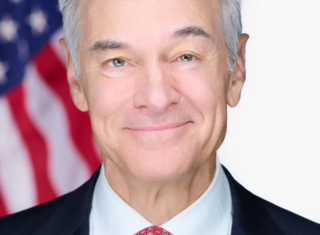


Peter Balakian

Balakian’s New York Trilogy Presents Rich Layers of Poetry

203
0

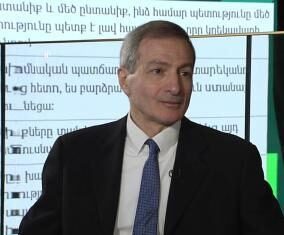
WATERTOWN — Peter Balakian continues to write poetry in a complex modernist and post-modernist tradition. He gives his take on life in today’s complicated world, both sophisticated and earthy, while connecting to multiple realms of history and culture, including the Armenian heritage. His new book, New York Trilogy (University of Chicago Press, 2025), republishes three long poems, each of which appeared in one of his three last books: Ziggurat (2010), Ozone Journal (2015), and No Sign (2022).

At first glance, New York Trilogy is just a republication, but in fact bringing the three poems together completes a story or experience. Balakian said, “I always wrote them with the idea that this would be one long poem in three sections. I began the first poem ‘A-Train Ziggurat Elegy’ in 2003.”

Balakian said, “The poem is anchored by a persona, an invented character — distinct from me, though based on many of my own experiences — who is undergoing a journey over a sixty-year period. I like to use the word persona so that readers don’t think that this is just autobiographical.” In other words, like other writers, Balakian has drawn on personal experience, but the poem itself is a work of fiction. He develops the character that he created through the three poems, which together present a journey over the course of around half a century.

There is an Armenian dimension to the poems based on personal experience which he transforms with the imagination. Balakian said that his trip with the “60 Minutes” crew to the Der Zor desert where many Armenians died during the Genocide is one example which has become an important part of the “Ozone Journal” poem.

Balakian’s writing draws on varied spheres of life, from literature to art to jazz to Armenian history and beyond, so it is complex and requires time and even sometimes research to fully understand and enjoy. He observed, “My model for this poem emerges from literary modernism, in which the mythic method, a technique that the [Erzra] Pound – [T. S.] Eliot era inaugurated, is an assumption about how the imagination inhabits history.”
Get the Mirror in your inbox:

Balakian stressed that modernism brought a new kind of intertextuality into poetry, and though it made the poem more challenging to some readers, it was key to making a poem richer, more layered and complex and, he said, “also, I hope, fun and exciting. The modernist poem opened up poetry to a wider world of knowledge and language.” Endnotes at the conclusion of New York Trilogy can provide at least some assistance to readers seeking sources of allusions and clarifications.

His poetry incorporates the sad and tragic as well as bright dimensions of life. Balakian described this aspect of his writing as follows: “I am a sensualist, a realist, immersed in the significance of history, like many poets in a modern tradition from [W. H.] Auden, [William Butler] Yeats, [Robert] Lowell, and [Adrienne] Rich. But the impress of history doesn’t preclude moments of transcendence, of sensual joy and pleasure, and love, and immersions in art and literature and music. I hope there is a fullness of the human experience in this poem.”

Writing Horizontal

His latest work reflects his interest in the American long poem tradition that comes out of Walt Whitman, William Carlos Williams, Adrienne Rich and others. Balakian said, “I feel that this is a journey for me into an idiom and form in American poetics that has energized me for a long time.”

The structure of New York Trilogy is multisectioned and multisequenced. Balakian explained in a note he wrote for a friend: “This long poem works by sections and sequencing. By sequencing, I mean that in each of the three sections there are four threads or quasi-narratives, and the reader must shuttle back and forth with them and gather each thread and attach it to its antecedent. In that way, metaphor deepens, transformation occurs in many ways, and the images accrue layers as they unspool into extended metaphors.”

His first foray into the long poem was “The Claim,” published in Sad Days of Light (Sheep Meadow Press, 1983), in which he used his grandmother’s human rights lawsuit against the Turkish government that she filed in 1920 through the US State Department as documentary material around which he worked several layers of lyric language.

Topics: poetry

The multisequencing in the New York Trilogy though makes it much more complex and intricate than Balakian’s first effort. The first and last sections have 45 parts while the middle one, “Ozone Journal,” has 54 parts.

In his essay “Writing Horizontal: Notes Toward the Poem as Space,” published in his collection Vise and Shadow (University of Chicago, 2015), Balakian calls his approach “writing horizontal.” He states there (p. 261): “Writing horizontal was for me not an aesthetic program, but rather a way of opening up space both linguistically and in the mind. The horizontal poem, I felt, could still hold on to the verticality of the conceit’s self-reflexiveness, the idea that the germ at the beginning of the poem could unfurl in ways that could be surprising and still connected to a source, the way the poems of Donne, Marvell, Herbert, and the Metaphysicals were always a source and form of invention. Verticality could keep the horizontal poem rooted in itself, giving the poetic field a disciplined center. But horizontalness allowed for nuanced feeling and perception that could skitter along mental wires and optical alleyways. It was liberating to play more with splicing and shifting in ways that advanced a larger consciousness of the poem, a spaciousness that meant more opportunities for movement — the music of rhythm could glide into the image in unsettling ways.”

Balakian explains in that essay that a series of experiences in 1988, while he was living in London, moved him into this approach, including broader global trends and events (one of which was the Armenian earthquake that December). He writes: “For various reasons that had something to do with this sense of the world and some inner needs of my own, I wanted to find my own ways for the poem to have a broader reach, to be a wider net, to have a more spacious arena to absorb stuff, things, ideas, voices, bric-a-brac, a bit like a Rauschenberg combine. The idea of what I was privately calling ‘writing horizontal’ was nothing more than an instinct, a personal orientation, a way of feeling and pushing the poem for more space and layers and flexibility” (Vise and Shadow, p. 259).

Changing Times

When asked how to reach and interact with readers in the new digital world, where mentalities and thought processes seem different compared to 30 or 40 years ago, Balakian pondered a moment and then responded: “In one sense, in the digital age, we can communicate with large numbers of people very quickly, and there has been a whole new phenomenon that started in 2020 with the Covid lockdown of Zoom readings.” While he saw a lot of potential for reaching the wider world in the digital age, he said that the irony or contradiction is that, broadly speaking, the book is less important in the digital age when people are preoccupied with streaming movies, posting on social media and living on TikTok.

He said that the way people think is different now, maybe more visually oriented, but the place of poetry for a young generation maybe both enhanced by the digital age and hampered; it’s hard to tell. A bigger question, he said, is how fundamental is literature to the wider culture in the 21st century. In the pre-screen era a book with pages was your primary text. Now there are hundreds of competing texts. Consequently, he said, “It strikes many of us writers that literariness has less of an impact on the general culture than it did 50, 60, 70 years ago.” Balakian concluded: “If that’s true then it’s a worse world in my view for literature and it’s a worse world for democracy.”

At the same time, he said, “We live in a digital era where societies also live with language in many forms and forums and that can be important for making serious language a vital part of human consciousness and thought. And, of course, the place of literature also has to do with education, and systems of education. Poetry is our most ancient literary form — it is inextricable from chant, prayer, song, and dithyramb; it’s the foundation of many social and cultural forms and literary genres. And, if poetry is taught with some seriousness in the secondary school curriculum, it will make a big difference in how literature is grounded in any society.”

Meanwhile, Balakian said he was not working on more long poems but on a new book of poems, many in shorter lyric forms, as well as another family story in nonfiction, and a book of essays.

Get the Mirror-Spectator Weekly in your inbox: