

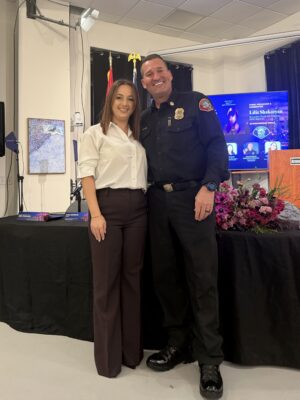
Lily Shakaryan and Chief of Glendale Fire Department Jeff Brooks

Community Leaders, Law Enforcement Officials, and Advocates Convene for Domestic Violence Awareness Panel

46
0

GLENDALE —Community leaders, law enforcement officials, public officials, legal professionals, domestic violence advocates, educators and residents gathered on November 12, for “Strengthening Community Awareness and Response to Domestic Violence,” a research-based public panel discussion organized and moderated by Researcher and Family Life Educator Lilit Shakaryan, in partnership with the Glendale Police Department.

The event brought together representatives from law enforcement, domestic violence services, legal advocacy, educational institutions and community organizations to examine the complexities of domestic violence, discuss barriers to seeking assistance, and explore ways to strengthen public awareness and access to professional resources.

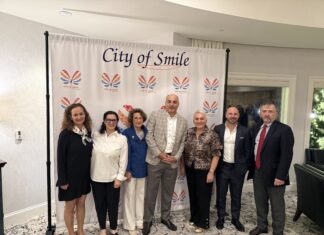
The gathering was attended by prominent public officials, including Mayor of Glendale Ardy Kassakhian; Chief of the Glendale Police Department Robert William; Chief of Glendale Fire Department Jeff  Brooks; Carlos Arce, Deputy District Director, representing California State Senator Sasha Renée Pérez; and Dr. Armond Aghakhanian, Board Member of the Burbank Unified School District.

Also in attendance was Jasic Boniatian Jarahian, Controller of the Armenian Relief Society (ARS), Western Region, whose presence reflected the organization’s continued commitment to community engagement and social support.

The participation of these officials and distinguished guests underscored the importance of cooperation among public institutions, law enforcement agencies, educational leaders, and community organizations in addressing domestic violence as a significant public and social concern.

A significant part of the program was dedicated to recognizing Lilit Shakaryan for her research, community engagement and leadership in organizing the initiative.


Get the Mirror in your inbox:

Glendale Police Chief Robert William presented Shakaryan with a certificate recognizing her contributions and efforts in bringing together law enforcement professionals, researchers, advocates, and community representatives for this important discussion.

Similarly, Kassakhian presented a Certificate of Honor to Shakaryan in recognition of her initiative and community contributions. He also presented certificates to the panelists and actresses who participated in the special theatrical drama performance.

Additionally, California State Senator Sasha Renée Pérez issued a Certificate of Recognition to Shakaryan in acknowledgment of her work and efforts in organizing the domestic violence awareness initiative.

The initiative reflects more than 15 years of Shakaryan’s academic, educational and research experience, as well as her continued commitment to family well-being, women’s empowerment, and community engagement.

A graduate of the University of Nevada, Reno, Shakaryan is currently continuing her academic journey at the University of Southern California (USC), pursuing graduate studies in clinical social work.

Her academic career includes 15 years of university teaching as an adjunct faculty member in the Department of Sociology at Yerevan State University. During this period, she developed approximately seven academic courses and authored three educational handbooks, contributing to university-level instruction and curriculum development.

Her international academic experience also includes participation in the Women’s Leadership Program at Arizona State University and an academic visit to the university’s School of Social Transformation, where she further developed her interests in educational methodologies, women’s leadership, and social transformation.

One of the most significant achievements of her research career was a year-long domestic violence research initiative conducted with the HOPE team at the University of Nevada, Reno. The research received the Purple Ribbon Award. According to Shakaryan, the findings contributed to the subsequent development of a 40-hour training program for relevant state agencies.

She continues her research on domestic violence in California, focusing on public awareness, access to resources, community perceptions, and barriers that may prevent individuals from seeking assistance.

Beyond her academic and research activities, Shakaryan serves as a Board Member of the Walking With Alex Foundation, which supports children with autism and their families.

Awareness Does Not Equal Access

One of the most significant components of the initiative was the presentation of Shakaryan’s original research, including a community-based survey of members of the Armenian Woman Power Facebook Group, a platform with approximately 15,000 members.

The survey received 96 completed individual responses and examined perceptions of domestic violence, awareness of different forms of abuse, familiarity with available support services, perceived barriers to seeking assistance, and the role of families and community organizations.

The findings revealed an important distinction between recognizing domestic violence and knowing how to access professional assistance.

93% of respondents recognized that domestic violence can occur without physical violence.

87% recognized that domestic violence involves power and control.

89% reported being very or somewhat familiar with the term domestic violence.

However, only 18%  said they knew specific domestic violence services or organizations.

This difference highlighted one of the central conclusions of the research: general awareness does not necessarily translate into knowledge of where to seek assistance, whom to contact, or how to access support.

As Shakaryan emphasized during her presentation: “Awareness is important, but access is what turns awareness into support.”

The survey also examined what respondents believed might prevent women from speaking up or seeking assistance.

The most frequently identified barriers included:

72% selected shame or embarrassment.

66% identified financial dependence.

66% identified fear of the abusive partner.

59% identified fear of community judgment.

58% identified fear of family judgment.

58% identified concerns about children.

These findings suggest that barriers to seeking help are complex and interconnected. Emotional support alone may not be sufficient; access to housing, financial assistance, legal information, confidential referrals, and professional services can also be essential.

The research also explored community messages that respondents believed women might encounter.

79% selected the message “stay for the children,” while 68% identified the idea that family matters should remain within the family. Another 37% selected the perception that domestic violence is a private matter.

Importantly, these results reflect respondents’ perceptions of messages women may hear in their communities, rather than direct measurements of personal agreement with those messages.

The results highlighted the need for accessible, accurate, and confidential information about available resources, particularly information that explains how individuals can contact professional organizations and what assistance they may receive.

Respondents also identified the communication channels and people they considered important in raising awareness and providing support.

Armenian social media pages and Facebook groups were selected by 68%, Armenian community organizations by 55%, and domestic violence professionals by 52%.

When asked who has an important role in responding to domestic violence, 77% selected family and friends, while approximately 51% identified social workers and counselors and another 51% identified domestic violence organizations.

These findings suggest that trusted community networks can serve as important entry points for information. However, community members and organizations should also be connected with trained professionals and confidential support services.

From Research to Practical Recommendations

The open-ended responses provided additional insight into what participants believe their communities need.

Several recurring themes emerged:

Greater recognition of emotional, psychological, verbal, and financial abuse.

Reducing shame, silence, and victim-blaming.

Improving access to shelter, housing, employment assistance, legal information, and counseling.

Providing confidential and culturally responsive support.

Expanding Armenian-language information about available services.

Strengthening cooperation among families, community organizations, and trained professionals.

Taken together, the findings point to a central message: addressing domestic violence requires more than awareness campaigns. It also requires clear pathways to assistance, trusted referral networks, accessible resources, and responses that respect the needs and decisions of individuals seeking help.

A Multidisciplinary Panel of Professionals

Moderated by Lilit Shakaryan, the discussion brought together specialists representing law enforcement, domestic violence services, legal advocacy, and community-based organizations.

The panelists included:

Moderator: Lilit Shakaryan — Researcher and Family Life Educator, organizer and moderator of the initiative.

Lieutenant Ernesto Gaxiola — Glendale Police Department, representing law enforcement and public safety.

Debra Suh — Chief Executive Officer, YWCA Glendale & Pasadena. The organization works to eliminate racism, empower women, and promote peace, justice, freedom, and dignity for all.

Mariya Melkonyan — Criminal Defense Attorney, providing a legal perspective on issues involving domestic violence and access to legal assistance.

Alina Krikorian, MA, LMFT — Representative of the Armenian Relief Society’s Child, Family & Youth Guidance Center, bringing professional experience in family and youth support.

Maya Tokhalyan — Founder and Administrator of the Armenian Woman Power Facebook Group, representing community-based engagement and the perspectives of women within the community.

The audience also had the opportunity to engage with the panelists through questions and discussion, creating an environment for information-sharing and meaningful public dialogue.

The event’s central message was clear: addressing domestic violence requires awareness, informed public discussion, accessible resources, and a coordinated response involving the entire community.


Get the Mirror-Spectator Weekly in your inbox: