
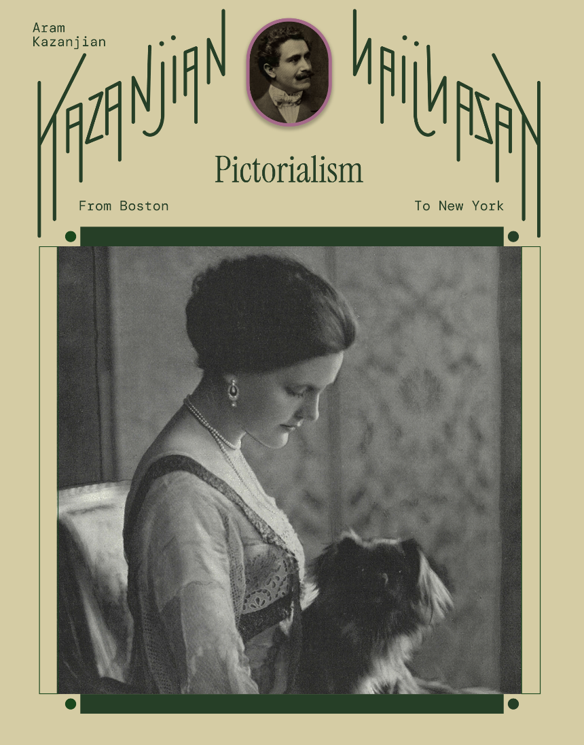
New AIA Exhibit Puts Focus on Photographer on Aram Kazanjian

24
0

LOS ANGELES — “Pictorialism from Boston to New York,” the first exhibition of the works of renowned photographer, Aram Kazanjian (1878-1966), was launched by the Armenian Film Foundation’s Armenian Image Archive (AIA), on October 19.

The AIA was founded in 2022 to support the study of Armenian photography and the unique role Armenian photographers have played in the evolution of modern photography. This new online exhibit is a wide-ranging retrospective of the Armenian-American photographer whose career evolved during the early 20th century in Boston after he emigrated to the United States from Erzincan, Turkey.

The exhibition has been spearheaded and curated by Joseph Malikian, Ph.D., founder of the Malikian Collection, which has thousands of photographs from Armenian photographers, spanning many decades, from 1850s to the 1960s. Many of these photographers were pioneers in the field of Ottoman photography. Like Kazanjian, some established themselves in the United States, creating successful studios and, at the same time, launching photography as an art form in and of itself.

“I am so happy to share Kazanjian’s life work with the world,” said Malikian. “His images are really striking. Some of his portraits are like works of art. Similar to the renowned Armenian photographer, John Higue Garo, Kazanjian’s portraits depict an early genre of photography identified as Pictorialism.”

Malikian is also the author of The Armenians in the Ottoman Empire: An Anthology and a Photo History (2011) and The Krikorians of Jaffa Road: Architects of Armenian Photography in Jerusalem (2024). The Kazanjian online exhibit, created by Malikian and designed by Masato Nakada of the Happening Studio, tells the story of a young man who, as a sixteen-year-old Armenian émigré from Erzincan, Turkey, arrives in the Boston area around 1895.

His parents had been killed in the Hamidian massacres of 1895 and the family home destroyed. Along with his cousin, Varaztad Kazanjian, who later became a renowned oral surgeon and founder of the modern practice of plastic surgery, Kazanjian came to America to seek a new life. His life and legacy are celebrated in this exhibition.
Get the Mirror in your inbox:

Kazanjian was influenced by the Pictorial aesthetic movement that created photographic images rather than simply recording them. From portraits to documentary photographs, his work reflected a blend of varied photographic styles that evolved around the turn of the 20th century. Boston became a hub for Pictorialism which promoted photography as fine art. Amongst the influx of Armenian immigrants in this rapidly growing diasporan community, those who were entrepreneurial, artistically creative, and trained to practice photography established successful commercial portrait studios. Armenians were widely known to have mastered photography throughout the Ottoman Empire; this reputation not only made assimilation easier into American society, but it also facilitated their efforts to open studios in the major diaspora hubs of Boston and New York.

Kazanjian’s aviation photos have themselves become part of the historical record. During his years in Boston, Kazanjian stepped out of the studio to visually document the inaugural Harvard-Boston Aero Meet which took place from September 3-13, 1910. These documentary-style photographs captured a sequence of images that chronicled, as some newspapers called it, “the greatest meet of its kind in America which drew over 60,000 paid spectators.”

The photographs, signed as “Aram,” gave him name recognition in the field of commercial and documentary photography. Kazanjian produced and commercially distributed postcards that documented the events from the aviation meet of 1910. His photographs, taken over the course of ten days, not only supplemented his income and produced collectible postcards that were highly valued around the turn of the 20th century, but also served as memorabilia of a captivating event in the history of American aviation.

Kazanjian’s daughter, Arlene Francis (born Arline Frances Kazanjian), October 20, 1907 – May 31, 2001, was an American game show panelist, actress, and radio and television talk show host. She was a pioneer for women in television, and is best known for her long-running role as a panelist on the television game show “What’s My Line?” on which she appeared regularly from 1950 to 1975.

“Pictorialism from Boston to New York,” is viewable online at the Armenian Image Archive’s website, on the following link: armenianimage.org

Also: https://www.armenianimage.org/wp-content/exhibit/kazanjian/

For more information about the Kazanjian exhibition, please contact: joseph.malikian@gmail.com


Get the Mirror-Spectator Weekly in your inbox: