

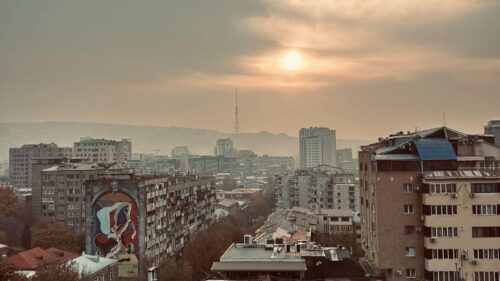
Yerevan’s polluted skyline giving “Blade Runner” vibes (photo Raffi Elliott)

The Air Clears, the Problems Don’t: Inside Yerevan’s Pollution Crisis

328
0

YEREVAN — Denizens of Armenia’s capital have been greeted with scenes reminiscent of the neo-noir sci-fi movie “Bladerunner” on and off for almost three months since temperatures began to drop in mid-November of last year. The cause, smog, is rapidly becoming a seasonal occurrence that Yerevan residents now expect as regularly as the regular water cuts, or Christmas, with potentially deadly consequences for those forced to live with various airborne pollutants for extended periods. Despite the uncertainty, however, there is little hope that this grey-brown veil will lift over the city any time soon. According to over a hundred air quality monitoring stations placed across Yerevan, fine particulate matter such as PM10 and PM2.5 levels have reached 2.4 times and 4.8x the recommended limit, raising the risk of long term health concerns such as heart disease and lung cancer.

While the meteorological and geographical conditions which set the stage for these phenomena are nothing new, the introduction of a byproduct of the city’s recent prosperity in the form of construction dust and underregulated vehicle emissions is. With the smoke from several ongoing forest fires in the Armenian highland, this toxic combination has dragged down Yerevan’s current air quality to one of the worst on record.

This situation and a slew of other mostly-environment-related issues plaguing the city has garnered mounting public outcry for Mayor Tigran Avinyan to act decisively. Concerns over Yerevan’s air quality have even topped the national government’s agenda, with Prime Minister Nikol Pashinyan announcing the formation of two separate task forces to address the issue. However, despite the mounting pressure, Mayor Avinyan’s administration has done little to address the problem, claiming in a press statement that the smog plaguing the city is essentially a meteorological phenomenon that can’t be addressed.

Environmental experts and city planners disagree with this conclusion, suggesting that the municipality has many more tools to tackle the worst of it immediately, as well as policy changes that would reduce the frequency and severity of smog-induced pollution in the city for the foreseeable future. The experiences of other global cities in solving similar chronic smog issues also point to alternative solutions which the City appears slow to consider.

Situated at the eastern corner of the Ararat plain, Yerevan is both one of the highest-altitude capital cities in the world and also one of the driest. Capped by Mount Ararat on the one side, the city itself is surrounded on the other three sides by mountain ranges, placing it in a sort of geological “bowl” often trapping warmer, stale air inside of it.

These conditions usually persist through November and December as the approaching winter brings a low-pressure front, with cold air pushing warmer air down and trapping it above. These conditions remain until relieved by more humid air, which causes precipitation and cycles the older air out of the aforementioned “bowl.”

Get the Mirror in your inbox:

‘Prosperity Paradox’

While climatic conditions are largely determined by local geography, the deadly cocktail produced by the introduction of nefarious particles serves as a paradoxical testament to the country’s recent economic prosperity.

Yerevan’s air quality issues have persisted in some form since the 1980s, as the fumes from massive Soviet-era industrial concerns, known for lax enforcement of environmental regulations, billowed day and night. Perhaps the most significant culprit, the infamous Nairit chemical plant, lingers in local memory long since the plant closed its doors for good almost twenty years ago, with longtime residents of the city claiming they can still remember the “taste” of the air every morning.

Yerevan’s air quality saw a dramatic recovery in the years following the collapse of the Soviet Union in 1991, and with it the continent-spanning common market, which demanded Armenian industrial goods. However, the positive environmental byproduct of rapid deindustrialisation would soon be countermanded by new noxious gases in the skies above Yerevan.

Historical air pollution data show that while Armenia experienced a near-collapse of industrial pollutants, toxic particulates such as nitrogen dioxide and sulfur dioxide, most commonly associated with car exhaust and wood-burning fires, have grown at an exponential rate since the mid-2000s, in line with the gradual (and later explosive) rise of car ownership rates. Ministry of the Environment data shows that air pollution in the country’s capital has risen by up to 40 per cent in the past five years alone. Some 70% of that was caused directly by cars. A decade ago, 483,600 registered motor vehicles were on the country’s roads, with just under three million inhabitants. By 2023, half a million cars were driving in the streets of Yerevan alone. Notably, a recent rise of EV sales has offset declining imports of ICE (internal combustion engine) cars in the past two years.

Critically, the vast majority of these cars are privately imported used vehicles, often shipped as ‘parts kits’ rather than full cars. Despite stricter legislation on vehicle inspection and emission standards, many of them arrive without their catalytic converters installed, while others are stolen or removed by owners concerned with ‘performance’.

Topics: pollution

Dust particles also found in the air over Yerevan have been attributed to the numerous construction sites across the city and to rock quarries outside the city. Man-made forest fires in Dilijan, as well as the practice of burning leaves in the city, have both been blamed for the higher rate of formaldehyde detected in the air.

Government (In)action

While experts have been raising the alarm on the mounting effects of car pollution for over a decade, authorities have been slow to enact legislation and even slower to enforce it. A recent study published by the International Energy Agency (IEA) and the European Union, which recommended a speedy and sustained electrification of Armenia’s road networks, also specifically cited the re-export of used catalytic converters as a major factor contributing to excessive air pollution across Armenia. The report called for tougher vehicle inspections, stricter customs checks on imports, and meaningful fines for those who bring in non-compliant cars. It also recommended a “green inspection” system that could reduce urban particulate pollution by up to 40% within 10 years, and urged Armenia to align its fuel and emissions standards with EU norms.

The Yerevan municipality has already been mulling the introduction of bans on cars lacking catalytic converters since the beginning of last year. “We’ve started to talk about this because we have the required equipment that has been showing significant deviations from the norm in winter months,” Mayor Avinyan told reporters last April.

Despite the promises, critics continue to accuse City Hall and the Armenian Government of dragging their feet on enforcing clear measures to ease the pollution situation. Yerevan residents, reinforced by some of the more active among the tens of thousands of Russian émigrés living in the city, have been mobilising on the grassroots level to advocate for change. An ad-hoc network of monitoring stations installed by private individuals across town has helped raise the alarm about the looming emergency while holding authorities accountable.

One concerned Russian transplant, industrial designer and hardware developer Kristina Loginova, went so far as to design and code her own air-quality monitoring device, fabricated from over-the-counter equipment ordered from AliExpress. To make the product easier to adopt, she drew on her design expertise and 3D-printed the box in the shape of a white cloud that adheres to a window. “The white cloud on your window doesn’t obstruct your view, but reminds you to check the air quality,” she explains. She has so far donated or sold over 80 units, mostly through word of mouth. These stations transmit data to the open-source database Armaqi.org.

Cloud-shaped window-mounted air quality monitoring station developed by Russian industrial designer Kristina Loginova (used with permission)

Arsen Petrosyan, a Russian-Armenian repatriate and owner of one of Loginova’s cloud-shaped monitors, sees the air quality crisis as a catalyst for civic engagement. He observes that the air quality crisis has brought common cause between Armenian environmental activists and the tech-driven civic “maker culture” that Russian expats have introduced to the country. “Armenia still has a very nascent culture of providing feedback”, says the IT project manager who repatriated from Moscow three years earlier, “there is a preference for complaining in private, which reduces the chance of anything getting done.”

Petrosyan, who marched along with some two hundred activists, both Russian and Armenian, in late November to demand government action on the worsening air quality crisis, noted mixed attitudes from onlookers. While some told the Russians to go protest in their own country, others were genuinely curious about our complaints and our proposed solutions, he says. “Some local guys approached the protesters with camera phones, rudely heckling them until two Armenian-speaking girls among the protesters began addressing their questions and explained the situation. Their attitudes changed dramatically after that.”

The uneasy relationship that many of the transplant Russian environmental activists seemingly cultivated with indignant locals, often incensed at what researcher Maria Gunko dubbed “the Moscow gaze,” as in is the gaze of an arrogant subject, treads new ground in Yerevan’s future-history of urbanism. Shushan Grigoryan, a research fellow at the Institute for Security Analysis specifically referenced the fight against Yerevan’s air pollution in a study published on integration of Russian transplants into Armenian civic life. She described this form of civic participation as a “mode of political participation that occurred in less public settings but served as a means for them to disseminate their ideas and mobilize others.”

Despite growing demand for action, the municipality remains evasive on solutions. Mayor Avinyan claimed, in a December press conference, that industrial air quality monitoring stations which he had ordered in the wake of a previous public outcry show that human activity is responsible for only a small portion of the rise in pollution.

Still, over the winter, dust-retaining nets have quietly been installed around high-rise construction sites in the city, increased fines for burning leaves have been announced, and a new round of investment in electrified public-transport solutions has been announced. A tender process is exploring options to replace the fire-prone Nubarashen landfill with a modern recycling facility. The national government also set up an ‘anti-pollution taskforce’. Yet, air monitoring websites for Yerevan continue to recommend avoiding outdoor exercise, wearing masks outside, closing windows, and running air purifiers. The march, which Petrosyan attended, was not met by any representative of the municipal government. Yerevan isn’t the first municipality to face chronic smog issues, yet questions remain as to whether lessons learned elsewhere will be studied in the city older than Rome.

Get the Mirror-Spectator Weekly in your inbox: