

By K. M. Greg Sarkissian
For any sovereign state to function effectively, authority and responsibility must be clearly defined. Institutions must have distinct roles, and those roles must operate within a coherent constitutional framework. In Armenia, particularly when viewed from the perspective of the Diaspora, this clarity is sometimes blurred-most notably in discussions surrounding the relationship between the Armenian state and the Armenian Apostolic Church.
This is not an argument in support of any current government, nor is it a critique of the Church as a spiritual institution. Rather, it is an examination of how modern statehood functions and why the separation of church and state is essential to Armenia’s sovereignty and long-term stability.
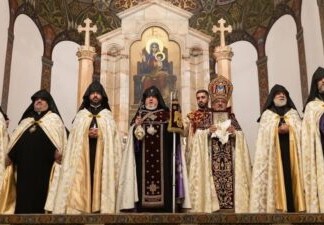
The confusion is understandable. For centuries, Armenians lived without statehood, and during that time the Church played an extraordinary role in preserving national identity, faith, language, and culture. In the absence of a state, the Church often acted as a surrogate national authority. That historical experience has deeply shaped Armenian collective memory, especially in the Diaspora, where community life has frequently revolved around church institutions.
As a result, some Diaspora Armenians continue to view the Church and the state as parallel or equivalent centers of authority. This perception is reinforced by the transnational nature of the Armenian Apostolic Church and the fact that the Republic of Armenia is a relatively young modern state. When church leadership based in Armenia speaks on matters of state, it may therefore appear natural or even necessary to some. However, this understanding does not align with how sovereignty functions in the modern world.
The Core Principle: The State Is Supreme