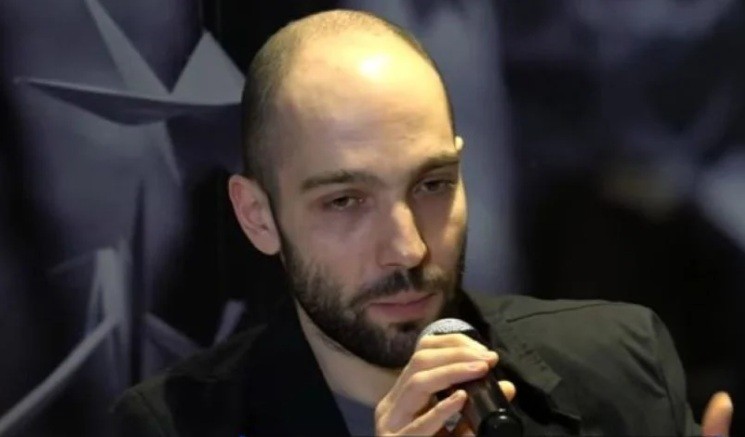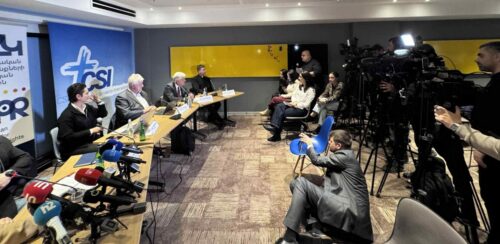


CSI and the Armenian Center for Political Rights (ACPR) held a press conference on February 3, 2026, following a fact-finding visit to Armenia

International Attention Turns to Persecution of Armenian Church: Christian Solidarity International Fact-Finding Mission Reports

14
0

YEREVAN (Zartonk) — The world-renowned religious freedom organization Christian Solidarity International (CSI) sent a fact-finding mission to Armenia the first week of February to investigate persecution of the Armenian Apostolic Church in parallel with the International Religious Freedom Summit in Washington, D.C. The visit concluded with a joint press conference at the Ibis Hotel Center in Yerevan with the Armenia Center for Political Rights (ACPR), a Yerevan-based human rights NGO that has produced a comprehensive legal report on the government’s anti-church campaign.
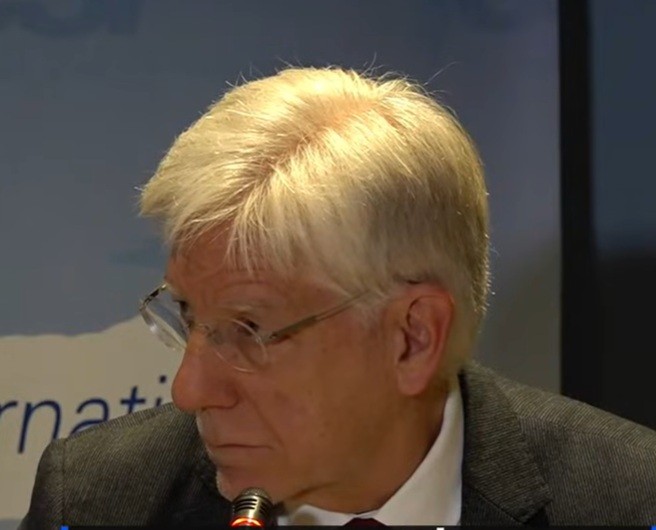
Erich Vontobel

Swiss Parliamentarian Erich Vontobel participated in the visit and press conference. The February 3 press conference, conducted in English, translated into Armenian on site by Niery Grace Bardakjian, and moderated by Lika Tumanyan was broadcasted live (https://www.youtube.com/watch? v=oWFUP7VaMn0).

This took place as religious freedom experts and non-governmental organizations gathered in Washington for the International Religious Freedom Summit, ahead of the visit to Armenia and Azerbaijan by US Vice President J. D. Vance in February.

“Religious freedom conditions have deteriorated sharply in Armenia since this summer,” reported Joel Veldkamp, CSI’s director of advocacy. “We hope to use this visit to put a spotlight on the escalating persecution of the Armenian Apostolic Church for Summit attendees.”

Brief History

Since June 2025, the Armenian government has imprisoned four bishops and one priest. Dozens of others have also been arrested, including church workers, lawyers for the arrested clergy, family members of the clergy, and public supporters of the church. Armenian Prime Minister Nikol Pashinyan has publicly vowed to remove the head of the Armenian Church worldwide, Catholicos of All Armenians Karekin II, from his post and replace him with a candidate selected by a state-appointed committee.
Get the Mirror in your inbox:

Due to the insecurity in Armenia, the Armenian Church recently scheduled its Episcopal Assembly to be held in Austria from February 16-19, instead of Armenia.

During a previous visit to Armenia in November 2025, in conjunction with the Republic of Armenia’s first “Prayer Breakfast,” the CSI delegation met with local civil society leaders, as well as family members and lawyers of those arrested.

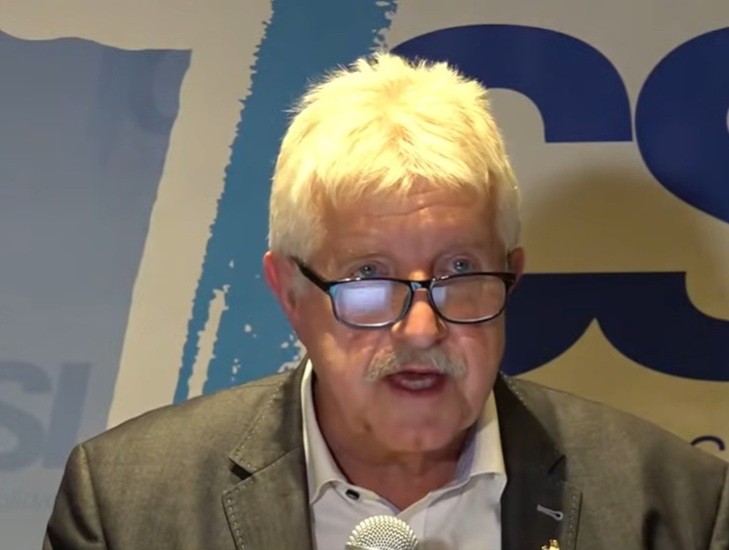
CSI President John Eibner

“The persecution of the Armenian Apostolic Church by the Armenian government is a grievous sign of things to come, not only for the Armenian people but for all in the international community who value religious freedom,” commented Dr. John Eibner, president of Christian Solidarity International. He said: “If a U.S.-allied government can so blatantly try to seize control over one of the world’s oldest churches with no international pushback, it will set a grim precedent for authoritarian governments the world over.”

He concluded: “We urge participants in the IRF Summit in Washington DC, as well as Vice President Vance, to intervene with the Armenian authorities to put an end to their campaign against the Armenian church, and to free the people they have detained as part of that campaign.”

After difficult negotiations with the relevant authorities of the Republic of Armenia, the CSI delegation had the opportunity to meet with imprisoned Archbishop Bagrat Galstanyan, who handed them letters signed by him addressed to the participants of the IRF Summit taking place in Washington, as well as to the US vice president.

Press Conference Details

“The detained Archbishop Bagrat is being held in the same cell where Bishop Bagrat Vardazaryan was murdered by the Soviet Union’s authorities in 1937,” said Eibner. “We have come to carry out consistent work as a continuation of our fact-finding work that we carried out in November. We are here to understand how the crisis between church and state has changed,” he continued.

He stated that during this visit they met with human rights defenders, lawyers, and the Catholicos in the Mother See, declaring “He is determined to protect his flock and his nation. This morning we visited Archbishop Bagrat in prison. We were happy to see Archbishop Bagrat in good health.”

Eibner said: “A few days before signing the document with the prime minister [attacking Catholicos Karekin II], the primate of the Artsakh Diocese said in his meeting with us that the Artsakh issue is not closed.”

Moreover, in response to a question Eibner said that at that time, “He did not express any opposition to the Catholicos.”

To the question of whether they had met with the 10 clergy who sided with Pashinyan and otherwise how could he talk about an objective fact-finding mission, Eibner replied: “We have not met with the ten clergy who came out against the catholicos. We met with the archbishop of Artsakh in November. Although we did not have a personal interview with the prime minister of the Republic of Armenia, we participated in the prayer breakfast in November. We listened to the Prime Minister and others. We are conducting our own research into their speeches. We are studying to understand what the ideology of the ‘Real Armenia’ is. So it is possible to be objective, listening to all sides, and we are doing this.”

Regarding Artsakh, John Eibner emphasized that “human rights can never be abolished.” He said: “If the fundamental rights of the people of Nagorno-Karabakh can be obstructed today, your human rights can be obstructed tomorrow, and they can be obstructed by the state.”

Sevak Hagopian, the editor of Zartonk daily, asked at the press conference what Eibner had to say about the ban on leaving Armenia that Armenian authorities imposed on six bishops who were to participate in the upcoming Episcopal Assembly in Austria. Eibner responded: “This is already the culmination of the repressions that have occurred so far, which will inevitably damage the reputation of the Armenian authorities before the international community.” Eibner also emphasized that it remains for the Mother See to find sensible means to circumvent these repressions in order to implement its aforementioned meeting.

Artsakh

“In the Republic of Armenia, it is said at the highest level that the Nagorno-Karabakh issue is closed. We look at the issue differently. In our opinion, as long as the displaced persons have not returned to their homes and cannot return, the case is not closed and should not be closed,” said Erich Vontobel, a member of the Swiss National Parliament, during the press conference.

According to him, the return of displaced persons should be an integral part of a sustainable peace agreement. He noted that he will do everything to bring the issue of the return of Armenians to the center of international attention.

He said that in October 2024, he met with displaced persons from Nagorno-Karabakh in Yerevan and “I asked them three things: what happened in September 2023; secondly, what do you want now; thirdly, how can that goal be achieved?” Their unambiguous answer was a roundtable between Azerbaijan and Artsakh on an international platform. Vontobel promised at that meeting that his group would return to Switzerland, and would try to do something.

“What happened in Artsakh in September 2023 was not fair. It was not right,” Vontobel said in response to a journalist’s question.

“People were deprived of their fundamental right – the right to return to their homeland. This was a gross violation of human rights. It was wrong. And now, 2.5-3 years later, if even one person declares that ‘the issue is closed,’ this will not change anything in reality. Such statements cannot change the facts. They cannot deny what happened. They cannot justify what was wrong and even criminal. Simply ask the displaced people whether this issue is closed for them. Their answer is naturally the same: no. They want to return, because their churches are there, their schools are there, their cemeteries are there. And for these people, cemeteries are a memory. They are very important. Therefore, simply saying that the issue is closed is impossible. It cannot be like that. This is the reason why we have the Swiss Peace Commission on the Nagorno-Karabakh issue. As long as we are sure and believe that this issue is not closed, we will continue to fight for it. We see the displaced people, we hear their voices, and it is their words that are the motivation that drives us forward,” said Erich Vontobel.

Zartonk editor Hagopian asked Vontobel the following about guarantees: “It was the same Christian and democratic Europe that 110 years ago did not lift a finger to prevent the Turks from driving my ancestors out of their ancestral village in Christian Cilicia, as a result of which my father, I and my son were born in Lebanon, while we should have been born on our ancestral lands, which were occupied by the Turks in broad daylight. What guarantees that the same will not happen to the Armenians forcibly displaced from Artsakh?”

In response, Vontobel regretfully stated that there are no such guarantees, but they will do everything to prevent that human tragedy from happening again in the case of the Artsakh Armenians. Dr. Eibner also intervened, condemning the Armenian Genocide in the strongest terms.

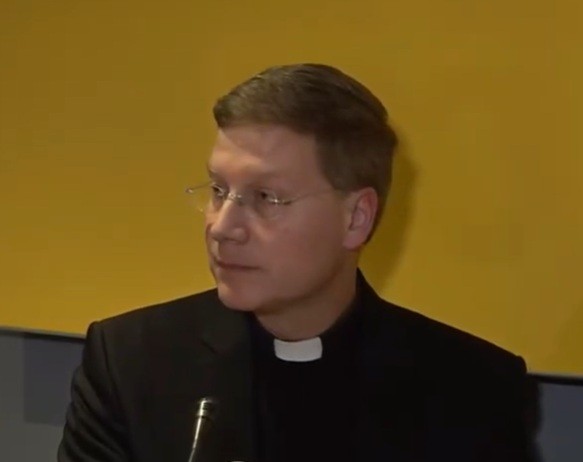
Fr. Peter Fuchs

In turn, Fr. Peter Fuchs, a German Catholic priest and member of the CSI, confirmed this and declared: “Christians in Germany today are concerned about the situation that is happening to the Armenian Apostolic Church in Armenia.”

Ishkhanyan of Armenian Center for Political Rights Speaks

“The campaign against the church and its ministers by the authorities is often interpreted as a conflict between the two sides, which puts a certain mark of equality and creates the illusion of competition, while this is not the case,” Rafael Ishkhanyan, president of the Armenian Center for Political Rights (ACPR), declared during the press conference.

Rafayel Ishkhanyan

He presented the results of the fact-finding mission and noted: “On the one hand, the state has a huge state apparatus, an absolute monopoly on the use of force, a monopoly on controlling the actions of the security forces. On the other hand, the church is a single religious organization. Therefore, equality cannot be drawn between the campaign carried out by the authorities and the actions of the church.”

According to Ishkhanyan, at first glance, the authorities’ campaign through the person of the prime minister was directed against individual figures, but later, it became understandable that this was directed against the church. He said: “When the prime minister brought the issue of changing the Catholicos to the agenda, this also touched on the rights of the faithful. We know that important events of citizens are directly related to the activities of the church.”

Ishkhanyan declared that one probably would not find a single right defined in international conferences that was not limited or violated during the campaign of the Armenian authorities: “The right to personal liberty, fair trial, and detention are the most frequently used means [for pressure]. We had seen violations of the right to fair trial in the case of the members of the same holy struggle, manipulation of facts and wiretapping, which mislead an entire society, creating the image that the members of the group had the intention to commit violence against society – not to mention the complete disregard of the presumption of innocence.”

(This report is the edited version of a translation of the original Zartonk article.)

Get the Mirror-Spectator Weekly in your inbox: