
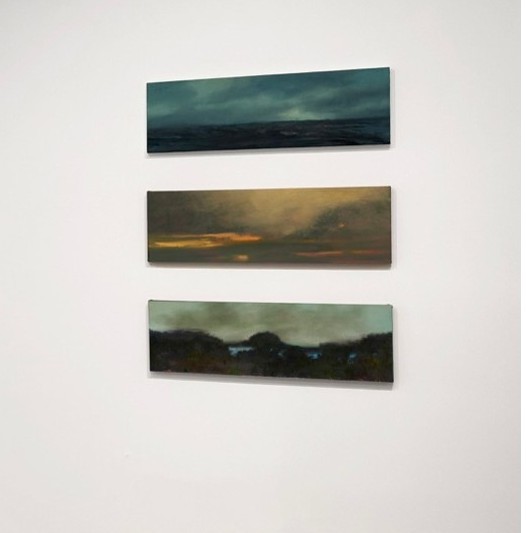
Guillaume Toumanian, “Distant Landscapes” (Series of 3), 2026, oil on canvas, 12 x 35.5 in.

Mellow Moodscapes at Guillaume Toumanian’s ‘Inwardness’

37
0

NEW YORK — Curated by Laura de Pontcharra, Guillaume Toumanian’s exhibition “Inwardness” at the Curator Lab in the 529 Arts Building in Chelsea introduces New Yorkers to a talented painter with a canny sense of the uncanny. Using a delightfully uncommon palette of midnight blues, glistening blacks, crimson reds, ochres and muted orange, he elicits in viewers a wide range of inner emotions. These hover somewhere between outright melancholia and bluesy unrest, through both landscape and portraiture.

They speak to us, and say something ineffable about the human condition, about its “inwardness” or inner life, as I take the painter to mean in the title used for the works on display.  The influence of Turner and especially Dutch and Flemish Lowland painters comes through strongly in these haunting mid-sized landscapes, with their ineffable and subtle play on light. The truncated bodies in others reflect both a philosophical mind/body schism, as well as our everyday estrangement from ourselves.

On the subject of Toumanian’s way with color, fellow critic Julie Chaizemartin recently wrote: “To enter Guillaume Toumanian’s paintings is to enter a nitescent darkness. Black gleams, not with classic chiaroscuro, but with a sheet of dreamy acidity of purplish and cobalt-blue stripes.”

Toumanian was born in Marseille in 1974 and divides his time between Bordeaux and Paris. He studied visual arts at Université Bordeaux Montaigne from 1993 to 1997, including drawing and painting workshops at the annex of the École des Beaux-Arts de Bordeaux. Since then, he has developed a distinctive visual language he describes as “landscapes of memory.”

He has held several solo exhibitions in Paris at the Lazarew de Pontcharra Gallery, which represents him internationally, and at the Luxembourg Art Week international art fair. He has also exhibited at the Chapelle des Cordeliers in Toulouse (2024), accompanied by the publication of a monograph by the Paris-based Éditions Lord Byron; Enraciné at the Centre d’art contemporain des Landes in Mont-de-Marsan (2020); and Variations at Galerie Samira Cambie in Montpellier (2018, 2021 and 2025). His career includes several major group exhibitions, such as Immortelle, at MO.CO. Montpellier Contemporain in spring 2023, which brought together eighty contemporary painters, as well as Luxe, calme et volupté at the La Malmaison Art Centre in Cannes.

At a time when contemporary art was dominated by conceptual art, photography and new media, Toumanian remained faithful to the traditional practice of painting. Emerging in the 1990’s he chose a path centered, as he explains, “not on irony, politics, or provocation, but on silence, contemplation, and the metaphysical.” As Dominique Rabaté has written on several occasions, painting for Toumanian is an “essential gesture.”
Get the Mirror in your inbox:

Toumanian’s practice is also informed by a renewed connection to his paternal Armenian heritage. His grandparents’ family survived the Armenian Genocide and settled in Marseille where a prosperous community of Armenian merchants has existed as far back as the 16th century. Like many Armenians, the Toumanians gradually lost touch with their ancestral roots as they rebuilt their lives. A visit to Armenia several years ago however, rekindled the artist’s interest in the country’s history and culture, inspiring a deep engagement with its contemporary artistic scene.

In 2022, he founded Projet Menk, whose name means “we” in Armenian, to foster exchanges between French and Armenian artists through residencies, exhibitions, and publications. The initiative creates opportunities for Armenian artists to gain visibility internationally, while enabling French artists to engage with Armenia’s cultural landscape.

Among the project’s activities are collaborations in printmaking and ceramics. In June 2024, the project brought Armenian artists Arman Vahanyan and Tigran Sahakyan to Paris for a residency at the prestigious Idem art printmaking studio. The collaboration extended into the publication This Morning, That Night in Yerevan, printed in Armenia by Editions Aivazian, accompanied by limited-edition printed engravings at Studio Sahakyan in February 2026. The book and accompanying limited-edition prints will be presented to the Parisian public in November at the Signatures Art fair at the Carreau du Temple. Fourteen artists have now created original prints through the initiative, several of which are available through the Projet Menk online site.

Over the decades, Toumanian’s mastery of pigments and his use of thinly layered oil and glazing have created a style both rich in depth and luminosity, while his use of sfumato and chiaroscuro recalls that of Caspar David Friedrich. Yet the artist’s take on classic oil painting is uniquely contemporary: the process is deliberately slow and forms are deliberately blurred or partially obscured. The paintings depend on uncertainty, on places recognizable but difficult to pinpoint.

There is also something strikingly contemporary about this way of treating an image. Toumanian’s blurred contours and unstable light suggest out-of-focus photographs or memories. But these are not paintings about technology. Interestingly enough, when first seeing these paintings last week, a distant memory etched in my head returned — it turns out that Mes Arménies blog editor Georges Festa, rest in peace, had used some of Toumanian’s landscapes to illustrate sections of a poem that rock musician Anne Hirshfeld had set to music. Sometimes life does imitate art and vice versa.

So what interests Toumanian as an artist? Not the perfectly preserved image but, as he states, “the image as it fades, flickers, or survives in memory.  quiet tension between the physical slowness of the paintings and the instability of the images they contain. Pigment is accumulated patiently, layer upon layer, while the forms themselves seem to be disappearing.”

Guillaume Toumanian, “Distant Landscapes” (Series of 3), 2026, oil on canvas, 12 x 35.5 in.

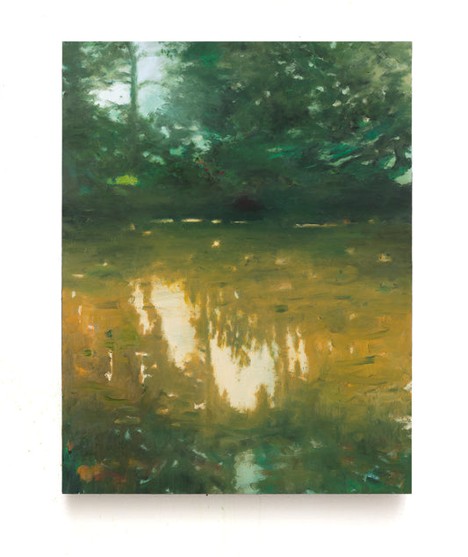
In “Double,” the artist depicts an eerily still forest and the shallow pond at its base, painted in ochre and different shades of vegetal green. The trees reflect down into the pool of water — everything seems both real and faded, like a memory we cannot quite recall, a place we have been many times but cannot quite place. It is both a specific forest and any forest. An almost pointillist method informs the work, but one is also reminded of Monet, absent the water lilies. Toumanian’s talent also lies in creating depth on a two-dimensional page and his ability to foreground objects and suggest space by dint of shading: the pond loses itself in the deep forest — whether it merges or ends towards the back is anyone’s guess. There is also the clever use of light, which is reflected in the water, almost otherworldly.

The vertical triptych entitled “Distant Landscapes” painted in deep blue, green and brown hues, as well as shades of dark brown, ochre and black recalls 19th century seascape painters such as Turner and another Armenian artist, the celebrated Crimean master Aivazovsky.

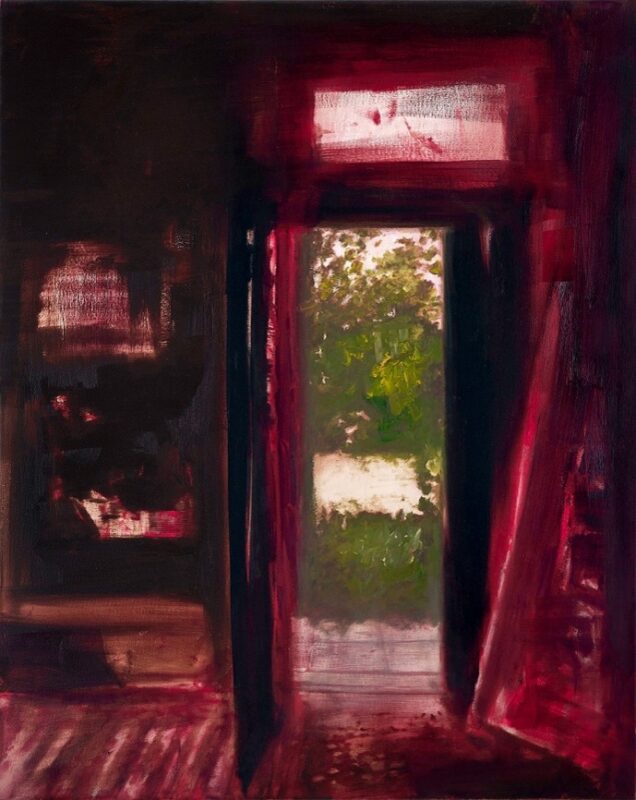
Guillaume Toumanian, “Threshold,” 2026, oil on canvas, 39 x 31.5 in.

Strangely enough, it is neither Toumanian’s Baconesque portraits nor his compellingly melancholy blue landscapes and seascapes that stay with one the most, but rather a deep glowing crimson work titled simply “Threshold.” This last work seems to recall an open barn at sunset, simultaneously brash yet subdued, where work has just ended, or perhaps a sexual tryst is about to take place.

The exhibition title “Inwardness” speaks to all these works and to our existential solitude and the inexorable dominion of nature over man. This first New York City exhibition was long in coming. The Curator’s Lab provides an important and unique way for artists of all stripes and genres to be introduced to the public in a salon environment in one of Chelsea’s modern if somewhat aseptic spaces. My one reservation about “Inwardness”: the works vary somewhat in quality and impact. A more selective choice of pieces and a better-considered arrangement could lend the exhibition a truly haunting power.

The Curator Lab, at 529 Arts, is located at 529 West 20th Street, New York City, and the exhibit runs from October 17 to November 4.

Get the Mirror-Spectator Weekly in your inbox: