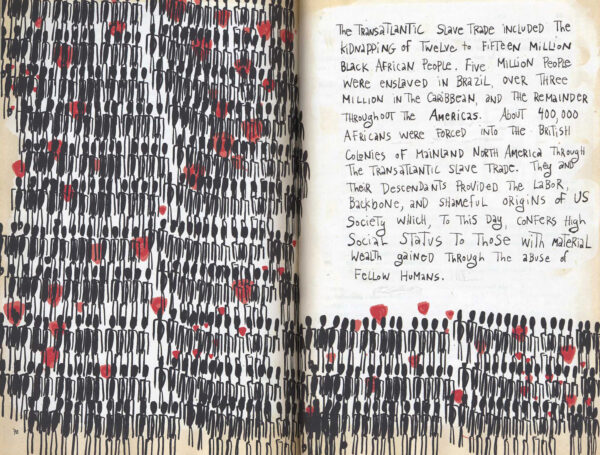

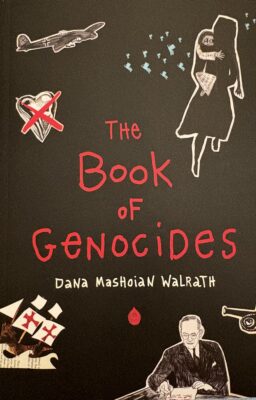
While a history lesson long overdue, Dana Mashoian Walrath’s The Book of Genocides (Harvard University Press, 2026), the graphic history in comic book format of 10 genocides spanning the past 500 years, is also very much about our current reality. Walrath’s is a deliberate attempt to expose, in its stark nakedness, the savagery that continues to plague mankind to this day. The ethnic cleansing of Artsakh in 2023 and the ongoing blockade and bombardment of Gaza are only two recent examples. “But our dreams can be different,” asserts the visionary who believes that getting the truth out will bring us a step closer to reclaiming our humanity. Even if it should take the millennia, the attempt to reform the world is worth the try, had declared that other visionary, Virginia Woolf, a century earlier.
Text and graphics intermingle in Walrath’s narrative to depict the full horror inflicted upon indigenous peoples by colonial settlers who forcibly remove local populations from the area they have called “home” for millennia so they can grab the land themselves. “Genocide is always a land grab,” writes Walrath, who minces no words to bring to light Australia’s history of convict settlement — the British government’s policies of forced assimilation and sterilization of the Natives — or the Ottoman government’s carefully planned and systematically executed deportations and the mass killings of the Armenian population living within its boundaries, in 1915, in its attempt to exterminate a whole people.
Also included in the book are the genocides of the First Peoples of the Americas, the Genocide of Black Americans, the Genocide of Jews in the Holocaust, the Palestinian Genocide, the Cambodian Genocide, the Tutsi Genocide in Rwanda, the Bosnian Genocide and the Rohingya Genocide.
Each chapter begins with a “History of the Genocide,” followed by an interactive section where Walrath invites the reader to actually engage in an act of violence herself, by cutting pages across dotted lines, with a pair of scissors, “to create a Turn-The-Flap Book that can generate thousands of ways human beings can dehumanize each other.” “The act of cutting is not one of desecration. Instead, I invite you to consider it a form of Liberation,” writes Walrath.
The Book of Genocides is not an easy book to read. The gut-wrenching facts — the accounts of the slaughters and the mutilations, the tortures, the lynchings, the neck-chaining, the use of fellow human beings as chattel, or the policies promoting the forced removal of children from their families are extremely distressing. Yet, at no point does one get a sense that the content is intended to sensationalize or to thrill. What shocks is witnessing the unimaginable and the unutterable made into historical truth. The challenge for Walrath must have been bringing the fiction, her story, closer to the reality of the cruelties she has made her mission to uncover. The barbarity is real.
“How come we don’t know?” has inevitably been my non-Armenian students’ response when introduced to the realities of the Armenian Genocide. The recognition of evil, any evil, is unsettling, but learning about scientists at leading research universities using Aboriginal children as laboratory rats in their medical experimentation is downright horrifying. If one could classify the cruelties committed by governments into tiers, shaming indigenous children into internalizing their biological and cultural inferiority would probably be in a higher grade than gun violence.