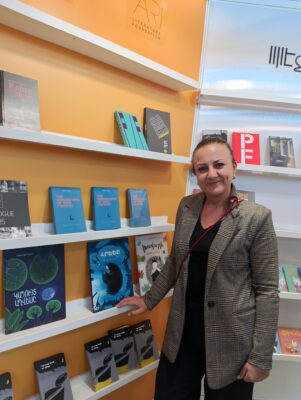


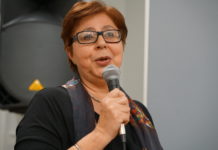
Arevik Ashkharoyan at the Armenia stand

Armenian Literature Takes its Place at Frankfurt Book Fair

28
0

FRANKFURT, Germany — The Frankfurt Book Fair is correctly considered the highpoint of the cultural year in Germany, especially among voracious readers, up-and-coming authors, children and of course the people who make it all possible: essayists, novelists, illustrators, translators, literary agents and publishers.

An estimated 235,000 people attended the fair, which opened on October 7 for the 4,000 exhibitors and 119,000 people in the trade and welcomed the public from October 9 through the weekend. The guest country was the Czech Republic and 137 other countries were represented at stands in the massive fairgrounds.

Among them was the Republic of Armenia, in one of the international publishers’ halls; the colorful stand displayed numerous new titles, in Armenian as well as translations. And the ARI Literature Foundation sponsored events contributing to discussion of important issues.

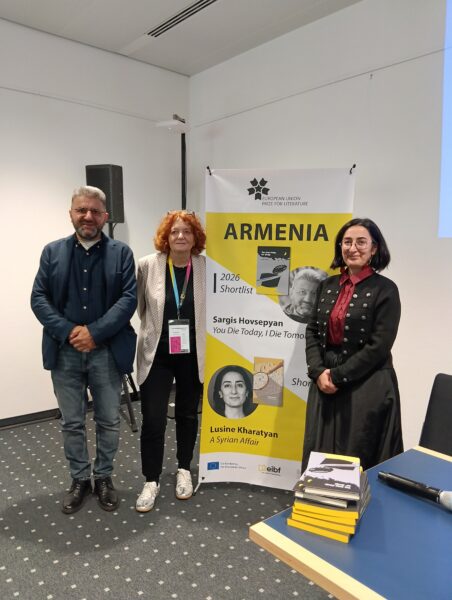
The first event hosted by the literary agents was an informal reception on the second day, “for conversation,” networking and the opportunity to meet Sargis Hovsepyan and Lusine Kharatyan, Armenian authors whose books have been in the short list of nominations for the European Union Prize for Literature (EUPL). The event was titled “Armenian Literature & Brandy.” Both authors appeared in panel discussions the following day, providing insight into their worldviews and works.

Literature in Times of Crisis     

The countless interviews, readings, round tables and workshops that filled each day addressed perennial topics like translation, as well as politically and socially relevant issues of our world today, among them, the rise of populism and right-wing extremism and especially the threat of AI; American historian Jill Lepore detailed in a keynote address how AI threatens freedom of thought and expression — books, reading, culture, the core of constitutional democracy. Whatever the theme, the role of literature and the importance of reading constituted the leitmotif of discussion.
Get the Mirror in your inbox:

The two Armenian shortlisted EUPL candidates shared insights with visitors in an event on “The EUPL Effect – Enlarging European Borders,” moderated by Anne Bergman of the EUPL. This literature prize, initiated in 2009, is an award for the best European up-and-coming authors, highlighting linguistic diversity and literary excellence among participants. It aims to lend greater visibility and prominence to all nominees beyond their home countries.

Lusine Kharatyan, born in 1977, is a cultural anthropologist from Yerevan, author of two novels, several short stories and essays. Her first collection of short stories Անմոռուկի փակուղի (Dead End Forget-Me-Not) was shortlisted for the 2021 EUPL and her second novel, Սիրիավեպ (A Syrian Affair) was a finalist in 2023. Last year she won the Saroyan Prize for Short Story of Yerevan International Book Fest and her works have been translated into English, Georgian, German, Greek, Maltese, Polish and Russian.

On the short list in this year’s competition is Sargis Hovsepyan, for his You Die Today, I Die Tomorrow, a novel that shows how past events impact the present. In the novel, Frida, a young woman in Yerevan, uncovers family secrets through research conducted on a forgotten victim of Stalinism. The past emerges in the present, in the year 2022, after the outbreak of the war in Ukraine leads to a flow of refugees into Armenia. The personal drama is reflected in the city’s history, the Soviet past and the challenging present.

Armenia, Language and Translation

During the discussion, Hovsepyan noted that those unfamiliar with the country, confuse it with Russia: “People think Armenians speak Russia,” he said; “some see Armenian as a Slavic language,” unaware of the fact that it occupies a category of its own among Indo-Germanic or Indo-European languages.

This led to consideration of the role of translators, of whom Kharatyan has had many. She praised her Polish translator as an “ambassador, a co-author in another language,” and her Georgian translator as “an advocate for Armenian literature,” noting that the quality of translation is crucial for success of any book.

Hovsepyan added the important, perhaps not widely known fact, that Armenia is the only country with a religious holiday commemorating translators, the Feast of Holy Translators, from Mesrob Mashtots on. Not all translations are successful: the Farsi version of Hovsepyan’s own novel was banned by an Iranian Ministry, he added.

Ignorance of Armenian culture is indeed widespread, as the discussants noted and translators have a difficult task. They must know the context of the work, for example, post-Soviet Armenia and Armenians, Western vs. Eastern Armenian, etc.

Bergman mentioned the close link of Armenians to their culture and offered that contemporary Armenian writers are not popular with Diaspora Armenians, who prefer classical authors. Here she spoke of the post-Soviet Diaspora. That said, Hovsepyan interjected that the Diaspora represents great potential, precisely because of its interest in world literature. The consensus was that translation has always been part of Armenian culture. Without it, the Armenians probably would not have survived as a culture.

From left, Sargis Hovsepyan, Anne Bergman and Lusine Kharatyan

Women in Literature and Publishing

Arevik Ashkharoyan, the founder and director of ARI, organized a second round table session on “Women Leading Cultural Change: Stronger Literary Markets Through European Integration.” Participants came from five countries in the Caucasus and Eastern Europe. All were publishers, each with a different background and focus.

Paola Erizanu, from Moldova, said she had been “born into literature” and loved to go to book fairs. Yulia Kozlovets, from Ukraine, had a sister who owned one of the first bookstores for children in Kiev and, as a child who loved to read, she wanted to follow her example.  Gvantsa Jobava, a member of the International Publishing Association from Georgia, said she was fortunate to have educated parents who supported her education. As a youth she wrote poetry that was published, even in Armenian translation. Her husband, a printer, had made posters for demonstrations when he was a member of the opposition and landed in prison. They both had a keen awareness that books and publishing could change the world.

Ashkharoyan noted that, although there are few women in publishing, they should prove themselves through their work, rather than fixate on the problem. Most of these women have had to deal with other problems, in particular censorship and state control. In Georgia, international financing in publishing is prohibited and anyone accepting funds would be legally charged with being an “agent.” Jobava said in fact for the past four years, the Georgia stand at the Frankfurt fair had been financed by independent publishers rather than the government.

In 2022, Kozlovets said, the Frankfurt Book Fair severed negotiations with Russia and other organizations followed suit. If special projects for publishing in Germany have been organized through the Foreign Ministry since then, they were due to years of networking beforehand.

For Ashkharoyan, “Ukraine is teaching us all a lesson.” In Armenia, she said, the 2018 revolution was followed by war. And Armenia still hosts Russian military bases. Yet, she said, this year world leaders came to Armenia for an EU summit and one of them, the Ukrainian president, said Armenia was a democratic country. In her words, during the Soviet era, “for 70 years we were neighbors, but never friends. Now through association, Russian, Armenian and Ukrainian writers are coming together.”

The same principle was at work in Moldova, Erizanu pointed out: after the Romanian-Moldovan border was closed, the two started building literary relations; with the same language, the same literature, they strengthened regional cooperation. In the 1990s, there was a literary boom, she said; books that had been prohibited in the Soviet era, appeared. People who had forgotten about neighbors, because regional relations were mediated through the USSR, began to understand the history oof their region.

Intercultural Exchange at Work

If the message transmitted by these gatherings was that intercultural exchange is the key to progress and understanding, it was manifest in a special way at the Armenian stand itself. Financial and personal support for the stand came from NOAH, an association founded by Ernst-Ludwig Drayss of Heppenheim, to promote cultural exchange between Armenia and Germany. NOAH contributed not only funds but also personnel and knowledge. Members of the association volunteered to help out at the stand, greet guests, introduce them to the exhibitors and tell them about Armenia’s cultural heritage and current offerings.

Among the volumes displayed at the stand was the richly illustrated book, Twenty Years of NOAH, issued by the association.

Get the Mirror-Spectator Weekly in your inbox: