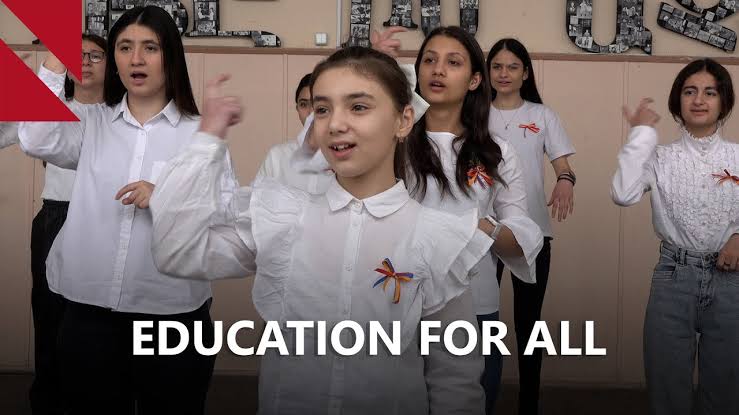
Deaf children in Armenia

Deaf Community Seeks to Have Access to Better Education, Inclusion

16
0

By Armik Grigoryan

Special to the Mirror-Spectator

YEREVAN — According to official and community estimates, there are over 3,500 to 4,000 deaf and hard-of-hearing individuals in Armenia, alongside a broader community of sign language users, interpreters, and family members who rely on Armenian Sign Language (ASL) for daily communication. Armenian Sign Language is not a recent invention, nor is it a direct translation of spoken Armenian; it is a language that has evolved organically.

Behind official summaries and project reports, however, the deaf and hard-of-hearing community faces an impenetrable wall of informational, educational and cultural barriers every day. Media materials, videos, and official pages created about deaf issues often lack ASL translation or adequate accessibility.

Community advocate Astghik Alaverdyan recently highlighted the negative impact of this inaccessibility in a social media statement regarding content created about deaf issues without actual  sign language translation.

“My husband is deaf, and sign language translation and context are completely inaccessible to him, just as they are to the entire deaf community,” Alaverdyan stated. “Producing materials about deaf people without involving them and offering inaccessible content constitutes pure discrimination.”
Get the Mirror in your inbox:

The native language of deaf individuals is sign language, meaning written text alone does not always ensure full comprehension. For a significant part of the community, written Armenian is a second language, making delivering information in their native language essential for both linguistic and cultural appropriateness.

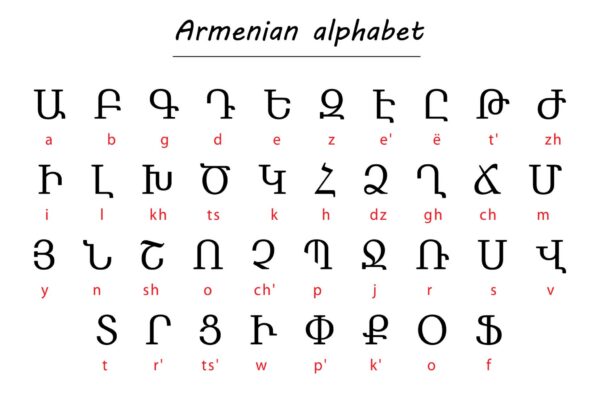
Armenian alphabet chart featuring characters with Romanized transliteration

In a statement provided to the Mirror-Spectator, representatives of the Armenian Deaf Society emphasized that community involvement in developing educational programs, textbooks, dictionaries, and methodological materials related to Armenian Sign Language remains dangerously inadequate.

“Today, the involvement of the deaf community in developing educational programs and dictionaries is neither sufficient nor systematic,” the Armenian Deaf Society stated. “Our firm position is that native speakers of Armenian Sign Language must be involved at every stage of the process — from collecting linguistic material to evaluating textbooks and methodological guides.”

These linguistic discrepancies become critically dangerous in classroom settings when non-deaf specialists or organizations invent artificial signs by translating spoken Armenian words verbatim, the statement continued.

They added, “When a specialist or project independently creates a new sign and presents it as ‘official,’ that sign is often either not used in the community at all or carries an entirely different meaning,” the Armenian Deaf Society explained. “If a teacher, an interpreter, and a deaf child use different signs for the exact same concept, the child is forced to learn conflicting variations rather than a unified linguistic system, hurting language development.”

The Society noted that the core reason the deaf community continues to be bypassed is that certain entities still view inclusivity as service provision rather than an equal partnership.

“Armenian Sign Language is not simply a tool of communication for which a new gesture can be ‘created’ at any moment — it is a natural language,” the Society emphasized. “explicit demand from the Ministry of Education, Science, Culture and Sports is that no program regarding Armenian Sign Language should be developed or funded without the genuine participation of the deaf community.”

The Armenian Deaf Society was founded in 1931.

In response to an official query, the Ministry of Education, Science, Culture and Sports clarified that the legal framework of Armenian Sign Language is regulated by the Republic of Armenia (RA) Law “On Language” and the RA Law “On the Rights of Persons with Disabilities.” However, the ministry acknowledged that an institutional framework for the development and approval of new signs is currently not fully established, and there is no mandatory procedure for state evaluation of sign language materials developed independently by private entities or NGOs.

To resolve this gap, the Armenian Deaf Society proposes a path forward based on the principle of “nothing about us without us.”

“We propose establishing a National Professional Commission for Armenian Sign Language with decisive representation of Deaf native speakers,” the Society outlined. “Decisions regarding Armenian Sign Language must not be made in place of the deaf community — they must be made with the deaf community.”

Get the Mirror-Spectator Weekly in your inbox: