

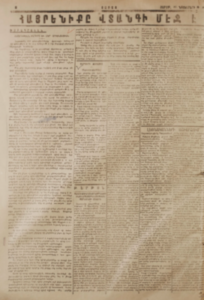
The original Armenian-language article

A Historical Document Relevant Today

28
0

The article reproduced below in English translation is an editorial taken from Harach, the official organ of the Hai Heghapokhakan Dashnaktsutiun (Armenian Revolutionary Federation), published in Yerevan. It is dated November 20, 1920 (page 2). The editorial was written against the backdrop of war and political crisis in the Republic of Armenia, caught between Bolshevik Russia and Kemalist Turkey.

The author of this editorial, Simon Vratsian, would soon become the last prime minister of the First Republic of Armenia and would hand over power to the Bolsheviks on December 2, 1920, marking the end of Armenian independence. At that time, he was a member of the Dashnaktsutiun Buro, the supreme executive body of the party. A few months later, Vratsian chaired the Committee of Public Salvation, the body that held insurrectionary power in Yerevan after the overthrow of the Bolshevik regime on February 18, 1921.

Two months later, after the Soviets returned in April, Simon Vratsian continued, first in Iran and then in the West, to advocate a pro-Western orientation and to extend a hand to Turkey in the name of a pragmatic approach to politics and the restoration of Armenian sovereignty. He shared this orientation with leaders such as Ruben Ter Minassian, Ruben Tarbinian, Hamo Ohanjanian, Arshak Jamalian, Mikael Varandian, and many others.

One hundred and six years later, in 2026, Armenia is experiencing an existential crisis, some characteristics of which echo the post-World War I era, with one major difference: while in 1920 the question of the borders between Armenian and Turkey were yet to be settled, neither republic today questions the existing borders.

One does not have to agree with every statement in this editorial to appreciate the value and relevance of the basic argument it makes.

Of course, this document is not the only one supporting the argument made in the editorial below. For example, in a report Vratsian presented to the Dashnaktsutiun Convention in the US in 1922, Vratsian argued that “the demand for a sea-to-sea Armenia is, at the least, childish.” (Hairenik Monthly, issue number 1.)
Get the Mirror in your inbox:

Reading this editorial reminds us how crucial it is to learn the right lessons from history and from the pronouncements of great Armenian figures of the period. And the most ironic aspect of this affair is that the official headquarters of the Dashnaktsutiun in Armenia is named after Simon Vratsian.

These considerations offer a few possibilities:

  • The Dashnaktsutiun in Armenia chose this name and endorsed all the writings of this former prime minister and member of the Buro of the Dashnaktsutiun. (Policy changes after 1933 had little to do with actual conditions in Armenia; rather, these were the political meanderings of an exiled now become a Diasporan party trying to find a degree of relevance in the Diaspora a changing international environment);
  • Or, the Dashnak party leadership today is not aware of the policy advocated by this editorial and is ignorant, or chooses to ignore, its own history. And that is a serious charge against a leadership that presents itself as the legitimate and faithful heir of an organization that is more than a century and a quarter old.
  • Alternately, the current leadership of the party could declare publicly that the Dashnaktsutiun, after its experience leading the First Republic, had reached certain conclusions and had adopted a view of Armenia’s future with which the current leadership disagrees. That is, not only does it declare evasively that “the party has made mistakes,” but that the leadership states specifically what were these mistakes and why are these policies now being assessed as mistakes. Otherwise, the party has no way to learn from history in general and from the history of this party, specifically.

But, sooner or later, the Dashnaktsutiun must decide what it represents in the Armenian world: a real political force that takes responsibility for its past; or a sectarian organization that relies on the image it wants to project and one that claims a legacy that has little to do with real history, certainly with its own history.

Gaïds Minassian

Jirair Libaridian

The Historical Editorial

The Problem of Reconciliation and of Our Orientation

Armenia is a state recognized de jure by the great powers. And this recognition is the supreme international achievement of our people.

The Armenian people, which has gained its independence with the sacrifices of millions of its children, can reconcile with the great contractions in its historical territory, can renounce many and many good things, but there is one thing with which it must never reconcile with, which it must never renounce. And that thing is the destruction of Armenia as an independent state.

Let Armenia be a small, even a very small state, but be independent state.

Being small is never an obstacle to future development. Greece was small when it was created and very weak, but now it is so big that it inspires fear even in a powerful state like Italy. Serbia was small, but now it is already a respectable state. Romania was small, but now it has multiplied, multiplied its territory and power.

The most important thing is the preservation of state independence, which is the greatest guarantee of the future development of the people.

From the point of view of great states, the existence of our state has as much meaning and value as it separates Turkey from Russia. The day when Armenia loses its independence and becomes a puppet in the hands of Russia, the only strong reason that forced and forces the great European states to accept the existence of Armenia as a state will disappear.

If Armenia wants to live as a state, it must avoid being a plaything of its great northern neighbor, Russia, at all costs.

On the other hand, our centuries-old enemy, Turkey, can finally come to terms with our statehood only when we once and for all renounce the Russian orientation.

It is true that Mustafa Kemal’s Turkey, which is at war with us today, acts as an ally of Bolshevik Russia. But it does not take great political wisdom to understand that Turkish-Russian friendship is a temporary alliance between two forces that are objectively and substantially opposed to each other in their interests.

It is no secret to anyone that the current friendship between the Turks and the Russians is an artificial bond that can be severed at any moment and will inevitably be severed when one or the other side has achieved its main goal.

Russia is the historical enemy of Turkey, and this hostility has never arisen from the subjective desires of the rulers, but has been an inevitable result of the objective conditions of the existence and development of the two states and peoples.

That is why neither the Bolsheviks nor the Kemalists can change themselves, change the ideological direction of their statehood, just as England became Russia’s ally during the last European war, because that was England’s temporary interest. But that alliance did not prevent England from remaining Russia’s greatest and most dangerous enemy.

It is not by being with the Russians that the Armenian people can ensure its existence and the existence of its state. Because the presence of the Russians in Transcaucasia, under the current international conditions, cannot be permanent and it will inevitably, sooner or later end, as soon as the Russian problem is resolved.

Russia itself, through the mouth of its Bolshevik rulers, has repeatedly stated that it is ready to respect and recognize the interests of England in Transcaucasia.

The Armenian people and Armenia cannot tie their fortune with a state which, by its own admission, will withdraw from the borders of Transcaucasia if England and other great European powers are willing to reconcile with its existence.

For its salvation, Armenia has only one way – to find a common language directly with its neighbor, the Turks.

If the Armenian people wants to live and ensure its state and physical existence, then, as a matter of fact, it must have not a Russian, but a Turkish orientation.

And if the Armenian people had not had a Russian orientation during the last pan-European war, but had sided with the Turks without reservation, in all probability, it would have avoided the massacres and their situation would have been even better than that of the Georgians.

Once and for all, we must understand that it is not by relying on foreigners that we can truly achieve peace for our people, but only by relying on our own forces that we will determine our fate with our strong neighbors, with Turkey.

Any foreign intervention, especially Russian intervention, can only be detrimental to the lasting peace between the Armenian and Turkish peoples.

Because the foreigner will first muddy further the atmosphere of mutual distrust that already exists between the two centuries-old neighbors and make a firm agreement impossible. And second, the foreigner will try to make us a tool in pursuit of its own interests and goals; from the foreigner’s point of view, a sincere and genuine Armenian-Turkish reconciliation is not really desirable.

Meanwhile, the Armenian people, like the Turkish people, is in need of a genuine reconciliation.

We have been deceived enough by foreigners.

Let us place our hope only on our own strength and speak with our enemy face to face, without “benevolent” intermediaries. And what we will achieve in this way, in any case, will be something more reliable, more stable, and more hopeful than what we can obtain through the efforts of intermediaries.

Get the Mirror-Spectator Weekly in your inbox: