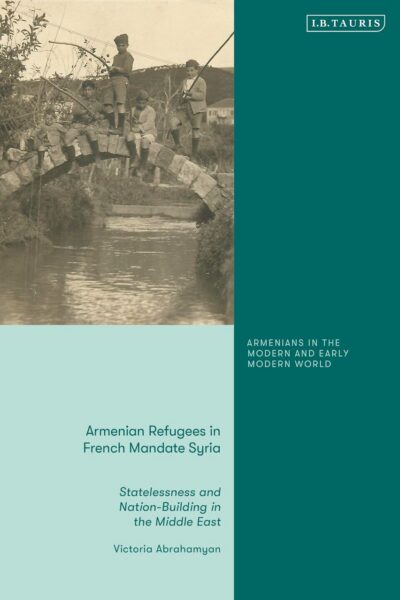



LONDON/NEW YORK—I. B. Tauris, an imprint of Bloomsbury Publishing, has announced the publication of Dr. Victoria Abrahamyan’s Armenian Refugees in French Mandate Syria: Statelessness and Nation-Building in the Middle East. The book is part of the series Armenians in the Modern and Early Modern World edited by Bedross Der Matossian (University of Nebraska, Lincoln).
In the aftermath of the First World War, the Armenian Genocide, and the Turkish War of Independence, Syria became home to thousands of Armenian refugees. In this comprehensive history covering 1920 to 1948, Victoria Abrahamyan foregrounds the experience of Armenian refugees in the Syrian Jazira as they navigated competing state-building efforts led by the French mandatory power, Syrian nationalists and Soviet Armenia.
The book reveals the refugees’ agency amid internal conflicts and diverse loyalties. It sheds light on the intricate power struggles over their status and belonging, particularly through competing French and Soviet post-war refugee settlement schemes, in a critical frontier between Western imperialist powers, the Soviet bloc, and Turkey. Drawing on Armenian, Arabic, Russian, and French sources, the book explores how the Armenian refugee community responded to the rise of Arab nationalism in Syria, complicating simplistic sectarian interpretations of their place and reception in interwar Syria.
By situating this history within the broader context of Armenian experiences in the Eastern Mediterranean and the role of refugees and displaced populations in state-building in the post-war Middle East, this study offers essential reading for students and scholars of Armenian and Middle Eastern history alike.
Abrahamyan commented on the book, saying, “Armenian Refugees in French Mandate Syria seeks to provide a nuanced understanding of the Armenian refugee experience in interwar Syria, challenging conventional Western narratives that portray Armenian refugees as voiceless, as well as dominant Arab nationalist accounts. The book explores the formative post-Genocide years, showing how Armenian refugees played a crucial role in shaping state- and nation-building processes in interwar Syria. Positioned at the intersection of competing state-building projects led by the French mandate, Syrian nationalists, and Soviet authorities in Yerevan and Moscow, Armenian refugees and their leaders exercised remarkable agency—navigating, negotiating, and at times resisting these pressures. In this sense, the book represents a History from Below.”
According to her, the book, for the first time, situates the Armenian refugees within broader geopolitical struggles. It examines how the French authorities, the League of Nations, Turkey, Soviet Armenia, the USSR and local Syrian actors sought to influence the settlement and political trajectory of Armenian refugees. Specifically, it traces the entangled history of Armenian refugee settlements under the French mandate and their intricate connections to repatriation efforts initiated by Soviet authorities. By connecting the Armenian refugees’ experience to global power dynamics, the book illuminates the interplay between refugees, state-building, and the longstanding involvement of foreign actors in Syria to control populations, resources, and trade routes. Reflecting on the early decades of the twentieth century, when various powers vied for control over Armenian refugees, offers a lens not only for understanding Syria’s past but also for grasping the enduring relevance of displacement, agency, and geopolitics today.