

Pressure on Iran Intensifies

63
0

In recent days, developments surrounding Iran have been unfolding at an extremely rapid pace, with possible scenarios pointing in very different directions. Just a week ago, President Trump was dispatching naval forces to the Middle East, stating that he hoped Iran would come to the negotiating table. Meanwhile, US Secretary of State Marco Rubio declared that the option of preventive strikes against Iran was currently on the table. Iran, for its part, announced that its armed forces were prepared for any possible developments, despite the protest actions taking place inside the country.

Shortly thereafter, US naval forces — specifically the aircraft carrier Abraham Lincoln and its accompanying strike group — were deployed not far from Iran’s maritime borders, prepared for possible action. However, no such action ultimately took place.

The next phase was marked by a significant escalation of US pressure: the imposition of sanctions on countries trading with Iran, along with intensified diplomatic activity by three Arab states of the Persian Gulf allied with the United States seeking to persuade President Trump to pursue a deal rather than war.

The subsequent phase involved concrete steps by third countries. First, several states began evacuating their citizens from Iran, while others announced their intention to designate the Islamic Revolutionary Guard Corps as a terrorist organization.

It is evident that we are currently dealing with a situation in which developments around Iran are unfolding according to a phased logic. In the initial phase, large-scale protest actions took place inside Iran. The authorities managed to contain and stabilize the situation, and no external intervention — at least in the form of military action — occurred, despite strong pressure and harsh rhetoric from the United States.

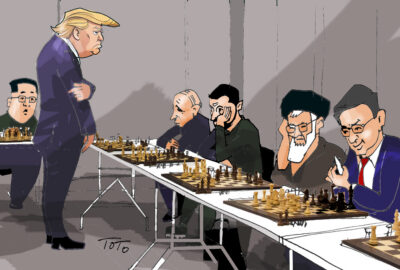
It is clear that President Trump, consistent with his negotiating style, is applying maximum pressure on Iran with the aim of forcing the country’s leadership to sit down at the negotiating table and ultimately abandon its nuclear program. Trump used this tactic before with different countries such as North Korea. At the same time, Iran has consistently stated that its nuclear program is exclusively peaceful in nature, a claim that Washington does not accept. It is also evident that within the Trump administration there are influential circles advocating a hardline approach toward Iran and pushing for the implementation of tougher measures against Tehran.


Get the Mirror in your inbox:

As for a change of power or a revolution, conditions that could have enabled such a development existed weeks earlier, when mass protests were taking place across Iran. At that time, President Trump chose not to take any action and instead waited to see how events would unfold. Undoubtedly, this decision was made on the basis of careful political calculations and assessments of intelligence information.

Of course, the key question remains what objective the United States is pursuing with regard to Iran: whether it is seeking the overthrow of the current authorities, merely attempting to bring them to the negotiating table, or contemplating Iran’s possible fragmentation along the lines of Iraq or Syria. The coming developments will provide answers to these questions. However, it should be taken into account that if the Trump administration had aimed to overthrow the current authorities, such an opportunity may have presented itself during the period of mass protests, when it appeared that demonstrators were quite close to achieving a change of power. The administration’s decision not to intervene at that moment suggests that its objective was somewhat different from simply pursuing a revolutionary change of power in Iran.

At present, developments around Iran appear to have somewhat receded into the background of the international news agenda due to the Jeffrey Epstein scandal in the United States. Leading media outlets are more focused on this issue than on the possibility of war with Iran or negotiations. Nevertheless, the New York Times reported that talks between the United States and Iran are expected to take place in the coming days, which could bring a degree of clarity to this highly volatile situation.

Naturally, the issue that concerns us most is what might happen in the South Caucasus in the event of a large-scale war. In reality, beyond the risks already present in the South Caucasus — discussed in my previous article — there is another important factor that deserves attention: the strengthening of Turkey’s position in the region. Historically, Russia and Iran have served as counterweights to Turkey in the South Caucasus, limiting Ankara’s role and influence and preventing more active Turkish involvement, including in the context of the absence of Armenian–Turkish relations.

Today, however, international politics appears to be moving in a direction where such counterweights to Turkey in the South Caucasus are diminishing. Iran finds itself in a complex domestic and foreign policy situation and is likely to focus primarily on confronting the United States and Israel rather than advancing its interests in the South Caucasus or elsewhere due to limited resources on the ground. The same applies to Russia, where no resolution to the Ukrainian crisis is in sight, draining Moscow’s resources and limiting its ability to consolidate its position in the South Caucasus.

As a result, it can be stated that for the first time in modern history, Turkey is emerging as the principal player in the South Caucasus, with all the political, economic, and geopolitical consequences that this entails. It is evident that Turkey is not only beginning to take advantage of this historical opportunity but is already doing so in full.

Get the Mirror-Spectator Weekly in your inbox: