
Tatyana Yangaykina

Tatyana Yangaykina: From the Depths of Mordovia to the Heart of the Armenian Soul

22
0

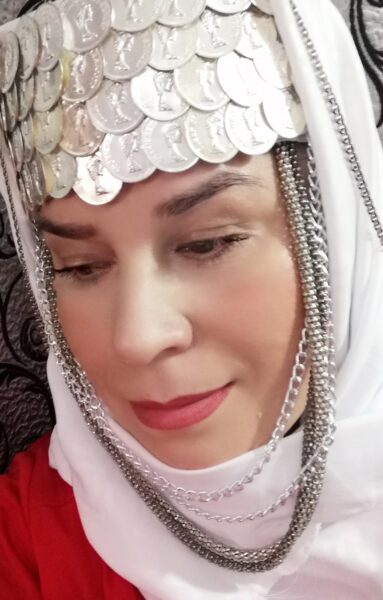
YEREVAN/SARANSK, Republic of Mordovia, Russia — Tatyana Yangaykina (born in 1978 in the village of Adashevo, Republic of Mordovia) is a Russian ethnologist. A member of the Moksha people, she was born in the Republic of Mordovia, a region in European Russia that is the historical homeland of the Finno-Ugric Moksha and Erzya peoples.

In 2000, she graduated from Mordovia State University. In 2008, she defended her doctoral dissertation at Mari State University. Since 2011, she has been a senior researcher at the Research Institute of Humanities under the Government of the Republic of Mordovia. Her research interests include Moksha vocabulary, the spiritual and material culture of the Mordovian people, and Armenian community of Mordovia. Since 2023, one of her research areas has been the artistic legacy of K. M. Magomedov, an Honored Artist and jeweler of the Russian Federation. In June 2026, she was awarded a certificate of honor by the Ministry of Culture of the Republic of Dagestan for her educational work, active promotion of Dagestani art. She is the author of more than 130 scholarly works.

Yangaykina was a finalist in the Second International Nikolai Marr Armenian Studies Competition, founded by Garnik Asatryan, director of the Institute of Oriental Studies at the Russian-Armenian University, and Vadim Fefilov, head of the Russian House in Yerevan. For her scholarly publication Armenia–Mordovia: Intercultural Interaction and Dialogue of Cultures, she received a special certificate of honor from the organizers.

Dear Tatyana, I have always been interested in how less numerous peoples (I dislike the term “small peoples”) preserve their languages. In our globalized world, this challenge is becoming increasingly difficult. How are the Mordovian people dealing with this problem?

Barev dzez, Artsvi Genrikovich! I also do not accept the term “small peoples.” It is inappropriate when referring to different ethnic groups; a people cannot be small. Every people is a separate, distinctive universe with its own unique cultural code. Is there a problem with preserving the Mordovian languages in the republic? I don’t think so. Today, schools in Mordovia are the main foundation for preserving Moksha and Erzya languages. We have good radio and television programs in the national languages. The state has established a continuous system: the foundations are laid already in kindergartens, while at school the languages are studied in class and reinforced through digital platforms and ethnographic museums. School prevents native speech from disappearing from the official sphere and makes studying it a normal part of life. But it is important to understand that school provides the foundation and knowledge; whether children will come to love the language and speak it in the future depends on the atmosphere in their families.

You study the material and spiritual culture of the Armenian community in Mordovia. How did your interest in Armenia begin? Do you speak Armenian?
Get the Mirror in your inbox:

My path toward the study of Armenian culture began with a chance meeting in Saransk with a shoemaker, Ishkhan Djanibekovich Chakhoyan. One day, during a conversation, he told me bitterly that his father — a well-known builder who had helped shape the appearance of our city — had been unjustly forgotten, and that his family was not mentioned in any book. His words touched me deeply. I promised the craftsman that I would piece together the history of his family and preserve it for the city. It was this human story that became the spark from which my major scholarly journey into the depths of the Armenian soul began.

As for Armenian studies and the Armenian language, I am still at the beginning of this profound journey. I know Armenian at the basic level of etiquette and greetings. For me, this is a sign of deep respect: whenever I speak before the Armenian scholarly community, I always greet them and say my first words in their native language, although I am still learning to speak it properly.

Your book Armenia–Mordovia: Intercultural Interaction and Dialogue of Cultures was recently published in Yerevan. Would it not have been more appropriate to publish it in Russia rather than here?

My monograph is, from the outset, a Russian publication. The first, electronic edition of the book was published in Moscow under the prestigious imprint of the Dmitry Likhachev Russian Research Institute for Cultural and Natural Heritage (Heritage Institute). It is an academic work recognized by the Russian scholarly community. As for Yerevan, the book was published there as a second, expanded print edition. In other words, Armenia was chosen as the place where the book would be printed, making it accessible to colleagues abroad as well, but its scholarly “heart” is entirely Russian.

How many Armenians live in Mordovia today, and what particular contribution would you highlight from the Armenian community to the life of the republic?

According to official figures, 1,356 Armenians live in Mordovia today. Their contribution is very diverse: they include builders who helped shape our cities, entrepreneurs, doctors, talented artists, and skilled craftspeople. I think census statistics do not always reflect reality with complete accuracy. Many Armenians are constantly on the move, creating and working, so not everyone ends up in official reports. I am convinced that there are many more Armenians living in the republic. And now, as a researcher, I am considering new ways — through personal meetings and the community’s internal networks — to establish their exact number.

The Russian linguist Roman Stackelberg compared 58 words from Finno-Ugric languages with Iranian languages and Armenian, and among other things identified a similarity between words meaning “person”: in Armenian, mard (man), and in Mordovian, mirti. Have you found other interesting parallels between Armenian and the Mordovian languages?

Yes, and these parallels are truly astonishing. The earliest layers of the Mordovian languages are connected precisely with ancient contacts. But the most remarkable thing happens when you encounter such parallels in real life.

In 2025, I took part in an international Armenian studies conference in Gyumri. As I listened to a presentation in Armenian, I suddenly realized that I was hearing familiar Moksha sounds. After the presentation, I approached the speaker and asked about the Armenian word verev. It turned out to mean “upper” or “above.” And in my native Moksha language, the word vyare has exactly the same meaning. It was an incredible moment of discovery. This layer of ancient linguistic connections still needs to be studied in depth, and this accidental thread, Artsvi Genrikovich, you have now opened up for me, giving me a new subject to think about.

I would also like to share an amazing story. Recently, when I visited the editorial office of Literaturnaya Armenia magazine in Yerevan, I met with its editor-in-chief, the respected Albert Mamikonovich Nalbandyan. He told me that he had heard the surname Yangaykina for the first time and was struck by how deep and interesting it sounded. Albert Mamikonovich said with a smile: “Tatyana, there is a lot of Armenian in your surname—YAN is the ending of Armenian surnames, GAY (hay) means Armenian, and KIN means woman.” I should note that my family name has purely Moksha roots, with the following etymology: YAN means path or footpath, GAY means resonantly or loudly, and KI means road.

Did you know that another of Mordovia’s smaller ethnic groups, the Erzya, also lived in Armenia? According to 1934 statistics, 419 Mordovians lived in Soviet Armenia. In 1994, the Armenian press published an article by Harutyun Minasyan about the small community of Erzya Molokans in Armenia.

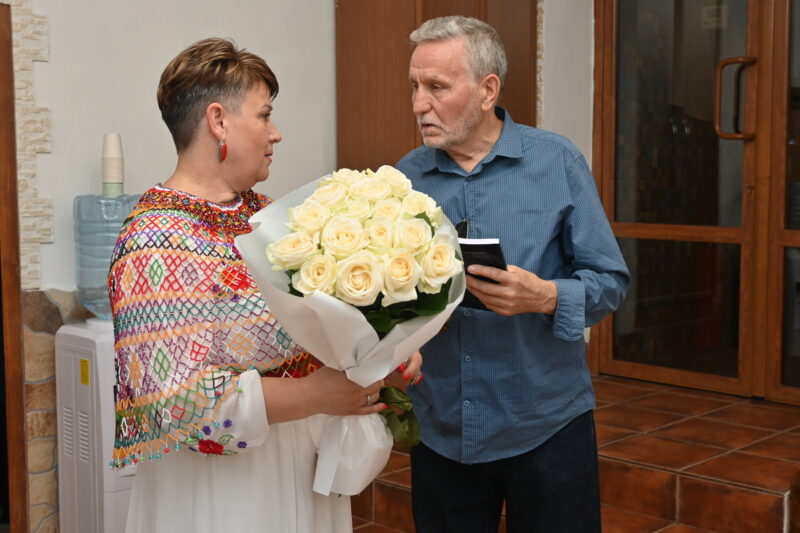
Tatyana Yangaykina and an Erzya man, Isai Ivanovich (Yerevan)

They still live in Armenia today, and I know them personally. It all began during my first trip to Yerevan, when I was invited by the Russian House. Professor Viktoria Aleksandrovna Arakelova introduced me to the well-known journalist and poet Elena Shuvaeva, who studies the Molokans of Armenia. Thanks to her, I was able to visit the village of Shoghakat (formerly Nadezhdino or Shorzha), where our Mordovian Molokans were settled as early as 1840. I spent several days there collecting unique ethnographic material and studying an old Mordovian cemetery. In 2025, I then researched the cemetery in Nubarashen district of Yerevan and met with Mordovians living in Yerevan. One of the things I was especially proud of was that a representative of the Molokan community, an Erzya man named Isai Ivanovich Grigoriev, attended the presentation of my book. It was incredibly gratifying to see a fellow countryman in the audience. Thus, the history of the Mordovian Molokans in Armenia is another important area of my scholarly work — one that was born thanks to this remarkable country.

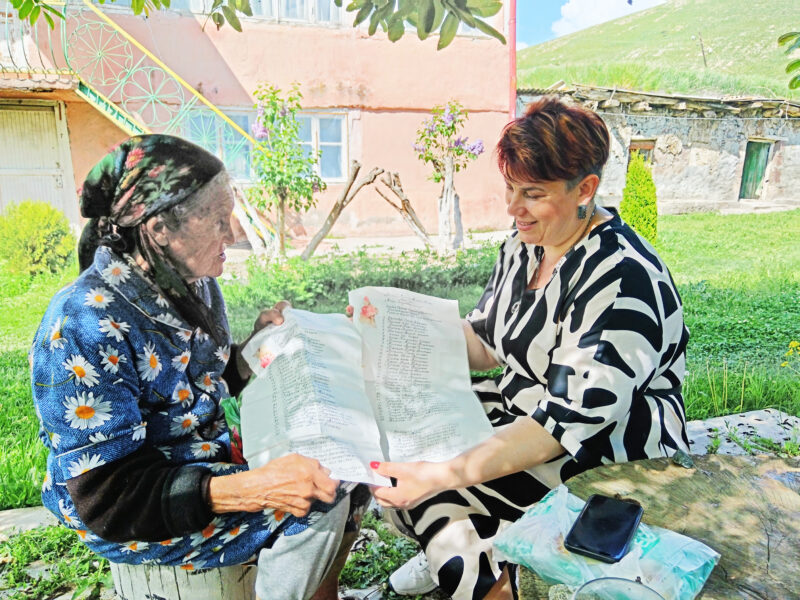
Tatyana Yangaykina and an Erzya woman, Evdokia Matveevna (Shoghakat village, Armenia)

Last August, you climbed Mount Ararat. Please share your impressions and tell us about the experience.

Yes, I really did have that experience. A year ago, my colleague, friend and intellectual inspiration, Elena Alekseevna Shuvaeva, suggested that I climb to the peak of Ararat. It happened just before the presentation of my book, which took place on August 11. Two days earlier, on August 9, as preparation and acclimatization, Elena, an experienced mountaineer, took me to Mount Aragats, the highest point in Armenia. To be honest, it was not easy: I have a phobia and am terrified of heights. But I successfully overcame that barrier and unfurled the flag of my native Mordovia at the summit of Aragats. We spent several days making our way toward the sacred Mount Ararat. We set off on August 14, and on August 16 an initiative group from the organization DIALOG — Elena Shuvaeva, as its adviser, and myself, as a regular contributor to an information portal — together with our friends from Russia, Armenia and Italy, successfully reached the peak of Greater Ararat (5,165 meters).

I often hear people say that this sacred mountain does not allow everyone to reach it. Perhaps that is true. Anyone can set out toward it, but how you make that journey is what matters. And this is not really about physical preparation, but about one’s spiritual state. A person who goes there with impure intentions, envy, or malice in their heart truly will not make it to the top.

Do you know what this mountain gave me? Humbleness and tremendous patience. Up there, I was not fighting physical hardship or the peak itself. A mountain is a mirror: it exposes a person’s true nature and shows who they really are.

Do you have any further plans connected with Armenia?

You know, I am a cautious and somewhat superstitious person, so I am always afraid of jinxing my future plans by talking about them too soon. But I can say this much: Armenia is a country that has entered my soul forever and become part of my scholarly projects. God willing, I will continue to visit this remarkable land with pleasure. And not only for research anymore — my dear Armenian friends live here, and I deeply value my conversations and friendship with them.

Get the Mirror-Spectator Weekly in your inbox: