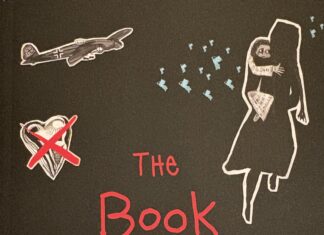

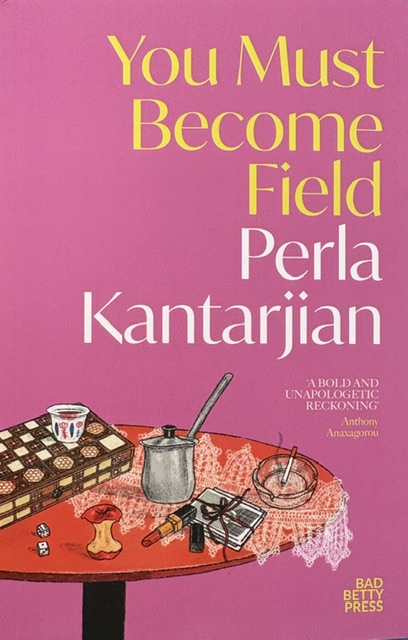
The poems in Perla Kantarjian’s debut poetry collection You Must Become Field (Bad Betty Press, 2026) have an urgency that can only come from a heart that carries within itself the cruelty of a history that killed a million to a million and a half of “us” and brought her family from Historic Armenia to the shores of Lebanon. “Karaman, Anatolia: my great-great-grandfather/a fabric merchant in the local market, Agha they called him/powerful man, yards of cloth so abundant they named him/for measure itself: Kantarjian. His son, grandfather Haroutioun/fled the massacres with fabric still folded in his hands, the trade/carried across the sea to Corfu, where the air remembers him. . . . Then, Piraeus, shoe-shine boys/until the sea carried them to Lebanon . . . In Bourj Hammoud, exile’s capital in Lebanon, Harutyun’s sons—my father and uncle carried the trade forward . . . . I am feeding you fragments/because that’s all I have. Gather what you can,” writes the poet candidly in “I Will Feed You Fragments,” the prose poem that opens the collection.
In “I Imagine The Writers,” Kantarjian conjures up April 24,1915, the date that marks the beginning of the Armenian Genocide, when Armenian elites in Constantinople were arrested and moved interior to be executed: “Komitas is on the train to Cankin. I am in the cattle-car with him, standing in the stench and crush of familiar bodies. He is humming—did you know that? . . . I watch the mouth move. Watch the humming stop. . . . Komitas hums louder, trying to drown out the screaming, the weeping, the smell of shit and fear and Cankin getting closer.”
With her stunningly bold images Kantarjian depicts the arrests, the forced marches — “Hundreds of miles under a sun/that would not move . . . We smelled our dead/before we saw them. The thud of bone on bone./Skulls on rocks. Tongues eaten by flies./Children shrieking without sound.” “I left the jar of apricot preserves cooling on the window sill./I left the key under the tile. For the neighbours. For no one,” vividly evokes the disruption to peaceful everyday lives caused by one’s forced removal from one’s land. Equally evocative is the depiction of the September 2023 exodus, more than a century later, from Artsakh:
I am driving every vehicle in the convoy of thousands—
Ladas, buses, flatbed trucks, mattresses roped to roofs.
I am every quilt stacked to the ceiling. I am every fruit jar rattling.