
Tina Afiyan Breiova

Tina Afiyan Breiova: ‘The Armenian Spirit Is Made for Art’

241
0

YEREVAN/LONDON — Tina Afiyan Breiova, born in Slovakia in 1993, is an award-winning movement director, performer, choreographer and educator based. A graduate of P.A.R.T.S. in Brussels and the Duncan Centre Conservatory in Prague, she has built a distinctive multidisciplinary career at the intersection of dance, theatre, film and circus.

As a performer, Tina has collaborated with internationally renowned artists and companies including Marina Abramović, Gecko Theatre, Alexander Vantournhout, Roberto Oliván, Thomas Ryckewaert, Milan Tomášik, Cie Willi Dorner and Cirk La Putyka.

Her work in film and music videos includes collaborations with Paul Thomas Anderson, Thom Yorke, Damien Jalet, Simon Riechel, Emma Farnell-Watson, Joe Connor, Emile Rafael and Ran Li, alongside experience within the movement departments of productions for Warner Bros. Pictures and Universal Pictures.

As an independent choreographer, Tina has received recognition for her solo “Shalakho” and duet “Blue Gloom.” Her duet “Ruina,” inspired by the 1988 Spitak earthquake, has toured across Europe and Central and South America. She is regularly invited as a movement director and choreographic collaborator on new productions, bringing together physical performance, dramaturgy and interdisciplinary creation.

Tina’s current research explores the relationship between AI, sound and immersive performance, developed in collaboration with AI specialist Colas Fiszman and sound designer Laurent Delforge. She is also the founder of Axis of Action, an evolving interdisciplinary training and performance methodology that she teaches and develops internationally.

Since 2020, Tina has lectured at London Contemporary Dance School at The Place, joining the course team for the MA Dance: Performance program in 2023 — one of the leading postgraduate dance courses in the United Kingdom.

Get the Mirror in your inbox:

Dear Tina, you have worked across dance, theatre, circus, music videos, and major film productions. How does your approach to movement direction change between live performance and the cinematic medium?

That’s a good question. I’d first say that I approach movement direction through the lens of a dancer. In the same way that actors who direct bring something different to the process than those who have only ever directed, I come to this work as a dancer by craft — I have the embodied knowledge, and I share the same language as the performers I work with.

The frame is completely different between live work and film, but the essence — having to be fully present — remains the same. On camera, you’re choreographing what the lens sees, so my job shifts from directing energy outward into a room, to directing precision into a frame that will be watched. But the question I’m always asking stays the same: what does this movement need to communicate?

Having collaborated with artists such as Marina Abramović and Paul Thomas Anderson, what have these interdisciplinary cooperations taught you about the expressive possibilities of the human body?

Oh! This question makes me think about the fact that I’ve always enjoyed a wide range of work, and when I look back, I really have tried so many genres. Working with Paul Thomas Anderson on “Anima” (which you can see on Netflix) was completely different to working with Marina Abramović at the Royal Academy of Arts. On “Anima,” I only played a small role within the choreography by Damien Jalet; it was really just a chance encounter that I ended up doing it at all.

But what I learned, mainly from watching Thom Yorke and the incredible professional he is, was where the similarity lay: endurance. You have to stay committed when you’re doing one take after another, and it’s the same with Marina’s work — you have to commit fully when you perform it.

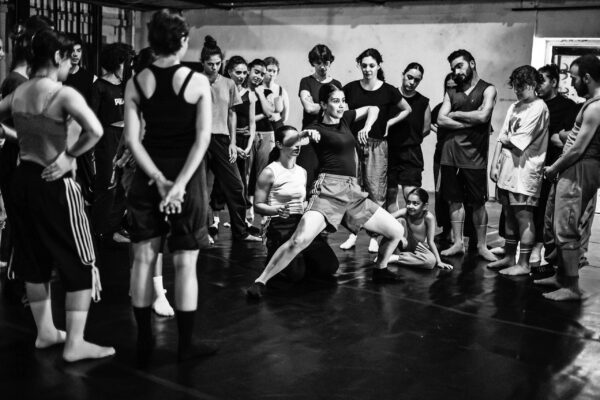
Tina Afiyan Brieova demonstrates choreography.

As the founder of Axis of Action and an educator at London Contemporary Dance School, what principles do you consider most essential for training the next generation of performers and movement directors?

This is exactly what we were asking ourselves when we were creating the MA in performance course. And I’m lucky, because my practice. Axis of Action takes me to so many different countries, festivals and institutions, which means I get to see the tendencies that are arising across the field.

What we’re seeing is that dancers are less often employed within one theatre or company for many years — in fact, most are now freelancers. To survive and succeed in a very competitive industry, they need to be versatile and unafraid to experiment with different styles and ways of working. They need to keep their minds open.

Your acclaimed duet “Ruina” is inspired by the 1988 Spitak earthquake in Armenia. What first drew you to this subject, and how did you translate such a profound historical tragedy into movement without words?

Well, let’s start with the fact that I merely tried — you cannot truly translate such a tragedy. The duet was less based on the earthquake itself, and more on what it left behind: the spaces that were once full of life, now destroyed and empty. It wasn’t the event itself that drew me in, but its consequence.

I was lucky to work with two brilliant dancers, and I focused mainly on the idea of interdependence. We wanted to create movements that would not be possible if the other person weren’t there.

You come from an Armenian and Czech family. Your mother Gayane Breiova is a well-known restaurateur, cookbook author, and TV presenter, recognized for promoting traditional Armenian culinary heritage in Moscow and Prague. Could you tell us how your multicultural background has shaped your artistic identity?

I think art is personal at its core. Every culture I’ve encountered — even the ones that shaped me just by living there — is part of my identity. I’ve lived in seven countries now, so I’ve picked up a lot of influences along the way.

My mum, originally from Yerevan, has always been an advocate for Armenian culture, and her way of expressing it is through food — she’s incredible at it. When I came back to visit her after living in China, she made tolma, and I cried. Food is memory, and it’s one of the most primal kinds. My dad always spoke Czech to us growing up, and it’s probably my strongest language today. Language shapes how we understand the world, and speaking Russian, broken Armenian, English, and Czech all shapes my thinking — and by extension, my art.

Recently the contemporary dance scene in Armenia has become vivid. What was your experience from your workshop in Yerevan last August 3-4?

I was delighted to teach in Yerevan. I must say I still don’t know the dance scene there well enough — I’d love to know it more, so please feel free to educate me whenever you have a moment.

The workshop was an opportunity to understand the field by actually being in the studio. My main expertise is teaching at a professional level, working with dancers who are already established in their craft. To build a scene with that kind of professionalism, we need investment in culture and a genuine appreciation of it. Only then will parents, children and adult dancers alike believe that this is a career worth pursuing. I expected to find charismatic and beautiful people, and I did — the Armenian spirit is made for art. I really hope to see more Armenian dancers making a difference, both in Armenia and around the world.

Get the Mirror-Spectator Weekly in your inbox: