

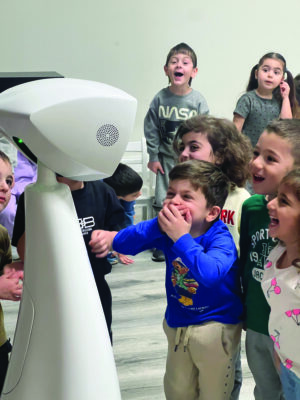
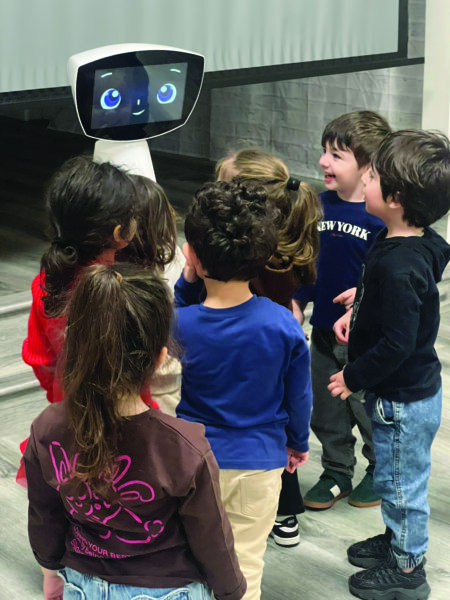
Children meet Robin the Robot.

Meet Robin the Robot

274
0

LOS ANGELES/WATERTOWN — Whatever one’s opinions about robots, they are seldom viewed as nurturers.

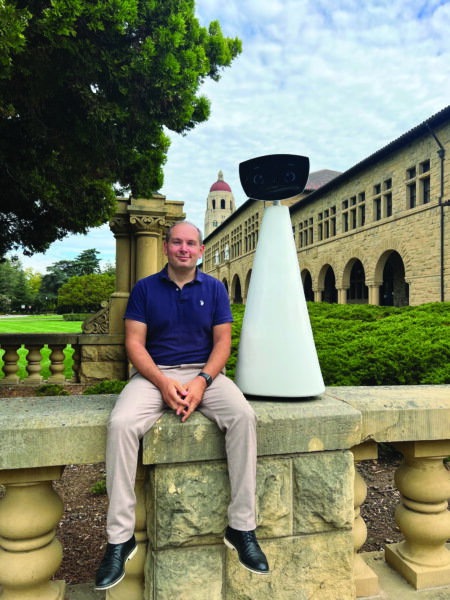
Robin the Robot, however, is as far away from that as possible; this compilation of software, metal and plastic is designed to offer compassion and warmth, in conjunction with human care givers, to the youngest and oldest members of society.

Robin is the creation of the Los Angeles-based Expper Technologies. Davit Martirosyan, the co-founder and head of engineering at Expper, in a recent interview, spoke about how Robin, a decidedly non-human-looking robot, is finding a home in many pediatric hospitals and dental practices, as well as nursing homes. Martirosyan founded the company with his friend, Karén Khachikyan, in Yerevan in 2019. The latter is the company’s CEO.

Martirosyan and Khachikyan grew up in Armenia. Martirosyan graduated from the radio physics faculty at Yerevan State University and was working on electronics and laptops before switching to software development.

Children in hospitals can face an array of scary medical procedures and tools. Robin can offer them company as well as a welcome distraction, he said. In addition, when it comes to the elderly, Robin can offer them games and social activities.

Robin the Robot creators Davit Martirosyan, left, and Karén Khachikyan

“It works very well for kids. Kids accept the robot as their friend. They start immediately to communicate with him. It’s much easier to kids to engage with robots than adults,” Martirosyan said.
Get the Mirror in your inbox:

Currently there are 33 Robins deployed in healthcare and senior care organizations in Massachusetts, California, New York and Indiana with another eight slated to arrive at their new homes this fall.

At UMass Memorial Children’s Medical Center in Worcester, Mass., Robin interacts with children and care teams, helping young patients cope with stressful medical experiences and the loneliness associated with hospitalization.

“When we started to observe different potential places for Robin, we figured out nursing homes for elderly people are very accepting of Robin. Elderly people accept Robin as their friend, and they spend time with him with great pleasure,” Martirosyan said.

Robin’s head is a screen, where words can appear also. Every day new content is added to Robin’s brain. He can show how an MRI works or how dentists work. “Kids see that their friend had this procedure and he’s ok and they start to feel confident,” he added. The videos are cartoon style.

Robin is programmed with some specific information by the staff about the patients. If a child is facing surgery, Martirosyan said, “Robin will talk with him and bring the conversation around to the surgery. Robin teaches the kids what the procedure is” and can reassure them.

Robin’s is equipped with proprietary software. One team member is an occupational therapy specialist who helped design Robin’s personality, that of a 7-year-old child. He has specific likes and dislikes programmed too, he said. For example, his favorite animal is a chicken.

Robin’s appearance is intentional.

“All credit goes to Karén, who had a vision of how Robin should look like and worked very closely with the designer,” Martirosyan said.

“I don’t see any reason to build robots similar to people,” Martirosyan concurred.

Robin the Robot and young fans

Prototype Robin

Martirosyan and Khachikyan started working together in Armenia and that was where they launched the prototype version of Robin. “After two years, in the middle of Covid, we built our first robots in the US,” he said, putting one at a dental clinic and another at the UCLA Children’s Hospital.

That initial Robin at the UCLA hospital, served as a prototype to examine and maximize the work of Robin.

“I am a very curious person and I want to learn how things work. … I broke literally any device I had in my childhood to see how they reworked,” Martirosyan recalled. “My co-founder is also an engineer and had an idea to have a robot friend. Somehow we came together and built this.”

One factor in the early success of Robin was the limitations caused by Covid. “When everything is closed and no one can enter a hospital, people are alone. Therefore they started to be deployed in hospitals,” first in Armenia and then in the US.

In the early days, the company had four employees in Armenia, each working remotely. “In one place, the robot was made, in another place the software was done, in another place we reached out to potential customers and from the fourth place we organized all things together,” Martirosyan said.

Khachikyan, according to Martirosyan, had contacts in Los Angeles, and that is where they focused their efforts. Now, the company has more than 40 employees.

“There is no difference between the kids who stay for a short time or those who stay long-term. Kids accept them as a friend so they started to communicate with their friend,” Martirosyan said. He stressed that Robin does not offer any medical diagnoses. Its job, instead, is to engage with the children in a positive way.

Robin typically walks into a child’s room and starts to wave and talk. “Robin can play games and the kids want to teach Robin something,” he said. As for his personality, “Robin is a child. It can’t know everything. In some situations, it asks the child, ‘can you teach me?’”

Davit Martirosyan and Robin

“When kids meet Robin, they naturally come and hug it. It’s a very cute moment. We didn’t do anything especially for that, but kids accept Robin,” he said.

One case involved a child who was refusing to eat, he recalled. Robin visited his room and after 20 minutes, said he had to go recharge and told the child that while he was recharging, he should also refuel. “After Robin left, the child started to eat,” he said.

“Robin usually works with child interaction teams at hospitals. They love Robin more than the kids do. They accept Robin as their family member. They become sad when Robin has a hardware issue,” Martirosyan said.

As for the cost, the range is from $1,500 per month and up to lease a Robin. The wait time, according to the company’s website, is one to three months.

“When we started Robin, AI was not like it is now,” he said. Now, Robin has AI and a human monitor operating Robin. At all times, Robin is monitored, first for AI and second for safety reasons.

As for what is next, Martirosyan said, “We are going to develop more and more to bring him to a position where we can trust Robin fully. It will take time.”

To see Robin in action, visit https://robinrobot.com/.

Get the Mirror-Spectator Weekly in your inbox: